Get Full Government Meeting Transcripts, Videos, & Alerts Forever!
Get email alerts on the County Budget topic
No spam. Unsubscribe anytime.
New Kent County proposes $131.1 million FY2026 budget; officials flag major school and courthouse projects that could raise tax rate
Summary
County Administrator Mr. Hathaway presented a recommended fiscal year 2026 general fund budget of $131,071,628 that holds the current real-estate tax rate but outlines borrowing and tax scenarios to fund two large capital projects — a new elementary school and a replacement courthouse — that together are roughly estimated at $130 million.
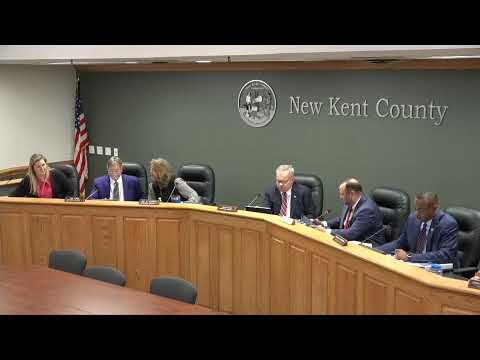
County Administrator Mr. Hathaway presented a recommended fiscal year 2026 general fund budget of $131,071,628 to the New Kent County Board of Supervisors on March 10, saying the proposal assumes no change to the county’s current real-estate tax rate.
The recommendation includes a $53,068,296 school budget and a separate $17,302,726 public utilities budget. Hathaway told the board the proposed general fund package can be delivered without increasing the current 59-cent real-estate rate but noted two large requests — replacement of New Kent Elementary School and a new courthouse — that are currently estimated together at about $130 million and could require new borrowing that would affect the tax rate.
Hathaway said a combined $130 million borrowing, financed over 30 years, would produce an estimated annual debt service of about $8.5 million. In a staff financing plan presented to the board, an initial $5 million county contribution and a staged borrowing strategy could limit the fiscal 2026 immediate impact to about 2 cents on the tax rate, with the possibility of additional 2-cent steps in FY2027 and FY2028. He described a “worst case” path that could total about a 6-cent increase but stressed the county will reassess revenue and borrowing conditions in subsequent years.
Besides capital projects, the recommended FY2026 budget includes personnel and benefit changes: a proposed 5% cost-of-living adjustment (COLA) for county employees; a recommended 1.5% bonus for constitutional officers and their comp-board-funded staff (contingent on state action); a health-insurance rate increase the county expects to be 7.3%, which the recommendation would absorb; and a one-month “health insurance holiday” (likely December) to give employees one month without premium withholding.
Hathaway outlined targeted personnel requests totaling roughly $2.8 million in additional resources driven largely by increased court activity and growth in building-permit workload. Proposed staffing changes include new positions and upgrades in the circuit court clerk’s office, the commonwealth’s attorney’s office, community development (permit technician; environmental manager), general services (grounds technician), and an additional GIS technician. Hathaway said some position upgrades are tied to retention and internal promotion planning.
Public utilities staff proposed a 4% user-rate increase for next fiscal year and asked to convert a part-time billing/customer-service position to full time. The public utilities budget proposal totals about $25.7 million compared with a current adopted budget around $17 million; staff said higher totals reflect capital projects and infrastructure work that will be discussed in detail at the board’s budget retreat.
Hathaway also highlighted a public-safety compensation plan the county is developing to address recruitment, retention and salary compression. He said comparable local salaries for new firefighters in surrounding jurisdictions exceed New Kent’s starting pay (examples cited in presentation included Chesterfield, Henrico and Hanover), and the county’s proposed public-safety pay plan would cost about $1.1 million if layered atop the 5% COLA. By applying an alternative approach (backing out the 5% COLA for public-safety employees and using targeted bonuses where needed) staff estimated the cost to implement the plan at roughly $540,000, or about 1 cent on the tax rate.
Timeline set by staff calls for a budget retreat March 14, a public hearing on tax rates April 14, a public hearing on the budget May 6 and anticipated adoption at the May 27 work session.
Board members asked for comparative compensation data for jurisdictions closer to New Kent’s tax rate and sought more detail on borrowing options; Hathaway said Davenport & Associates will present financing scenarios at the retreat and staff will quantify comparative borrowing advantages of pooled state programs versus open-market bids.
Clarifying details from the presentation: Colonial Downs revenues were moved into a separate fund in FY2026 accounting to improve reporting; the county projects approximately $2.8 million in net new revenue available for personnel actions; the one-month health-insurance premium holiday is budgeted at about $60,634; staff budgeted an 8% contingency for liability insurance pending final rates; and proposed capital projects total roughly $25 million funded by a combination of Colonial Downs dollars ($6M), capital fund balance ($10M), CVTA transportation funds ($5M) and state/federal grants ($2.9M).
The administration will post the full recommended budget showing line-item expenditures to the county website for public review prior to the board’s retreat and hearings.