Get Full Government Meeting Transcripts, Videos, & Alerts Forever!
Get email alerts on the Credit For Prior Learning topic
No spam. Unsubscribe anytime.
NSHE workforce committee moves to standardize credit-for-prior-learning; $30,000 grant to support mobility work
Summary
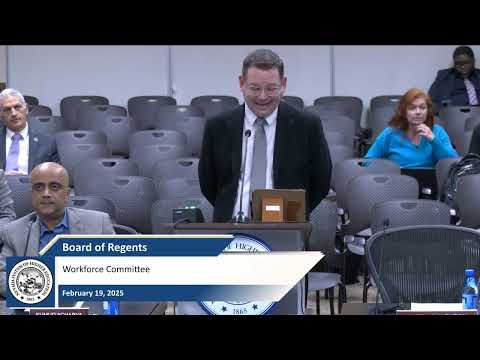
Vice Chancellor Daniel Archer told the NSHE Workforce Committee the system awards inconsistent college credit for identical external exams and military training and that staff will revise policy and develop systemwide standards.
Vice Chancellor Daniel Archer told the Nevada System of Higher Education Workforce Committee that the system currently awards different amounts and types of college credit for identical external exams and military training and that policy and faculty work will be used to create systemwide standards.
Archer said the inconsistency affects common instruments such as AP (Advanced Placement) exams, CLEP (College Level Examination Program) exams and military transcripts and creates confusion for students, parents and K–12 counselors. “We require that credit be awarded, but we don't specify what that credit is,” Archer said, describing how one AP score can lead to either three, six or nine credit hours depending on the receiving institution.
The discrepancy can have practical consequences for affordability and time to degree. Archer gave AP English Language as an example: a student who scores a 4 or 5 may receive the equivalent of both English Composition I and II at six NSHE institutions, but at one institution receive only English Composition I — a difference that can require a student to pay more than $1,000 in tuition and fees to take the second course.
To address those gaps, Archer described a multi-step plan. Staff are drafting policy revisions to replace dated language, remove restrictions (including a current limit that caps nontraditional credit at 16 semester hours), and map a process for faculty review and systemwide recommendations. Archer said, “We plan to bring you a polished, finished up policy in June,” and then to work with faculty in the fall to set standards for AP, CLEP and International Baccalaureate credits; the spring term would focus on common military training and high-school technical assessments.
Assistant Vice Chancellor Natalie Brown said NSHE has received a $30,000 grant from Ascendium Education Group to participate in the Holistic Credit Mobility (HCM) project run by Ithaka S+R and Complete College America. Brown described HCM as a three-part framework—technology to streamline transfers, institutional and system policy alignment, and responsive student-facing practices—and said the project runs January 2025–January 2026. “This framework moves us from an input based system, where credits are often lost in that transfer process, to an output based model that prioritizes student learning and degree completion,” Brown said.
Committee members and regents raised questions about specific areas where policy alignment is most needed. Regent Breger noted that not all students can “shop” campuses for the best credit awards and urged a public-facing, equitable resource so students and counselors can identify how much credit an institution will award for a given exam. Regent Del Carlo said removing the 16-credit cap could “be a game changer for our adult learners,” emphasizing the potential to recruit returning adults and speed workforce re-entry.
Archer and staff said they already have an inventory of inconsistencies developed with NSHE registrars and that some subjects (for example, AP psychology and introductory psychology credit) already show systemwide alignment. The vice chancellor recommended using national guidance from organizations such as the American Council on Education (ACE) and the Council for Adult and Experiential Learning (CAEL) when appropriate to avoid “reinventing the wheel.”
No formal vote was taken on the policy in this meeting; staff will run the draft policy through the Academic, Research and Student Affairs (ARSA) committee and the Workforce Committee before bringing recommended language to the board. Next steps: finalize board policy language by June, convene faculty in the fall to set AP/CLEP/IB standards, and develop military and CTE alignment work in the spring.
Why it matters — NSHE serves thousands of students who arrive with credits from high school, military service and nontraditional programs. Archer noted statewide volumes: more than 25,000 students took at least one AP course in Nevada in 2024 and the system administered over 42,000 AP exams that year; policy choices about how those exams convert to credit affect affordability, staffing needs and students’ time to degree.
For the record, NSHE staff emphasized this is implementation work, not a punishment: institutions were never asked previously to align these awards, so NSHE will bring faculty together and solicit stakeholder feedback before final adoption.