Get Full Government Meeting Transcripts, Videos, & Alerts Forever!
Get email alerts on the State Budget topic
No spam. Unsubscribe anytime.
CFO details governor’s recommended budget: COLA, caseload and phased formula changes included; some increases moved to one‑shot
Summary
NSHE Chief Financial Officer Chris Fatone told the Board of Regents the governor’s recommended 2025–27 budget covers major inflationary and personnel cost increases but moves several assembly items (including portions of the COLA‑related caseload adjustment) from recurring to one‑shot funding and phases in formula redistribution at 20% and 40% across the biennium.
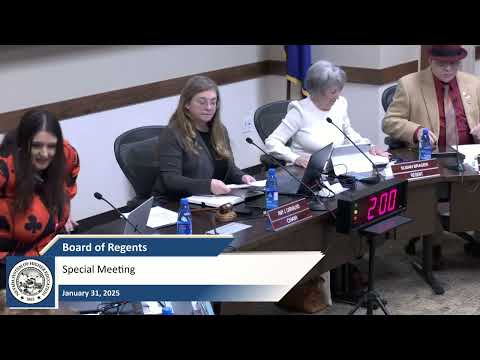
Nevada System of Higher Education Chief Financial Officer Chris Fatone briefed the Board of Regents on Jan. 31 about the governor’s recommended budget for the 2025–27 biennium and how it affects NSHE operating accounts.
Fatone summarized the package as a mix of maintenance‑level funding to cover current service costs (utilities, caseload adjustments and employer benefit rate increases) and enhancements that include phased formula implementation and partial continuation of one‑time nursing expansion funds.
The nut graf: Fatone told regents that much of the proposed increase funds ongoing cost pressures—most notably retirement contribution and health‑insurance assessment increases and a large caseload adjustment tied to weighted student credit hours—and that the governor’s office moved some previously proposed recurring items to one‑shot appropriations, which preserves 2025–27 funding but raises implementation and sustainability questions for later biennia.
Key budget elements Fatone highlighted: • Statewide personnel and benefit costs: PERS employer contribution increases and a higher Public Employee Benefits Program assessment were included; NSHE’s fringe (M300/M310) calculations reflect those changes. • Caseload adjustments: NSHE’s weighted student credit hour growth produced a caseload request; Fatone described technical changes in the calculation that account for cost‑of‑living adjustments and noted that a portion of that adjustment was moved to nonrecurring funding in the governor’s revised materials. • Formula/priority funding: The governor recommended phasing in an updated distribution model for instructional appropriations (moving from a pure weighted‑student‑credit‑hour distribution toward a blend that includes student‑based funding and a smaller, up‑front performance component). The governor’s recommendation phases the change in at 20% in FY26 and 40% in FY27 rather than funding it fully immediately. • One‑shot and capital: The governor’s budget includes $11 million in one‑shot funds for campus safety/security (below NSHE’s request), $10 million per year to continue previous nursing expansion funding, and $15 million for deferred maintenance via the state CIP vehicle.
Fatone told the board that the governor’s office amended the executive budget to move several items from recurring to one‑shot funding, a technical but politically important change that keeps funding in the biennium but leaves potential shortfalls at the start of the next budget cycle. He also walked regents through how institution‑level caseload and research O&M adjustments are calculated.
Regents asked follow‑up questions about phasing, the total of one‑shot items, and how safety/security allocations would be prioritized if the legislature approved the governor’s recommendation. Fatone and Interim Chancellor Charlton said the system would seek board direction for allocation procedures and would return to regents with prioritization recommendations.
Ending: Fatone closed by noting the governor’s recommended budget keeps many NSHE priorities visible in the biennium but limits the state’s ability to commit recurring funds; regents and administration agreed to follow up as the legislative process advances.
Quotes in this article come from Chris Fatone’s presentation and from follow‑up discussion recorded in the meeting transcript.