Get Full Government Meeting Transcripts, Videos, & Alerts Forever!
Get email alerts on the Education Budget topic
No spam. Unsubscribe anytime.
Chesterfield schools present $986 million operating budget, seek $15 million increase in county transfer
Summary
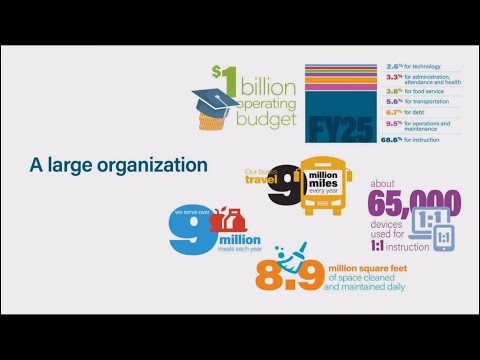
Chesterfield County Public Schools officials presented a fiscal 2026 proposed operating budget of $986 million and a total package above $1.07 billion, and requested a $15 million increase in the county transfer to fund compensation, special education growth and other mandated costs.
Chesterfield County Public Schools officials presented a fiscal 2026 proposed operating budget Friday that would spend $986 million from the district’s ongoing operating fund and roughly $1.07 billion across all funds, and asked the Board of Supervisors to increase the county transfer by $15 million.
The presentation, delivered by Dr. Murray, superintendent of Chesterfield County Public Schools, and Bob Meister, chief financial officer, outlined priorities that district leaders said are driven by state mandates, inflationary pressures and rising student needs. “Please keep in mind that the school budget is a work in process,” Dr. Murray said, noting the district still must reconcile state budget actions and ongoing county deliberations.
The nut graf: school officials said the package balances required costs and some locally prioritized investments while warning that state funding remains uncertain. The district’s proposed operating budget assumes roughly $560 million in state support and just over $400 million in local (county) support, and it counts on recent General Assembly actions and a still-pending governor’s sign-off.
Most of the proposed increase would go to compensation and mandated services. Meister said $20 million of new money in the plan is earmarked for compensation — described as a minimum 3% across-the-board increase and step adjustments for certified staff — and additional adjustments that move the district’s minimum hourly wage from $14.42 to $14.70. The presentation also restated longer-term pay goals: district leaders said the plan would move teacher minimums to roughly $55,000 and the district continues to target a $60,000 minimum teacher salary and a $16 hourly minimum for some positions, but officials said reaching those targets would require materially more funding.
Special education and English-language learner (ELL) services account for the largest single additions beyond compensation. The budget documents and presenters identified nearly $10 million in new spending tied to special-education caseload growth and higher-cost contracted services, calling for six additional special-education teachers and 28 additional instructional assistants to reduce out-of-district placements. Presenters said an additional 50 instructional aides are included to provide more one-on-one supports for students with intensive needs. On ELL, the district proposes roughly $4 million in new staffing tied to an enrollment increase of about 2,200 students since FY24 and to changes in the state’s Standards of Quality (SOQ) staffing ratios for ELL monitoring and instruction.
Officials also described a net $1.2 million reduction in the grant fund tied to a shift from a federally funded Head Start model to a state-funded Virginia Preschool Initiative (VPI) model, and they listed federal grant programs assumed to continue (IDEA, Perkins and similar programs). Meister said the district is monitoring federal funding but that the budget assumes no change in those programs for now.
Capital and operations needs were included without adding new CIP projects. The district reiterated previously announced projects — new and replacement elementary schools, a new middle school (Deep Creek) opening this August, the West Area High School project, an expansion at Thomas Dale and renovations to other facilities — and stressed that timing and priority for many projects depend on site identification and funding. Major maintenance was identified as a recurring priority; presenters described a target run rate of approximately $30 million per year for major maintenance that is funded through FY26 but said the balance begins to decline in FY27.
Technology needs include a proposed Chromebook lease to standardize the fleet and simplify servicing; presenters described the current fleet as a “Frankenstein” mix of devices acquired under different funding streams and noted that a single-model lease would improve reliability and support.
Board members and county officials pressed for details on pre-K access and special-education identification. Supervisor Carroll asked whether special-education growth was concentrated at particular grades; Dr. Murray said staff would follow up with details and noted a noticeable uptick in identification after the COVID pandemic. Supervisor Schneider urged continued advocacy with the state, noting the district remains, in local estimates cited in the presentation, roughly $250 million underfunded per a JLARC (Joint Legislative Audit and Review Commission) report. “So let’s hope we get more money from the state,” Schneider said.
District leaders repeatedly described the budget as contingent on state action and on the Board of Supervisors’ planned transfer; Meister thanked Matt Harris and county staff for identifying about $0.5 million in shared-service savings and for an early read on the likely $15 million transfer. The presenters said the General Assembly recently removed a support cap that generated roughly $12 million for Chesterfield and that the governor’s original proposal included about $12 million in new funding (about $10 million toward the state’s half of a 3% raise and roughly $2 million to support ELL growth).
No formal votes on the county transfer or the county budget were taken at this presentation; the district said the school board has already approved its proposal and forwarded it to the Board of Supervisors for consideration. Meister and Dr. Murray asked supervisors to consider the package as a needs-based, but balanced, plan that will be revised as state and county decisions are finalized.
The presentation closed with officials noting staffing and retention remain the district’s top operational concerns — “pay attracts, culture retains,” a supervisor paraphrased — and with a pledge to provide follow-up data on pre-K wait lists and grade-level patterns in special-education identification.
Ending: District officials said they will continue to monitor state and federal developments, refine assumptions and return with revised numbers where needed; they also thanked county staff and supervisors for ongoing collaboration.