Get Full Government Meeting Transcripts, Videos, & Alerts Forever!
Get email alerts on the K 12 Curriculum topic
No spam. Unsubscribe anytime.
Mount Lebanon administrators outline two-year elementary science curriculum review, recommend pilot choice next month
Summary
District leaders described a two-plus year review aligned to new Pennsylvania science standards (STIELS), said they piloted Amplify and FOSS across all seven elementary schools, and will recommend a single core resource to the board next month; implementation work and Atlas mapping will continue through summer.
Mount Lebanon administrators told the school board on March 10 that a multi-year elementary science curriculum review is nearing a decision and that the district will recommend either Amplify or FOSS as a core resource at next month’s meeting.
The presentation, led by Dr. Ramsey, principal of Foster Elementary and district science corresponding principal, and Brooke Webb, principal of Washington Elementary and district science corresponding principal, summarized nearly two and a half years of work to align kindergarten through fifth-grade instruction with the new Pennsylvania Science Standards — Science, Technology, Environment and Ecology (STIELS). "Provide our students with equitable opportunity, that's science for all," Webb said, describing the committee’s guiding philosophy.
The review team, the administrators said, included representatives from every elementary building and each grade level. They completed an Atlas stage 1 mapping of standards, big ideas and student expectations for K–5; ran concurrent pilots of two vetted core resources (Amplify and FOSS) this school year; and collected rubric-based feedback from pilot teachers for each unit. "We narrowed down to two after their presentations and review of everything they were able to show us," Dr. Ramsey said.
Why it matters: Pennsylvania’s updated standards integrate technology, engineering and environmental literacy into science instruction and assign skills to specific grade levels rather than broader grade bands. Administrators said the shift emphasizes three-dimensional learning — disciplinary core ideas, science and engineering practices, and cross-cutting concepts — and focuses on phenomena-based, depth-over-breadth instruction intended to develop student thinking and application rather than rote content recall.
Key timeline and implementation details presented: - Pilot phase this school year tested Amplify and FOSS in many classrooms across all seven elementary schools; teachers complete a detailed rubric after each unit to inform the committee’s recommendation. - Stage 1 in Atlas (standards, big ideas, student expectations) is complete for K–5; stages 2 and 3 (unit planning and student supports) are scheduled for this summer and to be completed before the 2025–26 school year. - Fifth-grade Pennsylvania System of School Assessment (PSSA) science will be field-tested this year (not scored) and is expected to be scored in 2025–26; administrators said both pilot resources are providing supports for that transition. - Administrators estimated the adopted core resource would be on a review cycle of roughly six to eight years.
On how the final recommendation will be reached, Webb said the team will weigh three factors: teacher pilot rubric scores, cost/contract terms, and the level of vendor support for district teachers. "It's like buying a car," Dr. Ramsey said, describing the balance of fit, price and support in the decision.
Administrators also said existing district science kits (previously developed and supplemented) will be retained as augmenting materials where appropriate; portions of older kits remain usable even as some components have been discontinued.
Board members asked about consensus-building. The presenters described a private rubric submission process for pilot teachers, a quantitative scoring review scheduled immediately after the pilot completes, and the option for the curriculum-writing team to add local supplemental materials to fill gaps identified during pilot feedback.
Board reaction was uniformly supportive in content and process. Several directors thanked the team for the length of planning and the collaborative approach; one board member called the work "exceptional" and said it aligns with high-order thinking and STEAM goals.
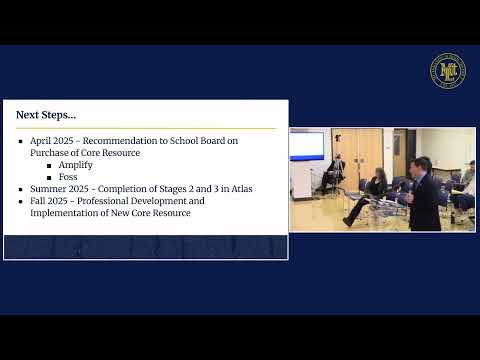
Administrators said a formal recommendation of a single core resource (Amplify or FOSS) will be presented to the board at the April meeting; following adoption, professional development and Atlas unit completion will continue through the summer so teachers have K–5 units ready for fall instruction.
Ending: The board did not vote on a resource on March 10. Administrators closed the presentation by thanking the board and public; the decision and any contract terms are expected to appear on the board agenda next month.