Get Full Government Meeting Transcripts, Videos, & Alerts Forever!
Get email alerts on the Infrastructure Maintenance And Stormwater topic
No spam. Unsubscribe anytime.
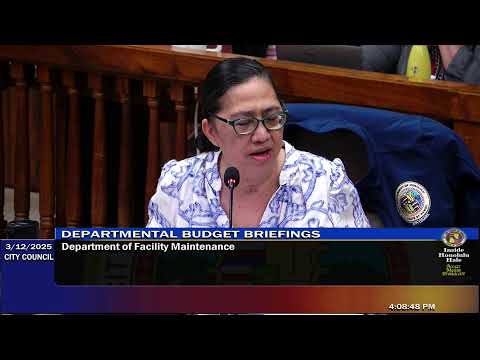
Facility Maintenance outlines operations budget, equipment needs and stormwater projects
Summary
The Department of Facility Maintenance proposed a roughly $134 million FY26 operating budget, reported substantial deactivated positions and requested capital funds for facilities and stormwater work while describing ongoing road and building maintenance responsibilities.
The Department of Facility Maintenance (DFM) presented its FY26 operating and capital requests to the Budget Committee, emphasizing core responsibilities from roads and storm drains to building and vehicle maintenance and noting staffing and equipment needs.
Director‑designate Gina Vano summarized the operating request and core functions: DFM proposed an operating budget of about $134,000,000 for FY26 (a 1.5% decrease from the prior year), with modest increases in salary costs and reduced current expenses. The department reported 239 active of 845 authorized permanent full‑time positions (≈27% staffed) and 91 deactivated positions.
Why it matters: DFM maintains the city's physical infrastructure — sidewalks, storm drains, municipal parking, lights and city buildings — and its performance affects safety, traffic, sanitation and stormwater management.
Divisional highlights: Vano provided division‑level summaries: Automotive Equipment Services (AES) manages vehicle and equipment repair and had an operating request of about $22.8 million; Public Building and Electrical Maintenance (PBM) requested about $44.8 million for custodial, electrical and building repairs; Road Maintenance (DRM) requested roughly $48 million and described street, sidewalk and sign maintenance; Stormwater Quality requested about $15.7 million to implement MS4 permit requirements and stormwater controls.
Overtime and operations: DFM reported estimated overtime of roughly 55,000 hours to support weekend collections and emergency responses, with higher overtime in AES and DRM due to 6‑day work patterns and weekend support for refuse/collection operations. Revenue sources include parking fees, fuel sales and other service fees.
Capital plans and equipment: The department manages or supports a broad CIP program; its own equipment request totaled about $7.2 million to replace aging vehicles and machinery ($5.8M) and to fund new equipment ($1.3M). DFM also flagged a department role in larger city CIP packages, including stormwater projects tied to NPDES compliance and a $249 million program administered across agencies for facility projects and stormwater controls.
Community engagement and staffing: Members thanked DFM for operational responsiveness and asked for further detail on lapses, vacancy causes and timelines for pothole and sidewalk repairs. Vano said the department is actively filling vacancies and pursuing reorganization options to convert contract staff to permanent roles and reduce lapses.
Ending: Councilmembers asked for follow‑up on positional lapses and more detailed performance timelines (potholes, streetlights, sidewalk repairs). DFM agreed to provide additional data and to participate in public engagement efforts on stormwater projects.