Get Full Government Meeting Transcripts, Videos, & Alerts Forever!
Get email alerts on the Permitting Modernization topic
No spam. Unsubscribe anytime.
Permitting modernization, fines collection and staffing top Department of Permitting and Planning briefing
Summary
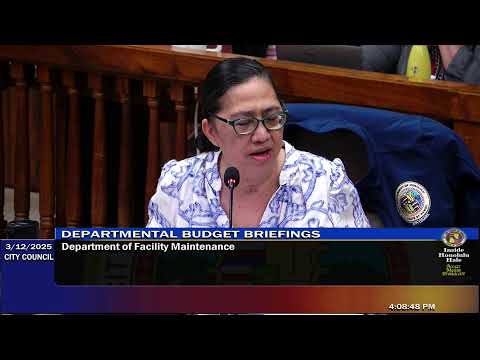
Department of Permitting and Planning Director Donna Puna told the Honolulu City Budget Committee the department has cut review backlogs but still needs staff, software implementation and enforcement resources to collect millions in short‑term rental fines and speed permitting.
The Department of Permitting and Planning on Wednesday told the Honolulu City Budget Committee it has substantially reduced old backlogs while preparing to implement a new permitting system and to step up enforcement and fine collection.
Acting Director Donna Puna told the committee the department has cut prescreen averages to one day and reduced residential code review to about 11 days, while commercial code review now averages under two months. "We've gone all e‑plans with important upgrades … and since 2023, we have assessed hundreds of millions of dollars in short‑term rental fines," Puna said.
Why it matters: Permitting timelines and effective code enforcement affect housing production, neighborhood quality of life and city revenue. Committee members pressed the department for particulars about staffing, backlog counts, short‑term rental (STR) fines and the department's plan to automate parts of the workflow.
Puna outlined the department's near‑term priorities as full rollout of the Clarity permitting system, deployment of SIFCheck artificial intelligence for residential and commercial code review, continued ePlans integration, and improved collections. "In calendar year 2025 and fiscal year 26, we will further bring down permitting times, fully implement the Clarity permitting software system … and the SIFCheck artificial intelligence," she said.
Staffing and vacancies: DPP reported 394 authorized positions and 99 current vacancies. The department expects to fill eight vacancies by July 1 and 25 during FY26; it identified 29 planner vacancies, 21 inspectors and 19 engineers among its open roles. Puna said recruiting remains difficult for technical roles and described actions to reduce vacancies including job fairs, one‑day hiring events, social media recruiting, a newly hired training specialist, and salary adjustments negotiated with Human Resources for planners and engineers.
Enforcement and fines: Puna told the committee the administration's enforcement approach has shifted from routinely settling for a small percentage of assessed fines to collecting the full amount "unless there are proven extenuating circumstances." She said roughly $225 million in STR fines were currently in the Zoning Board of Appeals (ZBA) appeals pipeline and cannot be collected until appeals are resolved. DPP plans several process changes to speed collections: automating notice issuance through Clarity, publishing notices in a newspaper to improve service of process, consolidating enforcement provisions now scattered across multiple ROH chapters, and pursuing foreclosure when liens exceed 50% of a property's value.
Board and appeals backlog: Committee members urged steps to unclog ZBA calendars. Puna said adding a second board would raise charter issues, but the department can immediately ask the board to appoint a hearing officer to process limited matters and help clear the backlog. Councilmembers suggested other procedural triage, and DPP said it will explore additional hearing officers for minor matters.
Budget details and capital needs: DPP proposed an operating budget of $38,602,461, a 1.1% increase driven primarily by personnel costs (about 75% of the budget). Major line items in the presentation included $5,000,000 for affordable housing grants targeting Bill 7 projects, $200,000 for renovation/relocation prep related to five FMB floors and Kapolei Hale moves, $100,000 for hazardous property cleanup (demolition, boarding), and vehicle replacements. On CIP, DPP listed $4,400,000 to renovate five floors at FMB with planning, design and construction expected in FY26.
Data and metrics: Committee members asked for clearer, consistent metrics. Puna said some city data systems have limited reliability and emphasized that the department is moving to Clarity to improve automation and reporting. Members requested counts the department did not have on the record (for example, the exact current count of overall permit backlog and CO‑wait lists) and Puna agreed to supply those numbers in follow‑up.
Next steps: The department will continue Clarity and SIFCheck implementation, press HR for salary adjustments to recruit planners/engineers/inspectors, pursue changes to collections workflow, and explore administrative steps (hearing officers) to reduce ZBA backlog. Committee members signaled interest in receiving the department's detailed metrics, vacancy fill plan, and lists of Bill 7 projects and canceled permits.
Ending: The committee moved to member questions after the presentation; DPP officials remained available for follow up and promised written answers on backlog counts, vacancies to be filled, and other clarifications.