Get Full Government Meeting Transcripts, Videos, & Alerts Forever!
Get email alerts on the Historic Preservation Signage topic
No spam. Unsubscribe anytime.
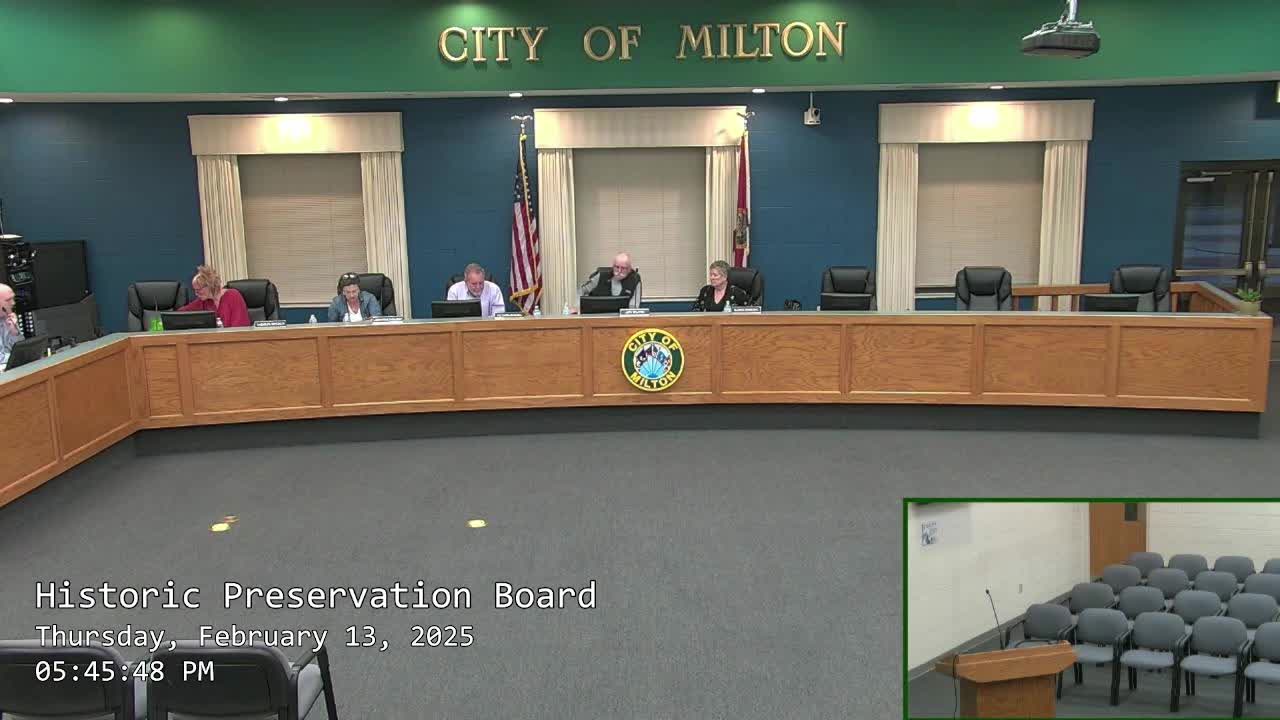
Milton historic-signage prototype unveiled; board assigns photo and text duties
Summary
The Milton Historic Preservation Board reviewed a lamp-post sign prototype for a downtown walking tour, discussed QR-code linking, placement constraints and image sourcing, and assigned members to gather photos and text for an initial batch of signs.
The Milton Historic Preservation Board reviewed a prototype for decorative lamppost signage intended to support a downtown historic walking tour and agreed to gather photos and trimmed text for an initial rollout.
At a meeting covering the draft sign, Tim, planning department staff, showed a mounted prototype and noted basic placement and technical details, saying, “The base of those signs would be at about 8 feet in height.” He also described a QR-code option and told the board, “Just needs to be a 4-by-4-inch QR code,” to link to online content.
Board members and staff discussed how much text and imagery to include on the signs and where signs should be located. Tim cautioned that the printed walking-tour booklets held by the city are difficult and costly to revise, while a website tied to a QR code could be updated more easily. He said the department has “hundreds” of hard-copy booklets in its possession and that edits to those booklets would be “a pretty pricey concept.”
Members recommended the signs act as an “appetizer” that encourages visitors to use a website or booklet for more detail. They urged larger photos and shorter on-sign text so passersby can read or photograph signs without needing close-up viewing or eyeglasses. The group discussed using a single QR code that opens the walking-tour portal from which visitors select the specific stop, rather than having separate codes for each sign.
Placement was a frequent topic. Board members asked whether signs could be attached to decorative downtown lamp posts, to utility poles, or to newly installed replicas where lamp posts are not present. Tim said attachment to nonstandard poles may be “a bit more involved” and that he would confirm options with the street superintendent. The train depot and Berryhill School were noted as desirable locations that lack the decorative posts, so alternatives would be needed for those sites.
Members also proposed placing some signs along the busiest pedestrian corridors (Highway 90 and Willing Street) rather than directly in front of each referenced building when foot traffic is the primary goal. Several board members suggested placing additional interpretive elements where historically significant buildings once stood (for example, a bench or marker at the Berryhill School site) if the original structures are gone.
The board reviewed sample sign text from other towns (Scottsboro, Alabama) and several members volunteered to research individual sites and collect photographs and historical details. Assignments mentioned in the meeting included the post office, courthouse, streetscape photos, and other of the original 10 nominated locations. Staff said members need not wait for the next meeting to submit material; the planning office can accept drafts and provide revised mock-ups for review.
The board closed the item by reiterating next steps: staff will confirm mounting options with public works, accept photographs and suggested sign language from members, produce revised mock-ups for the group, and explore linking signs to an online walking-tour page that can be edited over time.
Votes at a glance: The meeting recorded voice votes to approve the agenda and minutes earlier in the session and later to adjourn; these were passed by voice (individual tallies were not specified in the transcript).