Get Full Government Meeting Transcripts, Videos, & Alerts Forever!
Get email alerts on the Land Use Fences topic
No spam. Unsubscribe anytime.
Milton planning board considers easing ban on front-yard fences for commercial properties
Summary
Planning staff presented a proposed change to the Unified Development Code (UDC) that would allow limited fencing in front yards of commercial properties; board members discussed staff approval thresholds, variance routes and safety and aesthetic limits and asked staff to draft ordinance language for council review.
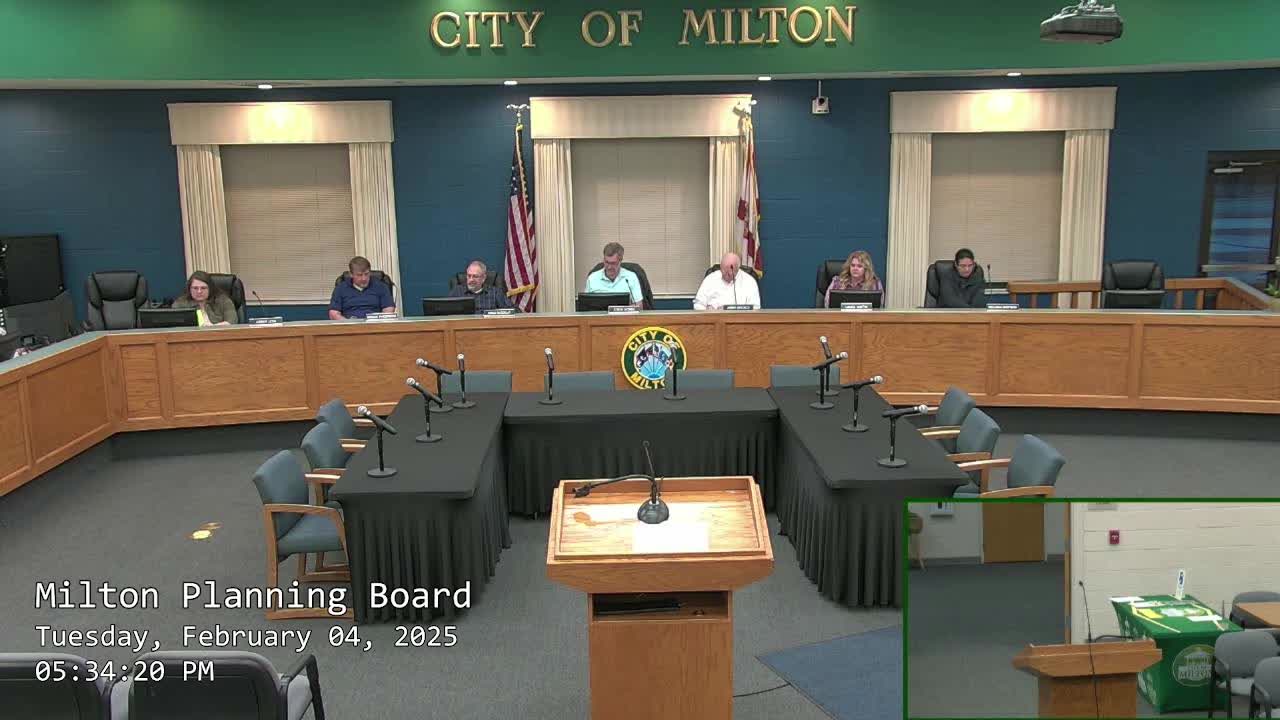
The Milton Planning Board on a recent meeting heard staff present options to change the city's Unified Development Code to allow certain fences in the front yards of commercial properties where the UDC currently prohibits them.
The proposal matters because the downtown and other commercial corridors contain businesses with tight lot lines where a front-yard fence could provide separation, safety or screening without harming public sightlines, planning staff said.
Tim Milstead, Planning Director, told the board that the current code contains a complete prohibition for nonresidential front yards: "fences, walls, and hedges are prohibited in the front or side yards unless otherwise required by the landscape and screening regulations of article 12." He said that the prohibition leaves no path to obtain a variance and that the city already has many nonconforming fences.
Board members and staff discussed a range of options. Milstead said any allowed front-yard fences should be limited in height and material: residential yards in Milton generally limit fences to 6 feet in side and rear yards and 4 feet in front yards, and staff proposed similar or more stringent limits for commercial fronts. Milstead also said he would "not want to see any sort of chain link fences" in front yards and suggested design standards such as masonry, picket-style or other decorative materials and a degree of visibility (he cited about "upwards of 50 [percent] transparency") so motorists and police retain sight lines.
Several board members favored a two-tiered approach: allow staff to approve routine, low-height, decorative front-yard fencing where it meets specified material and transparency standards, and require a formal variance to the Board of Adjustment for taller or opaque fencing. A board member noted life-safety constraints and asked staff to consult the fire chief before finalizing language for cases near high-speed roadways or zero-lot-line buildings.
No formal ordinance change was adopted at the meeting. Instead Milstead said he would draft proposed UDC language reflecting the board's discussion and bring it to the board for review at the next meeting. The board also asked staff to include clear permit and material standards to avoid long-term blight if a property later changes ownership.
What happens next: Milstead will prepare draft code language that (per the board's direction) would allow limited front-yard fencing in specified commercial districts, define what staff may approve administratively, set material and transparency limits, and identify circumstances requiring a variance. The draft will be provided to the board for review and then forwarded to city council if the board recommends it.
Ending: The board set no formal deadline; Milstead said he would present draft language at the board's next meeting.