Get Full Government Meeting Transcripts, Videos, & Alerts Forever!
Get email alerts on the Zoning Code Revision Article 2 topic
No spam. Unsubscribe anytime.
Planning commission reviews Article 2 zoning-code revisions; asks staff to refine notice and enforcement language
Summary
Commissioners reviewed draft changes to Article 2 (administration and enforcement) of the zoning code, discussed public-notice radius, enforcement penalties and nonconforming-use rules, and broadly directed staff to return with refined language and examples.
The Planning Commission reviewed a draft recodification of Article 2 of the City of Victoria zoning code — the division covering administrative actions, enforcement, appeals, nonconformities, and land-use permits — and provided staff directions on wording and policy choices.
Associate planner Travis Verley led the presentation, outlining about 500 items the city has identified for code review and explaining that Article 2 covers the zoning administrator, official zoning map, hearings, appeals, enforcement, and the variance and conditional-use processes. Verley said staff will present a red-line version of proposed ordinance language in future meetings and that the overall recodification aims to modernize and clarify administrative procedures.
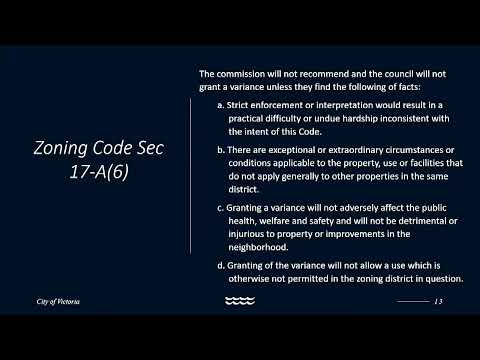
Key topics commissioners discussed: - Public notices: the draft retains the statutory minimum of mailing notices to property owners within 350 feet and publishing in the official newspaper. Several commissioners urged staff to explore expanded notification options (for example 500 feet), greater use of email lists and neighborhood platforms, and working with homeowners associations for broader outreach. Staff agreed to gather examples and return with data showing how many notices a 500-foot radius would generate. - Appeals and administrative-review procedure: the draft adds a formal appeal-of-administrative-decision process that pauses permits while an appeal is resolved; staff said parties would have 20 calendar days to file an appeal after an administrative permit decision. - Nonconforming structures and uses: the draft separates nonconforming uses from nonconforming structures, permits administrative expansion of a nonconforming structure up to 20% provided the expansion does not increase the degree of nonconformity, and follows state statute on rebuilding after damage (example: permit submission window following destruction greater than 50% of market value). Staff proposed using county assessor values for the damage threshold calculation. - Conditional and interim uses: staff reiterated that accessory dwelling units (ADUs) on residential property would remain a conditional use; for commercial properties the commission supported treating ADUs as an interim use in some cases. The draft requires recording approved conditional-use documents within 180 days or the permit would lapse. - Variances: the draft included a proposed statement disallowing variances for pools, height exceptions, and impervious-cover increases; commissioners discussed and ultimately signaled a preference to strike a blanket prohibition and instead tighten variance criteria and documentation. Several commissioners emphasized variances should be rare and the standard for granting them should be high. - Enforcement language: the draft includes a clause that violations may be treated as misdemeanors. Commissioners expressed concern about automatic criminalization and suggested staff consult the city attorney and consider civil penalties or phrasing that directs charging rather than presuming guilt. Staff agreed to bring revised enforcement language and legal context to the next meeting.
Commissioners asked staff to return with: examples of notices at current 350-foot and proposed 500-foot radii, recommended outreach channels, revised enforcement wording informed by city-attorney input, and the red-line draft with the noted edits (particularly the variance language). Verley said staff will coordinate with communications, public works and other departments and will present more detailed red-line language at the next Planning Commission meeting.
No final ordinance changes were adopted at this meeting; the discussion will continue in subsequent sessions as staff prepares the red-line code and legal review.