Get Full Government Meeting Transcripts, Videos, & Alerts Forever!
Get email alerts on the Sports Complex topic
No spam. Unsubscribe anytime.
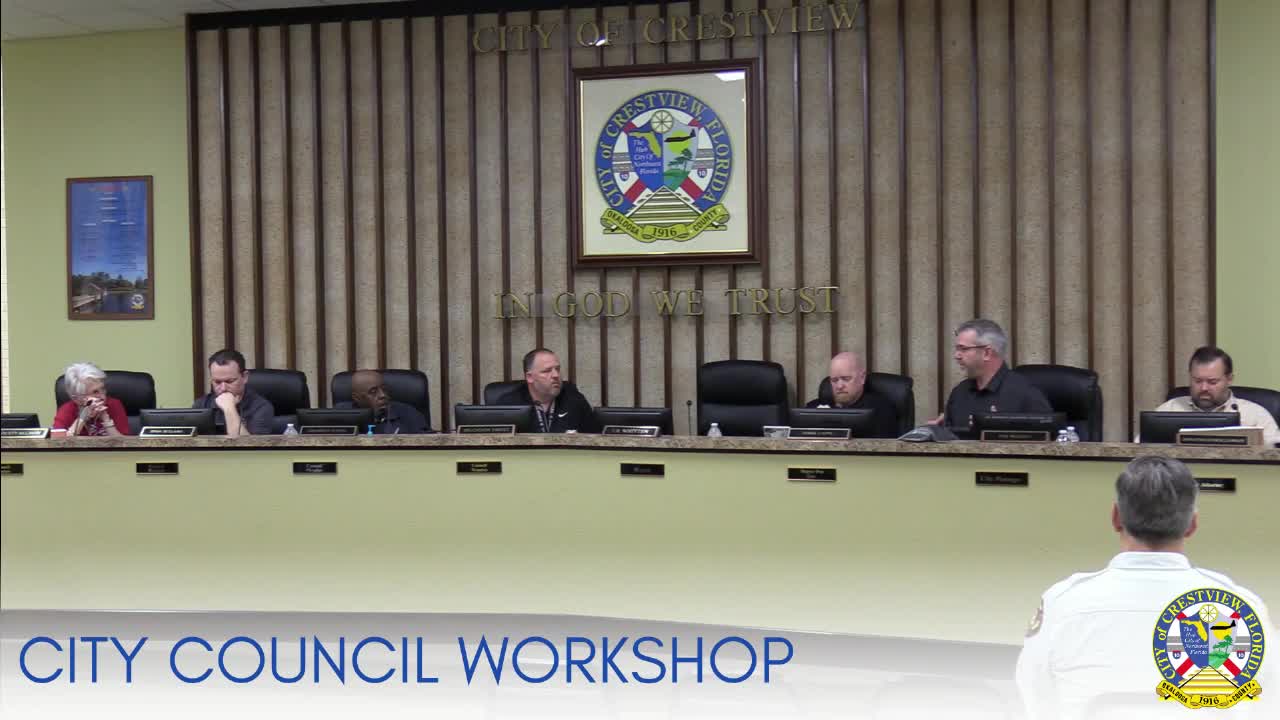
Crestview council workshop backs pursuing one proposed site for sports complex, directs staff to begin due diligence
Summary
At a city workshop, council members and staff heard a facilities master-plan presentation and gave consensus to pursue one of four evaluated sites for a proposed sports complex; staff and consultants were directed to open property negotiations, study funding and pursue public input.
At a Crestview City Council workshop, city officials and the consultant team presenting a citywide facilities master plan said they had identified multiple candidate locations for a regional sports complex and asked council for direction on which site to pursue. Council members gave consensus to pursue the large site shown on the workshop map and directed staff to begin due diligence, outreach to the property owner and conversations with the Tourist Development Council and Okaloosa County.
The workshop combined an overview of a 10–20‑year facilities renewal and replacement program with a focused review of four candidate sites for a sports complex. City Manager Tim Bolduc said the city hired a total‑project‑management team to assess existing buildings and prioritize projects so the city can move from a reactive maintenance posture to planned, funded replacements and additions.
The consultant team — led by Ajax Building Company and including Goodwin Mills Cawood and Sam Marshall Architects — described the program approach and procurement process, telling council the work will proceed in stages: a roadmap/master plan, individual project design authorizations, then a guaranteed maximum price (GMP) for each project before construction. "So that is the total price of the project guaranteed not to exceed," said Judd West of Ajax, describing the GMP step.
Consultants and staff spent the bulk of the morning reviewing four candidate sites that meet the city's selection criteria: (1) inside or contiguous to city limits so it can be annexed, (2) sufficient size (city staff established roughly 100 acres as a minimum target for long‑term growth), (3) good access from a main thoroughfare for tournaments, and (4) growth potential for adjacent commercial uses. The workshop record shows one site—a large, roughly 500‑acre parcel discussed in detail and tied to nearby river and wetland features—emerged as the staff and consultants' preferred option because of its size, topography and potential to attract adjacent commercial development and hotel partners that could support tourism‑dollar funding.
Staff warned that several cost and timing hurdles apply to certain candidate sites. The wastewater treatment plant parcel, for example, has attractive elevations but would require relocation of spray fields and utility work; staff estimated relocating those service elements could take a minimum of three years and would raise costs substantially. Acquisition examples discussed in the workshop included an estimate of roughly $2.5–$3.0 million per 100 acres for comparable South‑end property, a figure staff described as an illustrative market range rather than a firm price.
Council members also discussed how the city might pay for a sports complex. Staff said multiple funding options will be needed and will be studied with municipal bond advisers, including the Florida League of Cities municipal bond consulting component, use of state or federal loans/programs, targeted tourism dollars and possibly a referendum to pledge ad valorem revenue. Tim Bolduc summarized the policy point when he recommended next steps: "My recommendation is we move forward on this piece of property here," and council members indicated their agreement by voice, with several saying they would "join" the consensus.
Consultants and staff stressed that the proposal at this stage is programmatic and conceptual: the workshop displayed floor‑plan examples and program sheets meant to give spatial context, not final designs. West described a phased decision path: council would authorize the roadmap, then authorize each project's design phase, and only after design and competitive bidding would a GMP be presented for council approval for that specific project.
Next steps recorded in the meeting: staff and consultants will pursue due diligence on the recommended site, open negotiations with the property owner, engage the Tourist Development Council and Okaloosa County about potential partnerships and begin preparing funding analyses. The team also noted a public input session on the sports‑complex concept is scheduled for March 5 (an evening meeting to encourage family participation). The workshop closed with council directing staff to continue conversations and return with the information needed for formal authorizations later in the process.
The workshop also covered broader facility priorities that are part of the master plan — police and fire facility needs, rehabilitation questions for Twin Hills Gym, animal control capacity, a public works building and a multi‑phase plan for new and rehabbed fire stations — but council reserved detailed design and construction authorizations for subsequent, itemized actions once budgets and GMPs are available.