Get AI Briefings, Transcripts & Alerts on Local & National Government Meetings — Forever.
Odessa council reviews options for new police parking garage, staff urged to seek short-term paving
Summary
City staff presented six options for replacing a demolished Odessa Police Department parking structure, with costs ranging from about $1.6 million (resurface) to $23.2 million (five-story build). Council members favored a modest near-term fix and a broader downtown master plan before committing to major construction.
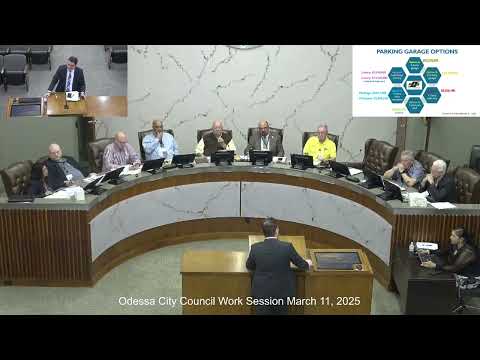
City of Odessa staff presented multiple options on Thursday for replacing a demolished parking structure used by the Odessa Police Department and municipal court, with estimates ranging from resurfacing to a five-story garage.
The presentation summarized six design and delivery options: full five‑story garage with retail, smaller two‑ or one‑story garages allowing future expansion, resurfacing with optional shade canopies, and automated (mechanized) parking. The largest estimate — a five‑story garage with design and construction — was presented at about $23,200,000; lower-cost options ranged from resurfacing near $1,600,000–$2,200,000 to a two‑story garage in the $11.5–$14 million range. Automated systems were presented as an alternate with purchase estimates shown around $9,100,000 for a single automated level and roughly $14,700,000 for a three‑story automated option; lease terms were discussed but specific lease figures were not available.
Council members and staff focused discussion on immediate needs versus long‑term planning. Presenters said the police currently need roughly 110 spaces and recommended planning for about a 20–25% growth over the next 20–30 years. The existing paved supply in the downtown area was described as dispersed after the demolition; staff said the ground‑level area formerly used for parking is not currently in usable shape and is causing officers and other users to park across downtown.
Given the wide cost range, council members asked staff for clearer comparisons. Council asked that staff provide a one‑page, side‑by‑side summary of the six options and costs. Several members urged a conservative approach — citing available 2019 bond funds — and recommended short‑term paving and canopy options to make the site usable while the city develops a broader downtown master plan that would consider courthouse construction, municipal plaza needs and possible joint solutions with the county.
Staff identified approximately $6,000,000 available from a 2019 bond fund that had been allocated for downtown projects; the transcript states the bond language restricted some uses but also that the 2019 instrument was a broad “catch‑all” for downtown, parks, police facilities and municipal projects. Staff said additional leftover bond dollars (about $6.2 million) were also available for reallocation but that council would need to decide priorities.
Short‑term directions recorded in the workshop included: have in‑house staff price out repaving the former parking area so it can be used immediately; prepare an estimate for paving a second lot across the street; prepare a one‑page comparison of the six options and their costs; and bring updated numbers to the next workshop or council meeting. No formal motion to award or to allocate construction funding was made at the workshop.
The discussion also reviewed non‑construction alternatives such as leasing a turnkey garage from a private provider (presenters said such vendors would build and own the structure and lease space to the city) and automated parking systems that would require ongoing maintenance agreements. Several council members expressed skepticism about automated systems and retail revenue assumptions, calling for a middle‑ground design if the city ultimately chooses new construction.
Staff said some short‑term work (paving and rapid canopy installation) could cost only a few million dollars and could be funded from the identified 2019 bond funds if the council chose to move forward. Staff also noted potential partnerships with the county’s planned parking and with hospital district parcels for leased parking.
Council directed staff to return with the one‑page comparisons, cost estimates for paving the two identified lots, and options for temporary shade/canopy coverings; they also asked staff to include the garage options when the council revisits a downtown master plan at a future session.
Ending: Staff will provide the requested side‑by‑side summary and cost estimates and return the topic for further consideration; no final construction decision or bond issuance was made in the workshop.