Get Full Government Meeting Transcripts, Videos, & Alerts Forever!
Get email alerts on the Medical Informed Consent topic
No spam. Unsubscribe anytime.
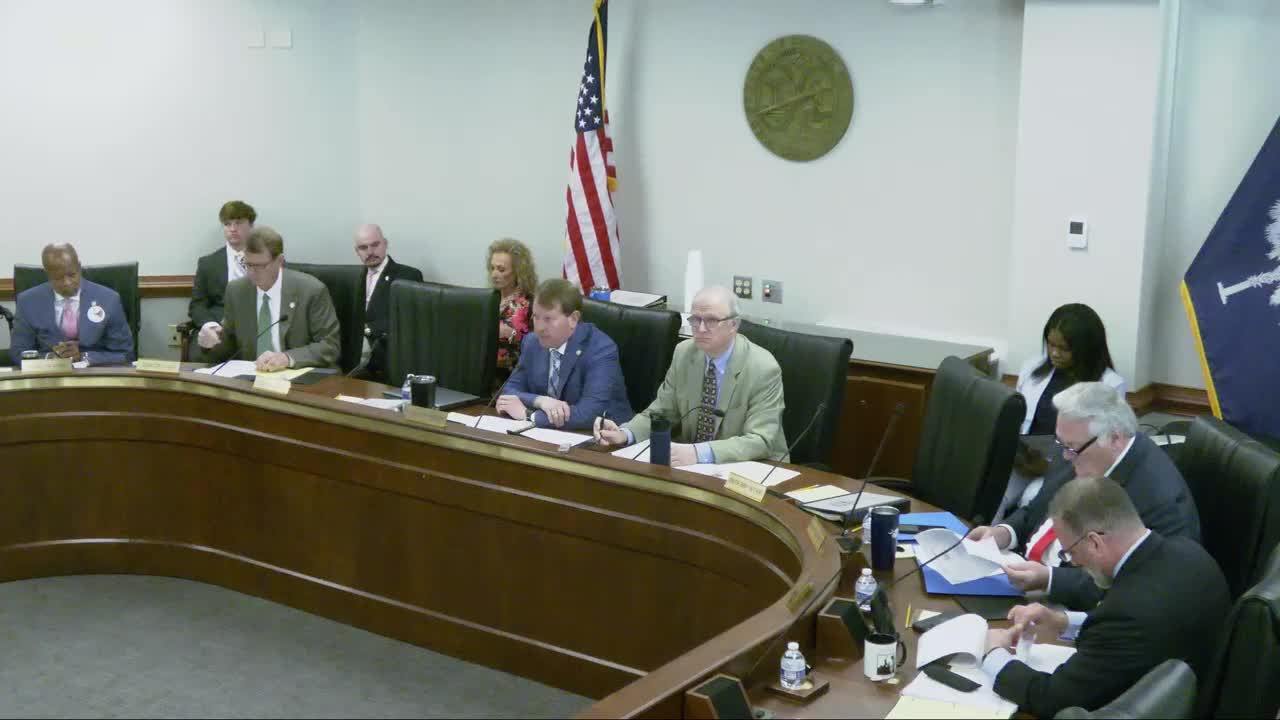
Senate subcommittee hears mixed testimony on SB54 Medical Informed Consent Act; adopts technical fix and carries bill over
Summary
Senate subcommittee chair Senator from Spartanburg opened testimony on S.B. 54, the Medical Informed Consent Act, describing the bill as an attempt to limit use of emergency powers and protect individual consent to medical treatments while preserving the state’s ability to respond to emergencies.
Senate subcommittee chair Senator from Spartanburg opened testimony on S.B. 54, the Medical Informed Consent Act, describing the bill as an attempt to limit use of emergency powers and protect individual consent to medical treatments while preserving the state’s ability to respond to emergencies.
The bill would, among other changes, replace a statutory requirement that sheriffs and officers "must" aid the public-health director with a discretionary "may," add due-process language for involuntary isolation and quarantine, prohibit discrimination based on vaccination status, and restrict employers from making certain vaccines or medical products an employment condition. "Nobody... should have to choose between a jab and their job, and we're not gonna make them," the subcommittee chair said while introducing the measure.
Why it matters: supporters called SB54 a civil‑liberties protection after the COVID‑19 response; opponents said parts of the bill could reduce public‑health authorities' operational clarity and impede standard medical safeguards.
What witnesses said
Dr. Jonathan W. C. Brock, a private pediatrician, told the panel he came because he was "concerned about the mandate being removed for vaccinations for our children, especially going into schools." Brock repeatedly asked whether the bill would change long‑standing K‑12 vaccine requirements; the chair and the bill sponsor said the bill’s intent was not to alter K‑12 school immunization law, and the chair agreed to clarify the language.
Dr. Shanna Agee, a pediatrician practicing in Spartanburg, said vaccine mandates for school and preschool have been central to eliminating diseases such as polio and measles and that "vaccine mandates... are a large part of how children are protected." She told the committee that pediatricians she had consulted read the bill as applying to any FDA‑approved vaccine and to school mandates, and asked for explicit drafting so schools and families would understand the bill’s reach.
Pharmacists and professional groups focused their testimony on section 4, which addresses when a pharmacist may refuse to fill a prescription. Brian Clark, CEO of the South Carolina Pharmacy Association, said section 4 "would severely restrict a pharmacist's ability to exercise professional judgment" and risk patient safety by forcing pharmacists to dispense medications they believe are unsafe or inappropriate for an individual patient.
Independent pharmacists echoed that concern. Renarda Jones, owner of an independent pharmacy in Camden, said in practice some pharmacies already avoid disputes by telling customers a medication is "not in stock," but she urged lawmakers to consider downstream effects of prescriptive rules. Amanda Hovis, a physician assistant who treated patients during the pandemic, described treating some patients with ivermectin in outpatient settings and said some people "were desperate to find a place that would offer that medication." Hovis said patients sought available options when they felt standard care offered no alternatives.
Committee action and next steps
The subcommittee adopted a scrivener's amendment to correct wording in section 9, subsection (b). The chair explained the change modifies the provision to read that isolated or quarantined individuals must be released when they "pose a substantial risk" (changing the printed word "no" to the letter "a"). The amendment was adopted by voice vote; the chair announced the vote "passes unanimously." The committee then voted, by voice, to carry the bill over to the next subcommittee meeting for additional drafting; the chair said staff will work with pediatricians and others to clarify that K‑12 vaccine requirements are not intended to be altered by SB54.
Discussion vs. decision
Much of the hearing was discussion and sworn testimony; no final policy decision on SB54 was taken. The committee accepted a technical amendment and decided to hold the bill for further drafting. Several witnesses and senators asked for clearer language about schools, pharmacist discretion when faced with drug interactions or contraindications, and the scope of employer authority.
What was not decided
The committee did not adopt or reject the bill’s substantive policy changes; it did not take a roll‑call vote on final passage. Witnesses requested—some sharply—that section 4 be deleted or rewritten to preserve pharmacists’ ability to refuse to fill prescriptions where they judge there are safety or interaction concerns.
Ending
The subcommittee chair said staff would circulate draft amendments and reconvene a subcommittee meeting to consider them before the bill moves further. The record contains extensive sworn testimony from pediatricians, pharmacists, and clinicians on both sides of the bill.