Get Full Government Meeting Transcripts, Videos, & Alerts Forever!
Get email alerts on the Public Safety Infrastructure topic
No spam. Unsubscribe anytime.
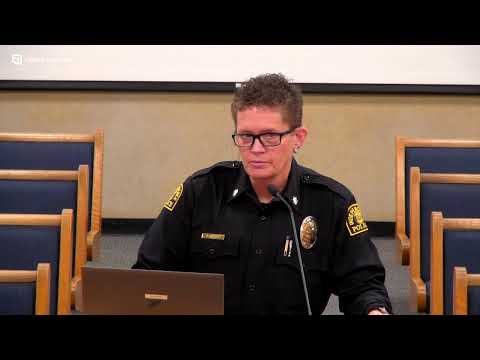
Deputy Chief Sumstead outlines Justice Center needs, $130 million bond question and building deficiencies
Summary
Deputy Chief Michelle Sumstead told the council that Independence’s aging and dispersed police facilities suffer from chronic leaks, overcrowded evidence storage and limited training space and that Question 1 on the upcoming bond would fund a new Justice Center campus and an animal-control facility.
Deputy Chief Michelle Sumstead and Chief Dustman briefed the council on the Justice Center portion of the city’s proposed general‑obligation bond (Question 1), describing long‑standing space shortages, evidence-storage limits, repeated water intrusion and maintenance problems, and training and parking constraints at current police facilities.
Deputy Chief Sumstead read the ballot language for Question 1 to the council: “Shall the city of Independence, Missouri issue its general obligation bonds in the amount of $130,000,000 for the purpose of acquiring, constructing, renovating, improving, and equipping public safety buildings, facilities, and grounds, including constructing, improving, and equipping a new justice center, demolishing existing law enforcement facilities, housing functions that will be moved to the new justice center, and preparing such sites for alternative uses, and acquiring, renovating, and equipping an animal control facility.” She noted state-mandated limitations and that the state auditor will verify bond proceeds are used only for the listed purposes.
Sumstead outlined current facility constraints: the existing 1970s-era building was sized for about 100–150 employees but now houses roughly 300 personnel across multiple off-site buildings. Property and evidence storage is nearing capacity; certain categories of evidence (homicide, some child-abuse or sex‑crime materials) must be retained indefinitely. She showed photos in the presentation documenting water leaks, ceiling and ventilation deterioration, an undetermined substance found in vents (tested but not conclusively identified), damaged ceiling tiles over evidence storage, rust and structural deterioration in the Sally Port and detention areas, and cramped and aging fleet and equipment storage. Sumstead also described inadequate training facilities: the department’s current firing range has four lanes, limiting on-duty training throughput, and a proposed new range in the Justice Center campus would expand capacity and allow scenario-based training including vehicle‑based exercises.
Chief Dustman and Sumstead said that many divisions are spread across multiple sites (K‑9 facility, Penniston building, three substations) and that consolidating functions onto a Justice Center campus would reduce travel time for commanders and better centralize evidence processing, detention, records and administration. They emphasized health‑and‑safety risks from repeated leaks and the operational inefficiencies of overly fragmented facilities.
Councilmembers asked about the campus design (multiple buildings on a campus rather than a single structure), square footage comparisons, and how often the department uses facilities (20‑24/7 for patrol and many functions). Sumstead said the project would also house municipal court functions and that specific square‑footage figures depend on the final design; staff offered to provide tours of the department and to schedule community presentations. No council vote on the bond was taken at the study session; councilmembers encouraged staff outreach and noted the city is continuing community information efforts about the three ballot questions.