
Sweetwater Authority receives legal briefing on DEIB and workforce development; board takes no action
Get AI-powered insights, summaries, and transcripts
Subscribe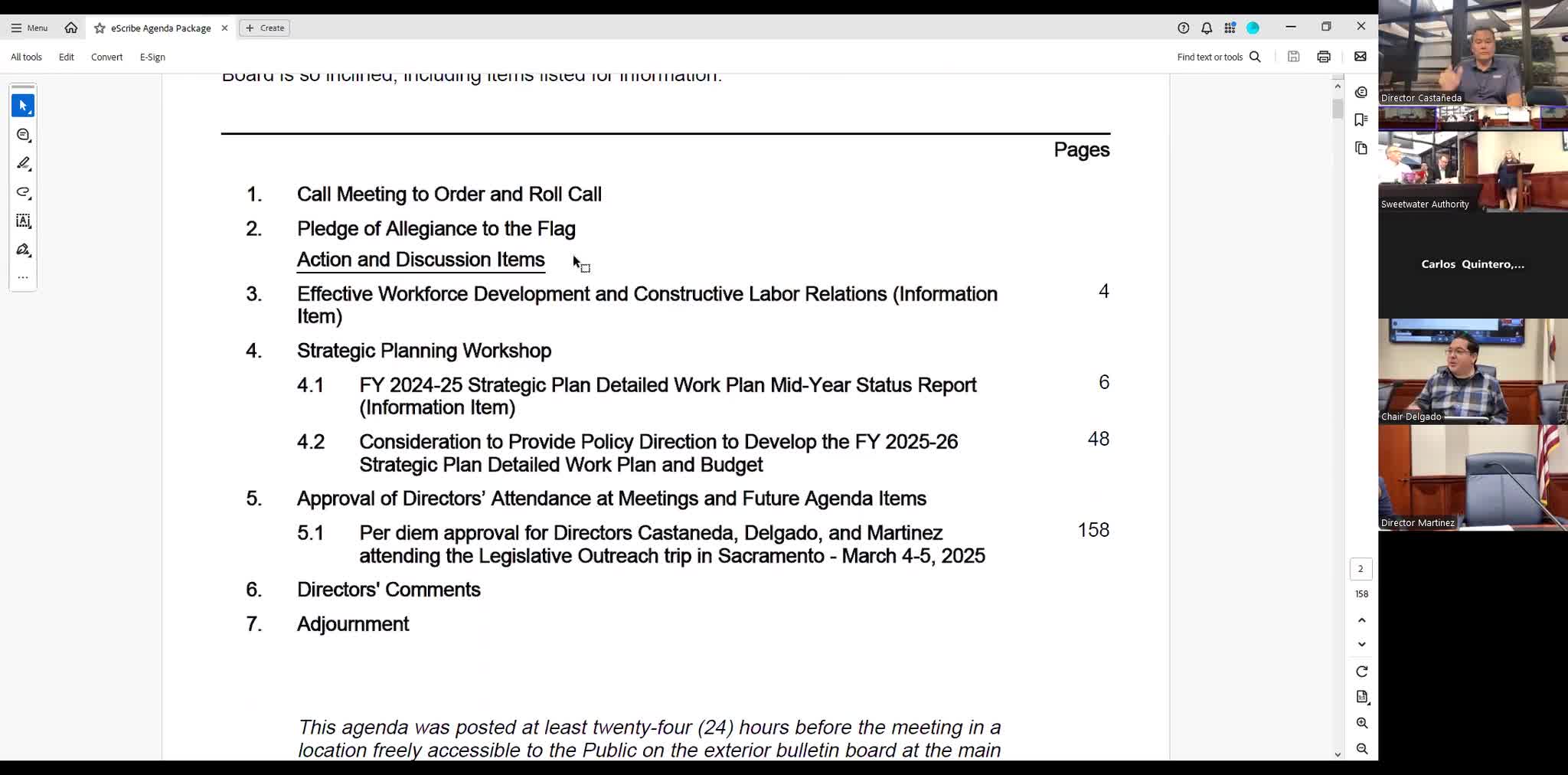
Summary
Jennifer Martinez of Hansen Bridal briefed the Sweetwater Authority Board of Directors on DEIB definitions, litigation and best practices; the briefing was informational and no implementation steps were approved.
Jennifer Martinez, a partner in the employer services section at Hansen Bridal and the firm’s chief diversity, equity and inclusion officer, told the Sweetwater Authority Board of Directors on March 1 that DEIB is a management framework that can strengthen recruitment, retention and innovation in public agencies.
The board heard an hourlong informational briefing on workforce development and constructive labor relations; no policy or procurement action was taken and staff said it would return with implementation proposals only after the board provided direction.
Martinez opened by defining the four DEIB elements and summarizing research on outcomes: “DEIB, that acronym that you hear, diversity, equity, inclusion, and belonging, is really nothing more than a framework, a framework for successful organizational principles, for your personnel,” she said. She cited industry studies showing diverse and inclusive workplaces score higher on retention, adaptability and innovation.
The presentation then turned to the legal landscape. Martinez reviewed the U.S. Supreme Court decision in Students for Fair Admissions v. Harvard (2023) and its limited direct effect on workplace law, explained that Title VII employment rules differ from higher-education law, and summarized recent litigation to watch: federal circuit decisions about adverse-action thresholds (Muldrow v. City of St. Louis; Hamilton v. Dallas County), a still-pending hostile‑work‑environment claim tied to specific training content (DePiero v. Penn State), and other cases involving employer trainings and disclosure requirements. She said the U.S. Equal Employment Opportunity Commission and California enforcement agencies have in some settlements required employer actions such as pay‑equity studies and demographic monitoring to address systemic discrimination.
On practical steps, Martinez recommended that the Authority focus on recruitment outreach and on bias‑reducing hiring practices (for example blind initial resume screenings and structured behavioral interviews), maintain careful documentary justifications for any targeted outreach, avoid quotas or percentage mandates, track demographic and hiring data, and design trainings and investigation procedures that are tailored and documented. She gave her firm’s sabbatical program as an example of an initiative that started to address a retention problem and ultimately benefited all employees.
During board discussion, Director Cox asked when staff would bring concrete recommendations for implementation; the general manager replied: “At this point, we will defer to the board as to what direction you want us to follow, whether you want us to put a plan together with some of these best practices or whether this is something that you don't want us to pursue.” Director Martinez Perez and others praised the presentation’s thoroughness. Director Yamani asked that the presentation materials be posted; staff confirmed a PDF will be available on the Authority’s website.
The item was presented and received for information; staff said it would be placed on the Authority’s FY 2025–26 detailed work‑plan discussion for any policy direction the board chooses to provide.
Ending: Staff will not proceed with implementation unless and until the board gives specific policy direction; Martinez and board members flagged areas—recruiting pipelines, training content, and investigation and recordkeeping practices—that staff said they would address in follow‑up materials to the board’s strategic planning process.