Get Full Government Meeting Transcripts, Videos, & Alerts Forever!
Get email alerts on the Water Quality topic
No spam. Unsubscribe anytime.
Water Quality Committee OKs one-year extension for Reynolds facility biological monitoring contract
Summary
The Sweetwater Authority Water Quality Committee approved a one-year extension to Merkle Associates' biological toxicity monitoring contract for the Richard A. Reynolds Groundwater Desalination Facility discharge permit, citing ongoing permit renewal delays at the Regional Water Quality Control Board and continued operational monitoring needs.
The Sweetwater Authority Water Quality Committee voted Feb. 20 to approve a one-year extension of the authority's biological toxicity monitoring contract for the Richard A. Reynolds Groundwater Desalination Facility discharge permit.
Staff member Justin told the committee the extension would let the authority meet permit monitoring requirements while it waits for a renewed discharge permit from the Regional Water Quality Control Board. The motion passed on a roll call with Directors Cox and Delgado voting yes and Director Martinez Perez absent.
The extension matters because the authority must carry out whole-effluent toxicity monitoring and other tests tied to its discharge permit. The current permit cycle began after the desalination expansion and discharge-line relocation completed; the authority said the existing permit became effective in 2017 and expired in 2022, and the regional board has not yet issued a replacement.
Justin said the authority has been required to monitor for biological effects — known as whole-effluent toxicity — which uses marine test organisms to determine whether brine and other effluent harm development or survival. "We're recommending to the committee for consideration to renew this contract on a short-term basis to continue some of the efforts," Justin said. He added, "We did what we're supposed to do," referring to the authority's renewal application and submittals to the regional board.
Under the authority's permit program, the Reynolds plant may discharge up to 2.5 million gallons per day of concentrate to the lower Sweetwater River through a near‑bay outfall west of Highland Avenue. Staff said roughly 20 percent of processed water becomes brine that is about five times more concentrated in salts than the feed water.
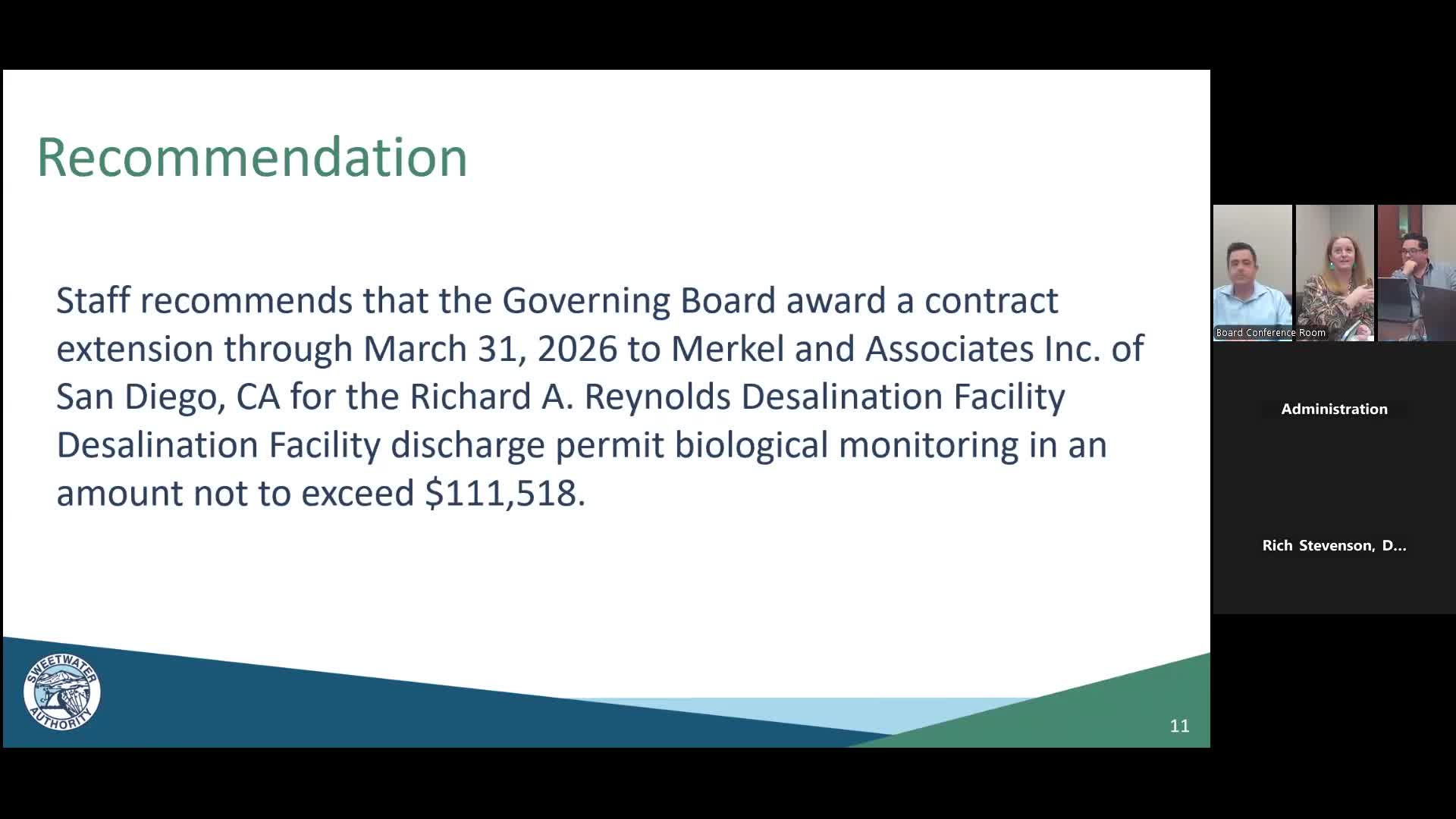
Biological toxicity monitoring at Reynolds is scheduled on a calendar-year basis, with sampling in April and October. Justin told the committee the authority paid about $35,300 for biological monitoring over the past two years; in a worst-case scenario that triggers accelerated monitoring and a toxicity‑reduction evaluation, costs could rise to as much as $210,000. The staff recommendation to the committee asked the board to authorize a one-year contract extension with Merkle Associates not to exceed $111,518 through March 31, 2026, to cover the next monitoring cycle and, if needed, follow-up work.
Staff described several reasons for the short extension request: the regional board backlog on permit renewals (the authority submitted its renewal application in early 2022 and continues to operate under the prior permit), the timing of April/October monitoring events, and continuity of laboratory and test-organism methods the authority now uses. Justin said moving lab work to a local laboratory and using locally sourced test organisms has coincided with fewer toxicity failures in recent years.
Committee members asked about contract procurement history and whether additional extensions complied with purchasing policy; staff said the board may approve sole‑source or extension actions and that the recommendation reflected the authority's need to ensure monitoring coverage while the permit remains pending. The committee approved staff's recommendation on a 2‑0 vote (Director Cox yes; Director Delgado yes; Director Martinez Perez absent).
The committee's decision covers the biological monitoring portion of the Reynolds discharge permit obligations; other discharge limits and chemical monitoring requirements remain in place. Staff told the committee the extension is funded through the water-quality laboratory budget and said they would return to the board if circumstances change (for example, if the regional board issues a new permit or if unusually costly monitoring is triggered).
The Water Quality Committee meeting adjourned at 4:25 p.m. The committee schedule shows the next meeting on March 17, 2025.