Get Full Government Meeting Transcripts, Videos, & Alerts Forever!
Get email alerts on the Legislative Oversight topic
No spam. Unsubscribe anytime.
Attorney General outlines office role, budget growth and public-safety priorities in oversight review
Summary
Attorney General Wilson presented an overview of the Office of the Attorney General to a Senate oversight subcommittee, detailing authority, staffing, revenue recoveries, public-safety initiatives (ICAC, state grand jury, violent-crimes unit), the consolidation of victim services, and a request for additional funding and office renovation.
Attorney General Wilson presented a wide-ranging review of the Office of the Attorney General to the Senate Oversight Subcommittee, describing the office's constitutional and statutory authority, staffing and budget growth, major revenue recoveries for the state, and current public-safety priorities including internet crimes against children and a mobile violent-crimes case reduction unit.
Wilson told senators the attorney general is “the chief prosecuting officer of the state’’ and walked the subcommittee through the office’s divisions, statutory responsibilities and recent organizational changes, including the 2017 consolidation of crime victim services under the AG's office.
Wilson said the office has grown substantially since mid-20th century staffing levels and cited current full-time-equivalent (FTE) counts and budget figures to illustrate that growth. He said the office reported about 310 FTEs in summer 2024 and that appropriations for 2024 totaled approximately $115.4 million, broken down as roughly $28.7 million in general fund appropriations, $26.7 million in earmarked fees/fines, and about $60 million in federal funds passed through the office. Wilson told the subcommittee the office’s recoveries and settlements returned tens of millions annually to the state — citing $67 million recovered in one recent year and roughly $70.4 million from tobacco-related settlements in another — and that those recoveries supplement the general-fund appropriation.
Wilson summarized the office’s major operational units: civil litigation (including tobacco and securities enforcement), consumer protection and antitrust (CPAT), a solicitor-general section that handles major appellate matters and amicus work, criminal prosecution and appellate units (including capital litigation and post-conviction relief), the state grand jury, and victim services. He noted that South Carolina is one of five states in which the attorney general also serves as the state securities commissioner and said that the securities section and CPAT generate substantial recoveries for the state.
On public-safety priorities, Wilson emphasized internet crimes against children (ICAC), human trafficking, Medicaid/provider fraud and the newly implemented violent-crimes case reduction unit (VCCRU), a mobile team meant to assist circuits with backlogs. He said ICAC now involves more than 128 law-enforcement agencies and just under 30 full-time staff in the AG’s office and warned that demand for forensic analysts and investigators remains high. He described the state grand jury as a “powerful investigative unit’’ limited to 15 areas of inquiry and noted its role in multi-jurisdictional and fentanyl-related investigations.
Wilson flagged an administrative-subpoena bill as a priority for investigations into online predation; he said the measure would allow the AG’s office to issue subpoenas to identify IP owners in the same way U.S. attorneys currently can, rather than relying on federal signoff to identify suspects. He also urged the legislature to include the attorney general on the Commission on Prosecution Coordination so the office can coordinate funding and prosecution strategy with circuit solicitors.
Wilson described internal management and oversight practices, including annual internal reviews of each section’s accomplishments and needs, and an external review by the National Association of Attorneys General earlier in his tenure. He repeatedly requested competitive attorney pay to limit turnover, noting the office employs roughly 90 attorneys among its total staff and faces recruiting pressure from other agencies and the private sector.
Wilson also discussed facilities and a pending renovation request. He said the AG’s office currently occupies multiple locations across the Capitol complex and is proposing further renovations of the Dennis Building now that another agency has vacated several floors. He estimated renovation costs of roughly $11–$13 million per floor and a total project that could be in the $40–$50 million range, and he said his office has already received some appropriations and is requesting additional funds.
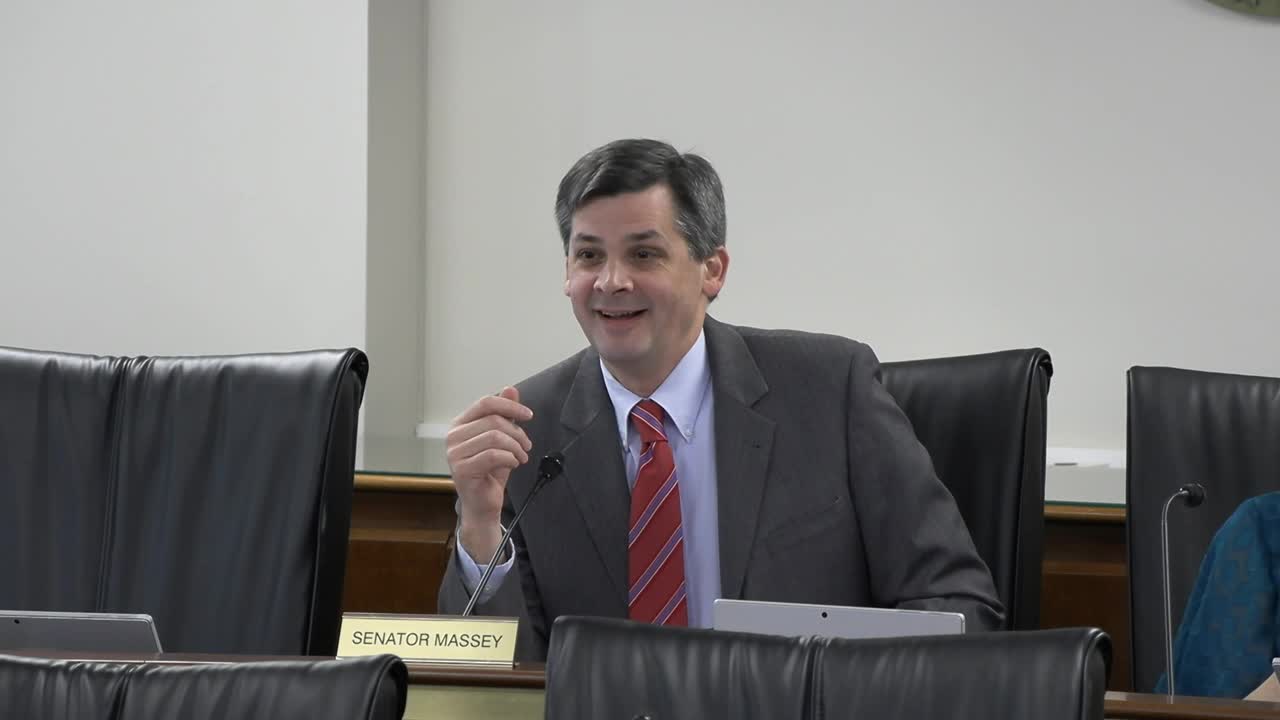
Senators briefly administered the oath to testimony at the start of the hearing and prompted Wilson to present. At the conclusion of his remarks, Wilson said he was open to questions and requested additional oversight follow-up; the subcommittee chair indicated staff would provide information requests and that follow-up was expected.
The presentation included a mix of factual descriptions of statutory duties and accounts of program performance, plus several requests to the legislature (funding for personnel and capital renovation, statutory changes to subpoena authority, and membership on the prosecution coordination commission). Wilson referenced prior legislative actions and statutes (for example, the creation of the crime victim services division in 2017 and the state’s Money Services Commissioner and securities statutes) when explaining authorities and recent organizational changes.
No formal motions or votes were recorded in the transcript of this presentation. The subcommittee’s next oversight steps and any formal requests for additional documents, figures or legislation were not specified in the transcript.