Get Full Government Meeting Transcripts, Videos, & Alerts Forever!
Get email alerts on the Evidence Collection And Penalties topic
No spam. Unsubscribe anytime.
Subcommittee carries over S.192 after witnesses raise concerns over reduced penalties and evidence procedures
Summary
S.192, proposing changes to evidence-collection liability, ignition-interlock rules and penalties for DUI/BUI, was carried over for further drafting after testimony from victims' advocates, prosecutors and defense attorneys urged careful, targeted changes.
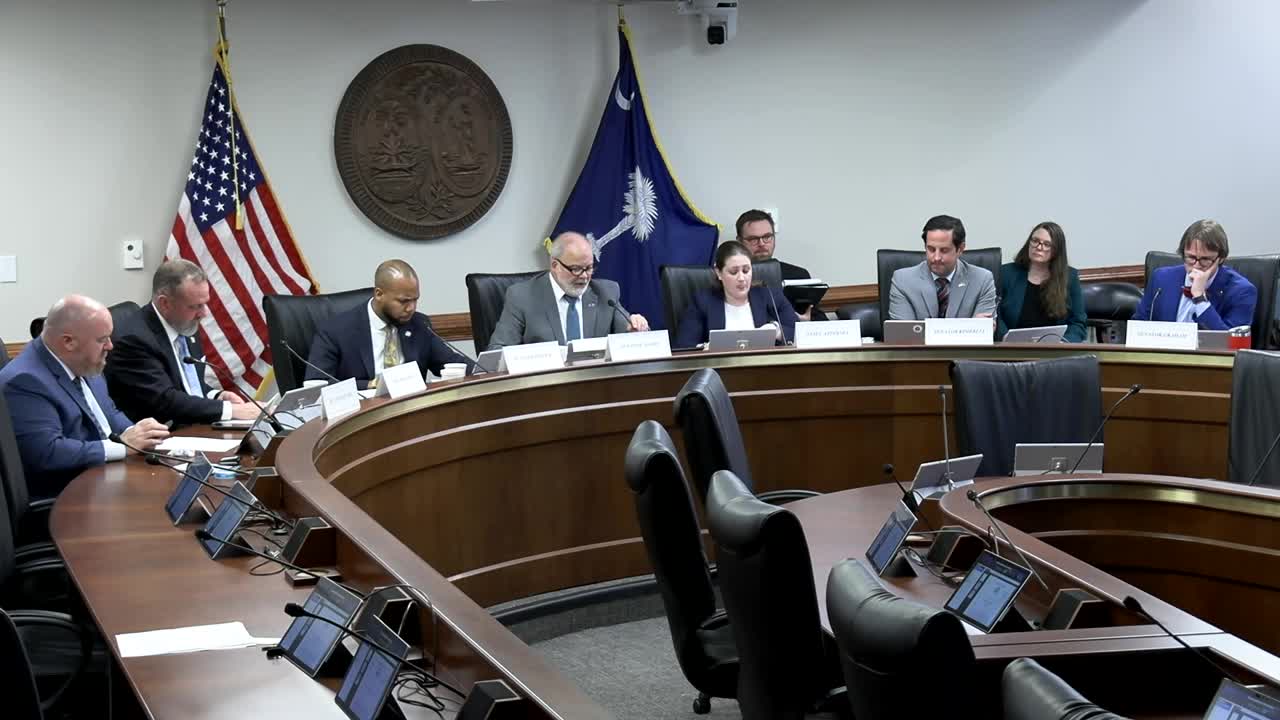
The Senate Judiciary subcommittee carried over S.192 for further work after testimony highlighted conflicts over penalties and the bill’s approach to evidence collection.
S.192 would revise procedures for collecting intoxication evidence, alter civil and criminal liability for negligent or reckless testing, clarify ignition-interlock provisions and change penalty timelines for certain DUI and boating-under-the-influence offenses, witnesses said.
Randall Smith, chairman of Boating Safety South Carolina, testified in opposition to a provision in S.192 that would reduce penalties in section 24-13-100(b), describing long-term harm to victims’ families and urging the committee to preserve current penalties. “When a drunk driver is responsible for the death, it is an innocent victim and their families who suffer the most,” Smith said, recounting fatal crashes and noting he and other victims’ families frequently appear before the committee.
Laura Hudson, who also testified, echoed concern and said violent-crime classifications enacted in earlier years recognize that DUI/BUI fatalities are not mere accidents and should not be down-graded.
Defense witness Jim Huff urged legislators to proceed with a “scalpel rather than a hatchet,” recommending more limited and precise changes. Huff supported removing urine testing from the implied-consent options and urged preserving the current breath-first approach and procedural safeguards, including due-process protections before imposing ignition-interlock device (IID) installation when a driver refuses a test.
Senator from Charleston moved to carry S.192 over; the subcommittee agreed by voice vote and will continue working on the bill’s language before returning it to committee. Members said they want to balance improvements to evidence collection and victim protections with constitutional and due-process safeguards.
The subcommittee did not adopt the contested penalty reduction and left several substantive questions — including IID timing, the status of urine testing, and liability language governing negligent sampling — to future drafting sessions.