Get Full Government Meeting Transcripts, Videos, & Alerts Forever!
Get email alerts on the Higher Education College Of Charleston topic
No spam. Unsubscribe anytime.
College of Charleston reports record enrollment, plans student housing after property acquisition
Summary
President Andrew Hsu told the House Education and Public Works Committee the College of Charleston recorded its largest student body in its 255-year history, highlighted a Moody's upgrade, a new Phi Beta Kappa chapter and a recent 2‑acre property purchase intended for student housing; he credited increased state funding for part of the progress.
College of Charleston President Andrew Hsu told the House Education and Public Works Committee that the college recorded its largest student body in its 255‑year history, with close to 12,000 students last fall and a record 32,000 applications.
Hsu said the rise in applications and enrollment reflects the college’s location and its growing academic reputation; he noted the institution will induct its first Phi Beta Kappa cohort this spring after a multi‑year application process.
Hsu emphasized recent improvements in the college’s financial profile. “This winter, Moody’s upgraded our institutional rating despite Moody’s having an overall negative outlook on higher education as a sector,” he said, tying that upgrade to a January closing on about 2 acres contiguous to the downtown campus that the college will use for student housing. He described the parcel as north of Calhoun, south of Vanderhorst, east of Cummings and west of St. Philip, and said the site once included a YWCA building and an adjacent parking lot.
During questions, Hsu said the college has reached an agreement in principle with the city to swap a piece of land and that the college “owe[s] them $5,000,000” as part of the arrangement; he said the city will move the proposal to its council soon. He also told members the parcel includes a converted condo at 199 Saint Philip now used for student housing.
Hsu outlined academic and workforce developments: formation of a School of Health Sciences in partnership with the Medical University of South Carolina (MUSC); a reorganization of STEM majors into the School of Natural and Environmental Sciences and the School of Engineering, Computing and Mathematics; new engineering programs; a new BS in Nursing developed with technical colleges and MUSC; and two applied doctorates—an education doctorate (EdD) and a Doctor of Business Administration (DBA).
On residency and outcomes, Hsu said the college’s student body is “right about fifty‑fifty” for in‑state and out‑of‑state students and that the college admits roughly 82–83% of South Carolina applicants. He added that 60% of first‑year graduates remain in South Carolina one year after graduation.
Hsu provided committee members with a fact book and a one‑page summary and offered legislative staff contacts, naming Paul Patrick as chief of staff, Shirley Hanson as a state representative for the college, and Campbell Mitchell among his legislative team.
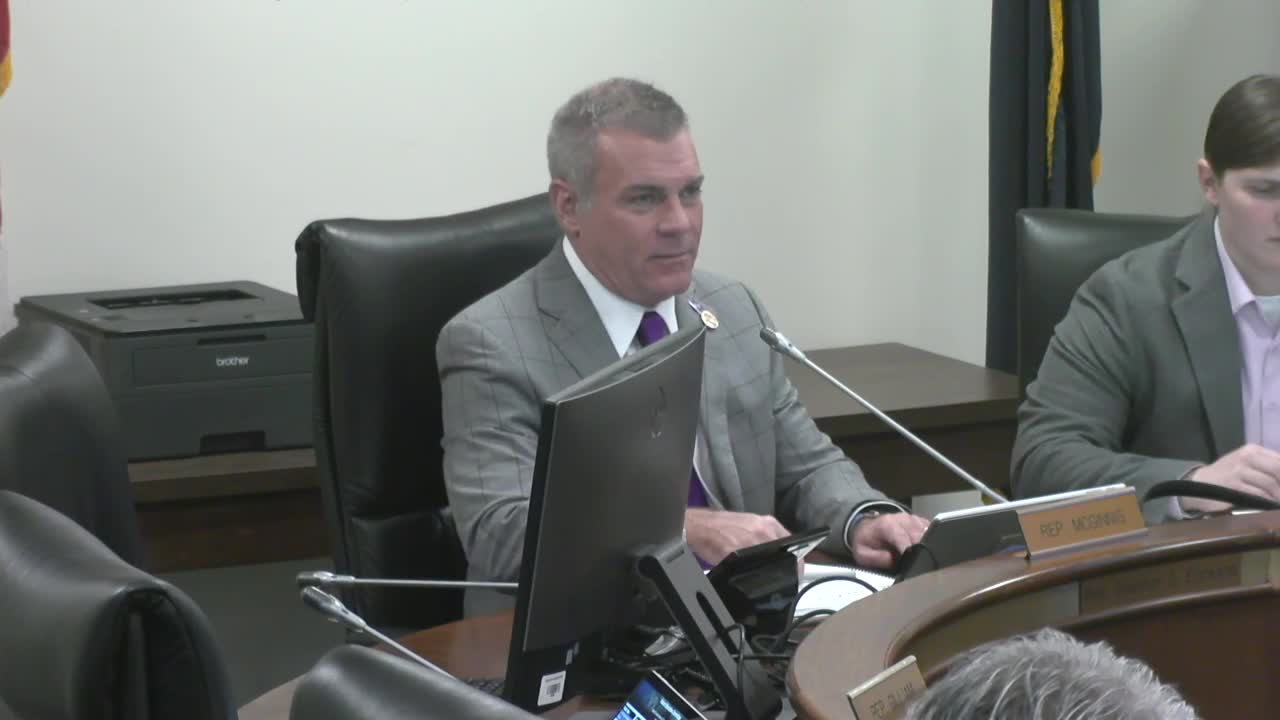
Representative Tim McGinnis, Representative Jackie Tarabile and Representative Huff asked questions during the presentation; Macy Webb is listed as the committee’s research analyst and introduced the session.
Hsu closed by inviting follow‑up questions and offering his staff as points of contact for additional data.