Get Full Government Meeting Transcripts, Videos, & Alerts Forever!
Get email alerts on the Education topic
No spam. Unsubscribe anytime.
State superintendent asks for Rap Back and legal funding, proposes cutting videorecorded summative assessment
Summary
State Superintendent Paul Kraft told the House Education Committee the SBOE needs $2.25 million annually from the GRF to cover Rap Back costs, urged elimination of the resident‑educator summative video assessment to save roughly $1 million a year, and requested direct GRF funding for assistant attorneys general to support administrative adjudications.
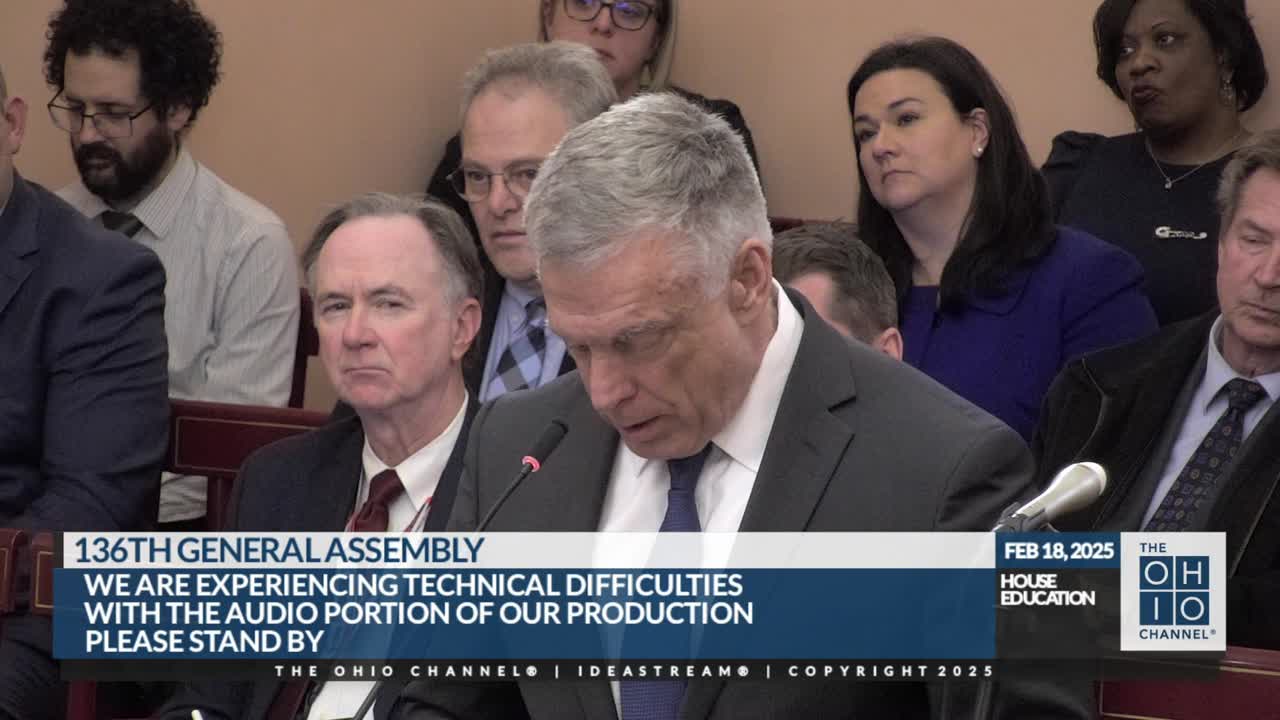
State Superintendent Paul Kraft told the Ohio House Education Committee that the State Board of Education (SBOE) is seeking direct General Revenue Fund support to steady the agency’s teacher‑licensure operations and background‑check system.
Kraft asked lawmakers to direct roughly $2,250,000 annually from the GRF to cover Rap Back enrollment and processing costs that currently draw on the teacher licensure fund. He also asked the legislature to eliminate the resident‑educator summative assessment (the 20‑minute RESA video), a change the SBOE estimates would save a little more than $1,000,000 per year, and requested direct GRF funding for assistant attorneys general to support administrative adjudications ($512,510 in FY 2026 and $527,886 in FY 2027 as submitted to the committee).
The requests come as the SBOE describes a steady depletion of the teacher licensure fund and a large increase in misconduct referrals and Rap Back enrollments. Kraft said the board has cut travel, hiring and meeting costs and has begun LeanOhio efficiency reviews, but that “these cuts do not solve our funding crisis.”
Why it matters: the board’s licensure office administers credentialing for educators statewide, operates the Rap Back criminal‑history alert system that notifies districts when certain personnel generate new criminal records, and oversees the Office of Professional Conduct (OPC) that investigates alleged misconduct. The state support sought would pay for expanded Rap Back participation and for legal representation in administrative cases; the proposed RESA elimination would remove the external video assessment component of the resident‑educator pathway.
Key details and context
- Rap Back enrollment and alerts: the SBOE said Rap Back enrollment rose to 456,344 registrants as of Feb. 1, 2025. Rap Back provides state‑level criminal‑history alerts to districts when enrolled individuals are arrested, plead guilty or are convicted. Kraft told the committee that the administration’s budget includes GRF funding that would cover part of the board’s Rap Back costs.
- Volume of referrals and case workload: Kraft told lawmakers that referrals to the professional‑conduct office rose from 13,160 in 2019 to 22,066 in 2023, a 68% increase over four years. The SBOE is using LeanOhio engagements and IT automation to speed intake and case management; Kraft said the board’s goal is to reduce case investigation timelines while preserving due‑process protections.
- Resident educator summative assessment (RESA): SBOE testimony said the RESA video assessment costs about $1,000,000 annually; in the 2023–24 school year roughly 7,100 teachers submitted the RESA video and 57 did not pass on a first attempt (a 99.12% first‑attempt passage rate). Kraft told the committee the board believes local districts are best positioned to attest to a teacher’s readiness and that eliminating the external summative video is a reasonable budget reduction during tight fiscal times.
- Licensure processing targets and service commitments: Kraft pledged service benchmarks tied to the requested funding. If funded as requested, he said the SBOE would issue complete, unflagged license applications within one week of submission and would limit professional‑conduct intake review to six weeks from referral to initial action for flagged cases.
- Legal support and funding flow: The SBOE described current practice of receiving full‑time assistant attorneys general (AAGs) from the Ohio Attorney General’s office for administrative hearings and appeals under Ohio’s administrative adjudication process (chapter 119 cited in testimony). The SBOE asked that AAG support be directly funded from the GRF rather than from the teacher licensure fund.
Direct quotes from the hearing
- “These cuts do not solve our funding crisis,” Paul Kraft, State Superintendent of Public Instruction, said of the agency’s internal savings. “We will not take more than six weeks to make [the professional‑conduct review] happen.”
- “Candidates do receive some feedback,” Dr. Jim Whiteman, associate director in the office of educator licensure and effectiveness, said when asked whether licensure assessments provide useful guidance. He described a new self‑paced vendor product, “Right Start,” intended to direct candidates to areas of needed review.
Committee discussion and immediate outcomes
Committee members pressed Kraft on whether the administration’s budget language covered the full SBOE request. Kraft said the administration included $2,000,000 of the SBOE’s roughly $2,250,000 Rap Back ask in its submission and did not include the attorney general funding in that amount. He said the amount included in the administration’s budget would prevent further staff cuts for the current biennium and pledged not to raise licensure fees during the fiscal biennium if the requested elements were funded.
What the SBOE recommended to lawmakers
- Direct roughly $2,250,000 annually from the GRF to the SBOE to cover Rap Back costs for individuals required by Ohio law to be enrolled in the system. - Remove the resident educator summative performance assessment (the 20‑minute videotaped RESA) from the Ohio Teacher Residency Program. - Direct GRF funding to cover assistant attorneys general and related support staff assigned to SBOE adjudications ($512,510 in FY 2026; $527,886 in FY 2027 as submitted).
Speakers and testimony sources
Speakers whose remarks are quoted or summarized in this article are listed below. All are identified in the committee transcript and were present during SBOE testimony.
- Paul Kraft — State Superintendent of Public Instruction, State Board of Education (government) - Jim Whiteman — Associate Director, Office of Educator Licensure and Effectiveness (government) - Chair Fowler Arthur — Chair, House Education Committee (government) - Representative Miller — State Representative (government) - Representative Piccolantonio — State Representative (government) - Representative Robinson — State Representative (government) - Representative Brennan — State Representative (government) - Representative Newman — State Representative (government) - Matt Verber — CEO, Teach Forward (written public testimony referenced)
Authorities cited in testimony
- Ohio Revised Code (statute) — referenced as the statutory basis for Rap Back enrollment and administrative adjudications. - House Bill 33 (other) — cited during testimony as a legislative change that expanded Rap Back coverage to additional categories of district employees.
Discussion vs. decision
- Discussion: committee members questioned the SBOE on program cost drivers, the RESA’s pedagogical value versus cost, licensure service benchmarks, and the effect of Rap Back expansions on the teacher licensure fund. - Direction: Superintendent Kraft committed that, with the requested funding, the SBOE would (a) issue complete licenses within one week, and (b) complete initial professional‑conduct review within six weeks of an intake that triggers investigation. - Formal action: None taken during the hearing; no votes were recorded.
Clarifying details extracted from testimony
- Referrals rose from 13,160 (2019) to 22,066 (2023). - Rap Back enrollment: 456,344 as of 2025‑02‑01. - RESA (video) costs: approximately $1,000,000 per year; 7,100 teachers submitted the RESA video last school year; 57 failed their first attempt (99.12% pass rate). - SBOE staffing: current operating headcount ~56 (cap 58); manning document had suggested 70. - Teacher licensure fund annual receipts cited around $11,650,000 (varies year to year). - Attorney general AAG funding request: $512,510 (FY 2026), $527,886 (FY 2027).
Proper names identified (selected)
- State Board of Education (agency) - Rap Back system (program) - Resident Educator Program / RESA (program) - Office of Professional Conduct (OPC) (agency) - Ohio Attorney General (office) - LeanOhio (state efficiency program)
Community relevance
- Geographies: statewide (Ohio) - Funding sources: General Revenue Fund (GRF), teacher licensure fund (fees), possible AG funding. - Impact groups: early‑career teachers (resident educators), licensed educators, school districts, students.
Searchable tags: ["Education","teacher licensure","Rap Back","RESA","SBOE","Ohio"]
Provenance
- topicintro: {"block_id":"block_146.83","local_start":0,"local_end":106,"evidence_excerpt":"Of the educators' position to ensure that all Ohio students receive instruction from educators committed to a safe, supportive, and healthy school community."} - topfinish: {"block_id":"block_4194.405","local_start":0,"local_end":23,"evidence_excerpt":"Thank you, chair. Thank you all."}
salience":{"overall":0.63,"overall_justification":"Budget requests affect licensure services, background‑check coverage and legal representation for educator discipline; large referral increases and Rap Back growth raise operational strain."},"topics":[{"name":"Education","justification":"Primary policy area: teacher licensure, professional conduct, and state education budget; directly relevant to classroom staffing and licensing administration.","scoring":{"topic_relevance":1.0,"depth_score":0.88,"opinionatedness":0.02,"controversy":0.35,"civic_salience":0.78,"impactfulness":0.72,"geo_relevance":1.0}}],"discussion_decision":{"discussion_points":["Teacher licensure fund depletion and staffing cuts","Rapid growth in Rap Back enrollment and associated operating costs","High first‑attempt passage rate on the resident educator video assessment (RESA)","SBOE commitments to processing time targets for license issuance and intake review","Attorney General support for administrative adjudications and associated costs"],"directions":["SBOE commits not to raise licensure fees during the current biennium if requested funding is provided","SBOE will pursue additional LeanOhio engagements to identify efficiency savings"],"decisions":[]},