Get Full Government Meeting Transcripts, Videos, & Alerts Forever!
Get email alerts on the Workers Compensation topic
No spam. Unsubscribe anytime.
Senate committee advances package of workers’ compensation bills after extended debate; insurers and employers warn of cost risks
Summary
The Public Health, Welfare and Labor Committee voted to advance multiple bills amending Arkansas’ workers’ compensation system after several hours of testimony from employer groups, insurers, attorneys, medical providers and the Workers’ Compensation Commission.
The Public Health, Welfare and Labor Committee voted to advance multiple bills amending Arkansas’ workers’ compensation system after several hours of testimony from employer groups, insurers, attorneys, medical providers and the state Workers’ Compensation Commission.
Sponsor Sen. Dan Peyton presented a package that he said was intended to recalibrate parts of the system to improve injured workers’ access to specialists and to update benefit calculations for higher‑wage workers. The committee passed the package by separate motions and recorded votes (by voice vote and committee roll calls where noted) to move the bills out of committee.
What the major bills do
• SB 288 — Change of specialist physician: Sponsor Peyton said SB 288 would allow an injured worker to request a change of specialist physician no more than once a year, limited to specialists within the workers’ compensation network unless the claimant can demonstrate a bona fide preexisting doctor–patient relationship. Peyton framed the bill as completing a pair of measures (one addressing primary care and this one addressing specialists) and said it would not allow “doctor shopping” outside network rules. The committee heard both supporting testimony from treating physicians who said workers should be able to see specialists they trust and a sustained opposition from employers and employers’ groups who argued it would prolong claims and increase costs. The committee voted to pass SB 288; the transcript records committee approval and an oral announcement that the bill passed.
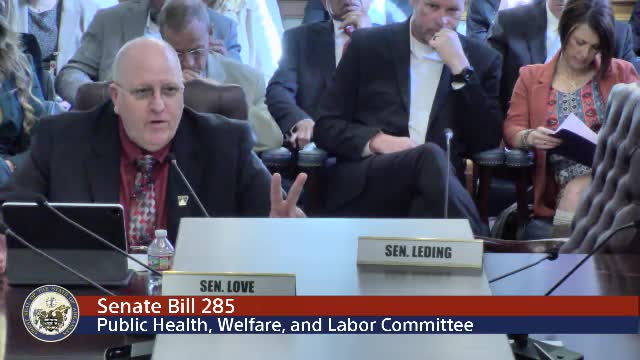
• SB 285 — Maximum benefit and replacement-rate change: SB 285 would raise the maximum average‑weekly‑wage base used in many workers’ compensation calculations and increase the replacement rate from 66 2/3 percent to 70 percent. Supporters, including injured‑worker advocates and some claimants who testified, said higher‑wage employees and professionals — for example, police officers and nurses — receive payments that are far below their normal take‑home pay and that the 66 2/3 cap is increasingly inadequate. Opponents — including the Arkansas State Chamber of Commerce and the Arkansas Self Insured Association — warned that the bill would materially increase insurance costs and cited NCCI (National Council on Compensation Insurance) analyses that projected notable rate impacts. Committee discussion focused on stated tradeoffs between improving income replacement fairness for higher‑paid workers and employer premium impacts. The committee voted to pass SB 285 by voice vote and a subsequent roll call procedure during which members’ positions were recorded.
• SB 286 — Scheduled injury valuation flexibility: SB 286 would permit the Workers’ Compensation Commission to adjust scheduled‑injury awards to account for circumstances where a listed impairment has an outsized effect on a worker’s ability to return to their former job (for example, a one‑eyed worker in a career that requires excellent binocular vision). Supporters said the change gives adjudicators discretion to fairly address durable, career‑ending consequences of certain impairments. Opponents expressed concern over introducing variability into a schedule designed to standardize awards; the committee moved the bill forward.
Opposition, fiscal concerns and agencies’ input
Business groups — represented in testimony by Carol Worley (legislative chair, Arkansas Self Insured Association) and Randy Zook (president, Arkansas State Chamber of Commerce) — said the bills would increase employers’ costs and cited industry studies and NCCI preliminary analyses that indicated substantial potential premium impacts (NCCI figures were discussed in testimony as showing an estimated direct impact up to about 9.9% for certain bills and other impacts summarized as 4.4–5.8% in different analyses). Employers noted Arkansas’ current standing among states for competitively low workers’ compensation premiums and cautioned against moving to higher statutory caps that could affect economic development decisions.
The chairman of the Arkansas Workers’ Compensation Commission, Dale Douthat, testified that the commission had requested financial‑impact studies from NCCI and that adoption of the bills would likely increase costs to employers, raise litigation, and potentially require additional staff at the commission. Douthat said the commission was willing to participate in joint, negotiated solutions between labor and management and had previously convened forums to try to find compromises.
Claimant‑side testimony and examples
Attorneys and injured‑worker advocates argued the bills would correct imbalances. Attorney Jason Hatfield urged the panel to permit more equitable access to specialists; claimant Steven Keeling offered personal testimony that delays and coverage denials left him without recommended surgery for 17 months. Attorney Eddie Walker, who described decades representing injured workers and serving as a former workers’ compensation judge, supported several measures to restore benefit levels and argued Arkansas’ prior reforms (Act 7 96 in 1993) had shifted the balance too far toward employers.
Committee action and next steps
The committee adopted motions to pass the bills discussed on the workers’ compensation agenda. Sponsors and the commission chair discussed obtaining and circulating more complete NCCI financial impact studies for the individual bills; the chairman of the commission said he had requested expedited analyses and would provide them to the committee when ready. Several members asked for follow‑up fiscal information and encouraged stakeholders to convene jointly to negotiate potential compromise language. The transcript records committee passage of SB 288 and SB 285 (voice votes and follow‑up roll calls), and SB 286 also passed. A related bill on attorney fees (filed as a separate item) was discussed and then pulled for amendment and further work; the sponsor asked to pull it down for revision rather than proceed to a final vote in the hearing.
Why it matters: The bills shift legal and financial parameters of Arkansas’ workers’ compensation system, with direct effects on injured workers’ income replacement, employers’ premium costs, and the administrative workload at the Workers’ Compensation Commission. Committee members asked for NCCI impact studies and urged joint negotiations among stakeholders before broader floor action.