Get Full Government Meeting Transcripts, Videos, & Alerts Forever!
Get email alerts on the Prior Authorization Transparency topic
No spam. Unsubscribe anytime.
House committee approves Prior Authorization Transparency bill, adds enforcement fund
Summary
The House Insurance & Commerce Committee passed legislation to clarify prior-authorization rules, create a fund for enforcement, and define what counts as prior authorization. The bill creates penalties that would feed a new enforcement fund and tightens definitions used by payers and providers.
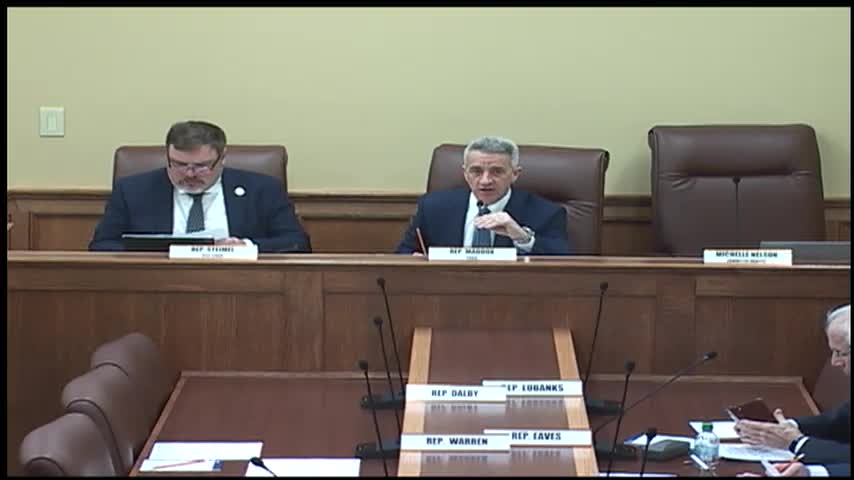
The Arkansas House Insurance & Commerce Committee on Tuesday voted to pass House Bill 1300, the Prior Authorization Transparency Act as amended, sending the bill to the full House.
The bill clarifies which administrative processes count as “prior authorization,” creates a prior-authorization transparency fund to pay for enforcement, and authorizes civil fines that will feed that fund. Representative Lee Johnson, sponsor of the amended bill, told the committee the fund is intended to “allow AID to have a funding source for some of the enforcement around these issues.”
Johnson said the measure also standardizes terminology. “We’re clarifying the definition of prior authorization,” he told the committee, pointing to a list of terms on page 3 the amendment treats as synonyms for prior authorization, including pre-admission review, pre-treatment review and pre-certification. Johnson said the bill is the product of extended negotiation with both payers and providers and that he will continue to work on it in the Senate if more amendments are needed.
When Representative Eaves asked how the new fund would be financed, Johnson replied, “It’d be funded through fines as related to prior authorization.” He and other supporters indicated that payers had resisted fines in negotiations but accepted penalties as a component of enforcement.
Committee members asked for more detail about expected revenue; Johnson said AID would be better positioned to estimate likely fine amounts. Representative Lanstrom asked for the “three big points” of the bill; Johnson summarized them as (1) creating a fund to pay for enforcement, (2) clarifying the statutory definition of prior authorization, and (3) resolving miscellaneous implementation questions that surfaced after prior sessions.
There were no public opponents present at the committee hearing. Representative Eaves made the motion to pass as amended; committee voice vote was recorded as “aye” and the chair declared the bill passed by the committee. Johnson said he had agreed to continue negotiating technical language once the bill reaches the Senate.
The bill now moves toward additional consideration in the legislature; sponsors said they expect further, post-passage negotiations on implementing rules and enforcement details.