Get Full Government Meeting Transcripts, Videos, & Alerts Forever!
Get email alerts on the Accounting Licensure topic
No spam. Unsubscribe anytime.
Committee hears bill to align Alaska CPA licensure and firm mobility with national practice
Summary
House Bill 121 would remove the statutory 150-credit-hour barrier (the extra 30 credits beyond a typical 120-credit bachelor's degree) for CPA licensure and extend practice-privilege mobility to out-of-state accounting firms; supporters say the changes reduce barriers to the profession without weakening oversight.
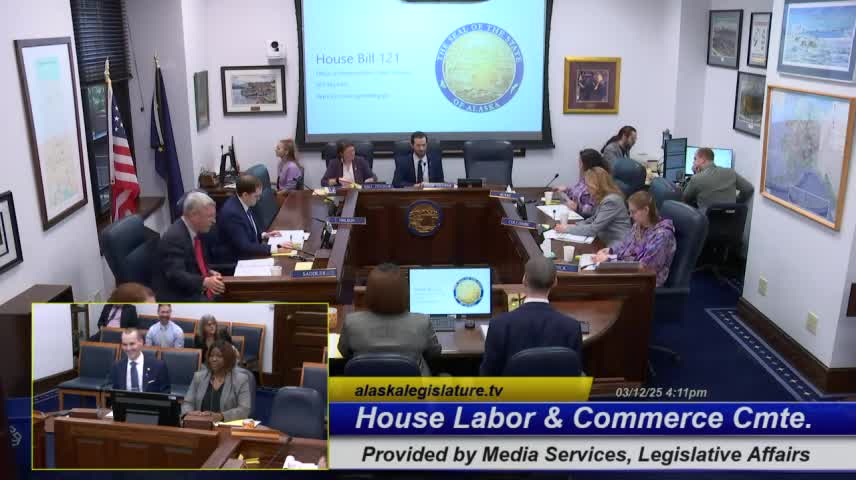
Rep. Calvin Tragi and legislative staff presented House Bill 121 to the House Labor and Commerce Committee, saying the bill would modernize Alaska's CPA licensure requirements and align firm mobility rules with national practice. "HB 121 aims to address these issues by aligning our laws with national standards," Amanda Endemo, staff for Representative Schrage (presenting HB 121), told the committee.
The education change: currently Alaska statute requires a total of 150 credit hours for CPA licensure (the typical bachelor's degree is 120 credits plus an extra year or credits). Testimony from the profession described that the additional 30 credit requirement can create barriers without demonstrable public-protection benefits. "Those additional 30 credits do not have to be accounting or even in business. They could be 30 credits of underwater basket weaving, and that would meet the hundred and 50 credit hour requirement," Beth Stewart, chair of the State Board of Accountancy and managing partner at KPMG Anchorage, told the committee.
Practice privilege and firm mobility: the bill also would update statutes so out-of-state CPA firms may provide services in Alaska under the same mobility framework that already applies to individual licensees, reducing duplicative administrative burden while maintaining board oversight. Tom Neal, chair of the Uniform Accountancy Act committee, said the proposed language "does not diminish in any way the public protection provisions that are contained in existing statute and rule for the state."
Support and rationale: the Alaska Society of CPAs and the State Board of Accountancy provided letters and invited testimony in support, arguing workforce shortages and fewer CPA exam candidates nationally motivate modernization. Supporters said the bill preserves essential requirements—passing the Uniform CPA Exam and relevant professional experience—while removing a non-specific 30-credit barrier that can extend candidate schooling by a year.
Questions: lawmakers asked whether a bachelor’s degree plus the removed credit requirement would allow someone to practice immediately; witnesses clarified a candidate must still pass the CPA exam and meet experience requirements before providing services independently. The sponsor said the bill’s effective date allows time for any needed regulatory changes and implementation details.
Ending: supporters said HB 121 expands the pipeline of qualified accountants for Alaska businesses while retaining professional oversight; no committee vote was recorded and staff circulated an available zero fiscal note.