Get Full Government Meeting Transcripts, Videos, & Alerts Forever!
Get email alerts on the Unemployment Insurance topic
No spam. Unsubscribe anytime.
Labor department outlines healthy unemployment trust fund, urges options to align statute with current costs
Summary
The Department of Labor and Workforce Development briefed the committee on unemployment insurance (UI) finances, showing revenues now far exceed benefits paid, producing a trust fund balance well above statutory targets and prompting discussion of possible legislative levers to rebalance funding or benefits.
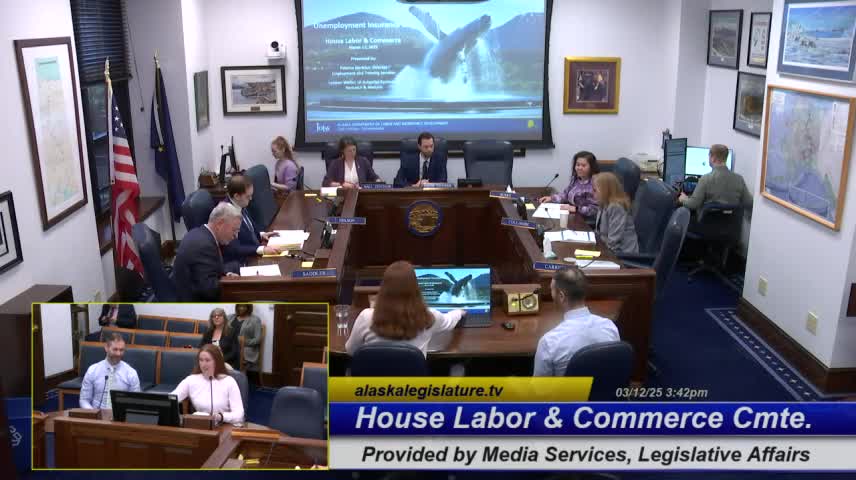
Paloma Harbor, director of the Division of Employment and Training, and Lennon Weller, the Department economist and UI actuary, presented a detailed briefing to the House Labor and Commerce Committee on the unemployment insurance trust fund and its financing. Harbor opened by explaining federal compliance obligations and how FUTA affects employer costs: "Employers in every state pay federal unemployment tax act or FUTA taxes on the first 7000 dollars of wages to each of their employees... as long as we maintain a federally compliant system, that cost is reduced to a maximum of $42 per employee," she said.
Weller then showed long-term trends in benefit costs and contributions and argued Alaska's statutory parameters have not kept pace with recent low claim experience. "When costs become exceptionally low, the parameters currently existing in statute just don't allow us to lower rates to meet the costs that we're actually facing," Weller told the committee, noting the statutory structure has limited ability to relieve accumulated reserves when claim levels are unusually low.
Key numbers presented: department staff said fiscal year 2024 revenue into the UI trust fund was $165,900,000 and benefit payouts were $45,300,000. As of Sept. 30, 2024, the trust fund balance was reported at $724,400,000, a reserve ratio of 4.44% of covered wages—about $186,200,000 above the department's target reserve ratio of 3.33% (the statutory target used historically). Harbor and Weller said the system currently collects far more than benefit costs and suggested several statutory levers could be used to rebalance: increase benefit levels, divert or change the share of employee-contributed funds (which currently partially fund training programs), or lower employer statutory minimum tax rates.
Training and contributions: Harbor explained Alaska is one of the states where employees contribute to the UI financing and a portion of the employee contribution funds two training programs. Testimony described the distribution as: "The employee minimum tax rate is 0.5% of taxable wages. Of that 0.1% goes to the state training employment program (STEP) and 0.25% goes to the technical and vocational education program (TVET)." Later in questions staff and the economist clarified aspects of the employee share and noted the department was operating at statutory minimum employer rates that still bring in substantial revenue because claimant counts are historically low.
Questions from lawmakers included whether benefits are intended to guarantee subsistence, when benefit maxima and dependent allowances were last adjusted (department staff said the benefit schedule last took effect in 2009 and the dependent allowance was increased to $24 in 1983 after first being implemented in 1979) and what reserve ratio is considered fully solvent (the department cited a target reserve ratio of 33.3% of covered wages historically used as a full solvency target). Committee members discussed using committee bill authority to propose statutory adjustments; the committee indicated it will draft a committee bill to explore targeted changes including workforce supports and UI stability.
Ending: the department urged caution because federal compliance is required to preserve employers' reduced FUTA credits; staff said changing statutory funding or benefit parameters could shift costs between employers and employees or trigger solvency adjustments in later years. The committee said it will pursue a committee bill and asked members to bring ideas on how to use excess reserves to support workforce goals without violating federal requirements.