Get Full Government Meeting Transcripts, Videos, & Alerts Forever!
Get email alerts on the Permanent Fund Eligibility topic
No spam. Unsubscribe anytime.
House committee hears bill to clarify PFD absences, add fingerprinting and privacy for applicants
Summary
Rep. Jeremy Bynum told the House Labor and Commerce Committee that HB 75 would close a gap in law so merchant mariner training counts as an allowable absence for Permanent Fund Dividend eligibility, while adding fingerprint-based background checks, confidentiality for applicant lists and an optional electronic levy notice.
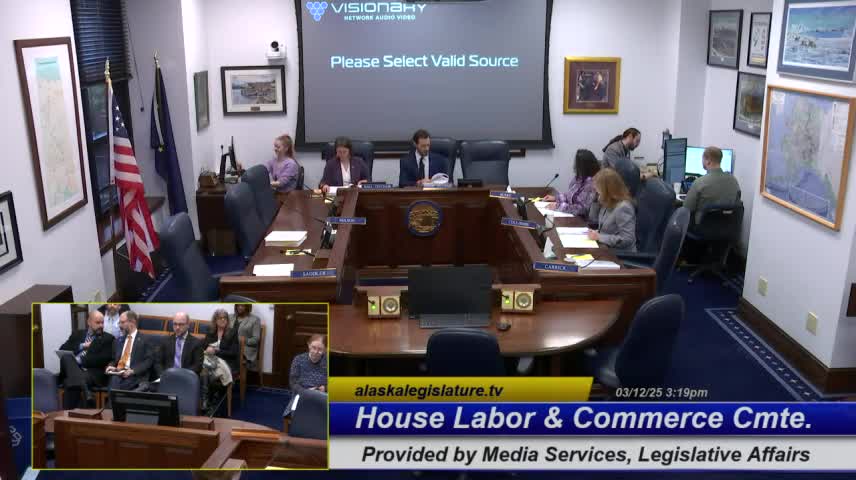
Rep. Jeremy Bynum introduced House Bill 75 on behalf of the sponsor and told the House Labor and Commerce Committee the bill would fix a gap in law so time spent at U.S. merchant marine training counts the same as college attendance for Permanent Fund Dividend (PFD) eligibility. "Ultimately, this legislation corrects a gap in the law ensuring that time spent in The US merchant marine program is treated the same as college attendance," Bynum said during the committee hearing.
The bill also clarifies the definition of covered service by amending a prior "armed forces" reference to "uniform services," a change carried forward from a prior State Affairs amendment. "That change actually occurred in State Affairs to change the armed services to uniform services," staff described, saying the intent is to include the Coast Guard, NOAA Commissioned Corps and Public Health Service alongside the other uniformed services.
Why it matters: committee members and invited testifiers said the bill aims to preserve career pathways for Alaskans and avoid unintended PFD ineligibility when training or emergencies take them out of state. Kari Noor of the Alaska Chamber supported the bill and said merchant mariner apprenticeships recruit and train Alaskans for maritime careers: "Denying PFD benefits to Alaskans, particularly the younger Alaskans while engaged in this required training discourages them from considering this pathway as a career opportunity," Noor testified.
Substance and protections: staff told the committee HB 75 would explicitly allow merchant mariner academy training to qualify as an allowable absence under existing statute that already covers individuals "serving under foreign or coastal articles of employment aboard an ocean going vessel of the United States merchant marine." The bill does not expand eligibility for unrelated out-of-state voluntary activities, staff said, but clarifies that necessary training leading to such service should be treated the same as other postsecondary or vocational attendance.
Administrative and fraud-prevention measures: Genevieve Watusik, director of the Permanent Fund Dividend Division, described operational changes the bill would require. "Currently, we do not background check. We would start the process if you approved it. We would take 6 months to develop regulations and we would, through those regulations, decide which crimes would be allowed versus not," Watusik said, describing a regulatory timeline rather than an immediate personnel action. The bill would require fingerprint-based FBI background checks for PFD division employees who handle sensitive personal data and would make the PFD applicant list confidential to reduce identity-theft risk. It would also allow applicants to opt in to receiving electronic levy notices.
Concerns and follow-up: several committee members pressed for clarity on the switch to "uniform services." Representative Nelson and Representative Sadler said they were concerned the broader phrasing might sweep in personnel whose service is not involuntary and asked whether NOAA and Public Health Service personnel should be treated the same as armed forces. Staff said the change came from the State Affairs Committee and that the estimated net number of additional people covered by the change is small—"less than 50," staff said—while acknowledging the committee could refine the definition.
Next steps: the committee held the first hearing and invited additional questions and possible amendments. Sponsors said they expect to work with committee members on targeted refinements.
Ending: supporters said the bill is intended as a statutory cleanup to protect training pipelines and tighten division security and privacy; opponents or skeptical members asked for precise definition language and cautioned against incremental expansions of PFD exemptions without clear statutory limits.