Get Full Government Meeting Transcripts, Videos, & Alerts Forever!
Get email alerts on the Education Ansip topic
No spam. Unsubscribe anytime.
Dozens of Alaskans urge House Finance to restore full funding for ANSEP Acceleration Academy
Summary
Multiple parents, students, alumni and staff told the House Finance Committee they rely on ANSEP(ANSIP) and urged lawmakers to restore the program's proposed base-budget cuts, citing student outcomes, college credits earned in high school and workforce benefits.
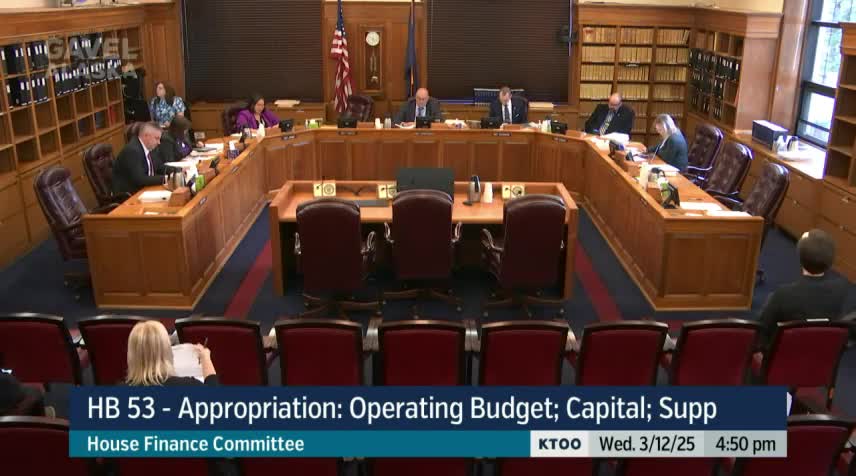
Dozens of parents, students, alumni and staff told the Alaska House Finance Committee on March 12 that cuts to the Alaska Native Science and Engineering Program(ANSEP) Acceleration Academy would harm students and the state—s workforce pipeline.
ANSEP founder Dr. Herb Schroeder, an engineering professor at the University of Alaska Anchorage, told the committee the program serves more than 3,000 students statewide and "ANSEP students can go from eighth grade to a BS degree in 6 years or less." He urged the committee to maintain the program—s requested budget so it can continue its statewide acceleration and college-enrollment work.
Committee members heard repeated accounts of students graduating high school with significant college credit and families saving money because of dual-enrollment. "By the end of the semester, I will have accrued 140 credits toward my degree in electrical engineering," said Ethan Johnson, a junior who testified that he will enter the workforce with a degree and professional experience sooner than typical graduates.
Alumni and staff described the program as a combination of college instruction, cohort-based supports, tutoring and career exploration that is not readily available in many Alaska school districts. "Our students start college as early as eighth or ninth grade and complete an average of over 60 college credits by high school graduation," said Jack McCaslin, student success specialist at the ANSEP Acceleration Academy in Anchorage.
Several speakers, including parents Patrick Stanley and Elizabeth Spangler, highlighted workforce needs in Alaska and said ANSEP helps retain students in-state and prepare them for jobs in engineering, health care and aviation. Samuel Gebbert, an ANSEP alumnus and current staff member, said the program produced an exceptional rate of college completion and that a proposed ~20% reduction to base funding would threaten the program—s reach and its ability to serve rural cohorts.
Students who testified described both academic and nonacademic benefits: cohort belonging, time-management skills, and exposure to career options. "This program doesn't just help with academics. It helps students believe in themselves and their potential," said Rhoda Joel, a parent who called in from Anchorage.
Speakers noted federal funding uncertainty and prior federal grants that have declined; several asked the committee to avoid further reducing the state contribution as federal dollars contract. Committee members did not take action during the hearing; public testimony was recorded for the operating budget (HB 53).
The committee will consider ANSEP funding as it finalizes the House operating budget; several testifiers said reductions would be felt across Anchorage, Mat-Su, Bethel, Kotzebue and other regional academies.