Get Full Government Meeting Transcripts, Videos, & Alerts Forever!
Get email alerts on the Land Partition Natural Resources topic
No spam. Unsubscribe anytime.
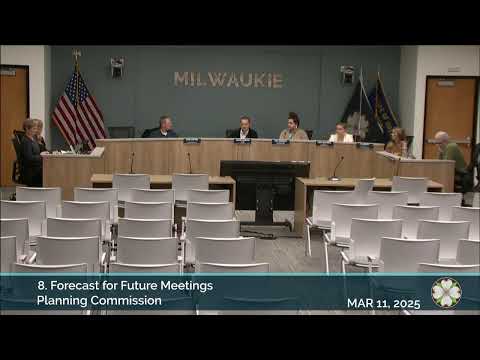
Milwaukie planning commission approves partition and conservation easement for 9201 SE McLaughlin Blvd.
Summary
The Milwaukie Planning Commission unanimously approved a minor land partition (MLP-2025-001) that splits a developed site along Johnson Creek and protects mapped natural-resource areas via a perpetual restricted development easement instead of creating a separate unbuildable tract.
The Milwaukie Planning Commission on Tuesday approved application MLP-2025-001, allowing a minor land partition at 9201 Southeast McLaughlin Boulevard that will divide the 14.5-acre site along Johnson Creek and place mapped natural-resource areas under a perpetual restricted development easement rather than creating a separate unbuildable tract.
The move, approved unanimously, resolves ownership for buildings on the site: if recorded the partition would give Clackamas County ownership of the roughly 10.9-acre parcel west of Johnson Creek, where the county’s community corrections facilities are located, rather than the county continuing to lease that land from the Oregon Liquor and Cannabis Commission (OLCC).
Staff said the site is already developed with OLCC offices, warehouse and distribution facilities east of Johnson Creek and county community corrections facilities to the west, and that no new development, changes to circulation or vegetation removal are proposed as part of the partition. Senior planner Vera Colley told commissioners the city code (see cited sections below) ordinarily requires mapped water-quality resource areas to be placed in a separate unbuildable tract with a conservation restriction; the applicant instead proposed a restricted development area secured by a perpetual easement that follows the mapped water-quality resource (WQR) and habitat conservation area (HCA) boundaries.
Colley said the restricted-easement approach would “accomplish the same level of protection that a separate tract would have, without the complication” of creating a third-party owner or entity to hold and manage a separate tract when the parcel is already developed and occupied. The staff report recommends approval subject to findings and conditions of approval.
The applicant team, represented by Ben Blessing of Gladstone and county assistant counsel Jeff Munns, said their transfer agreement with OLCC includes deed restrictions and a reversionary clause to ensure the site continues to be used for the same purposes in place since the late 1970s — community corrections, law enforcement, substance-abuse rehabilitation, behavioral health and social services. Munns described that deed restriction as an added assurance that the county’s uses will continue.
During deliberations commissioners emphasized protection of natural resources and agreed the restricted-easement approach would avoid administrative and operational burdens of a separate tract while delivering equivalent protections. Vice Chair Joseph Edge led the deliberation and moved to approve the application; Commissioner Lisa Gratrick seconded. A roll-call vote recorded ayes from Commissioners Ryan Louder, Penick, Gratrick, Vice Chair Edge and Chair Jacob Sherman; the motion passed unanimously.
The commission’s approval covers three components considered together: (1) the minor land partition, (2) the natural-resources review to address mapped WQR and HCA areas, and (3) a variance from the code requirement to place mapped resource areas in a separate unbuildable tract. Colley noted the application included an alternatives analysis and impact evaluation as required by the variance criteria.
No members of the public testified and no written correspondence had been received by staff. The planning commission closed the public hearing before deliberations. Staff advised that any future development proposals on either resulting parcel would still be subject to the city’s code and the restricted easement.
The decision is subject to appeal to the Milwaukie City Council; anyone wishing to appeal must file within 15 days of the mailing of the notice of decision.
Authorities cited in the hearing included specific chapters and sections of the city code that staff read into the record and relied on in the findings (listed below). The staff report and conditions of approval provided the factual basis for the commission’s findings.
Ending: The commission approved application MLP-2025-001; staff will mail the notice of decision and information about the 15-day appeal period to parties of record.