Get Full Government Meeting Transcripts, Videos, & Alerts Forever!
Get email alerts on the School Finance topic
No spam. Unsubscribe anytime.
Pasco School District reviews multi-year bond scenarios aimed at stabilizing tax rate
Summary
At a study session, district leaders heard from Trevor Carlson of Piper Sandler on bond and levy mechanics and scenarios that would raise between $600 million and $800 million in phased authorizations while attempting to hold or reduce the district tax rate under specific assessed-value and interest-rate assumptions.
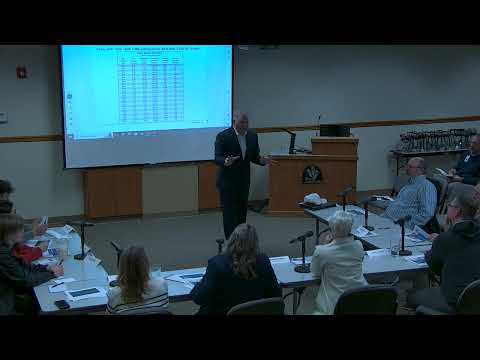
Trevor Carlson of Piper Sandler presented bond and levy planning scenarios to the Pasco School District board at a study session, outlining how the district could finance large-scale school construction and maintenance while aiming to keep the local tax rate steady.
Carlson told board members the presentation was intended as “a learning session” and laid out election timing, historical passage rates, statutory limits and four modeled financing scenarios. He said the district’s assessed value (the total tax base) and voter thresholds would be key to whether voters see a flat or rising tax rate under each plan.
The presentation matters because the district is planning long-term facility work to address growth and aging buildings, and the board will decide how much to ask voters to authorize and when. Carlson warned that the structure of borrowing, assessed-value growth and interest-rate assumptions together determine annual tax bills and total borrowing costs.
Carlson reviewed procedural items and empirical data: four possible election dates each year (February, April, August, November), historical passage rates for bonds and levies across Washington state and the special validation requirement for bond elections (a 40% turnout validation tied to the last general election). He said operating levies have generally had higher passage rates than bond measures and noted pending legislative proposals to reduce the bond-approval threshold from 60% to 55% or 50% (he cited the 50% scenario as an illustrative data exercise).
He summarized statutory debt-capacity math for the district, citing the district’s total assessed value at roughly $15.6 billion and discussing how capacity changes when assessed value rises or existing debt is retired. Carlson also described credit-rating drivers: enrollment trends and the general-fund balance are primary considerations for rating agencies; assessed-value growth and local economic activity are also important. He noted the district can access the state’s School Bond Guarantee Program and said district bonds have benefited from strong underlying ratings.
On scenarios, Carlson described four modeled authorizations that would total $600 million delivered as four equal authorizations (each $150 million) sold in successive cycles (presented as 2028, 2032, 2036 and 2040) under an assumed assessed-value growth rate (4.5% in his baseline). In that baseline the modeled total tax rate over time would remain at or slightly below current levels (he gave a current aggregate tax-rate example near $3.92 per $1,000 of assessed value and showed modeled decreases to about $3.82 or $3.44 under faster assessed-value growth). He also presented an $800 million scenario (four $200 million authorizations) and sensitivity runs using higher and lower assessed-value growth assumptions. Carlson emphasized that these are planning-level scenarios that depend on future assessed-value performance, interest rates and voter approval.
Carlson also covered technical financing points: interest-rate contingencies (planning with a cushion above current market yields), optional redemption and refinancing windows on outstanding bonds, the district’s outstanding UTGO (unlimited-tax general obligation) bonds and a rule of thumb that refinancing becomes attractive if estimated savings exceed roughly 4% of refunded principal. He named Foster Garvey as long-standing bond counsel and reminded the board that tax-law, federal securities law and state law intersect in school financings.
Superintendent Michelle Whitney thanked Carlson and praised his longstanding support for the district, saying: “Whenever we ask Trevor for something, the answer is always yes, even when it's inconvenient for him and his staff.” Director Phillips also commended the clarity of the presentation.
For next steps, Carlson and district staff said the Long Term Facilities team will meet to map specific schools and projects onto the draft authorization schedules (the 150/150/150/150 and 200/200/200/200 templates). The superintendent said she expects the facilities committee to produce packages the board can review and that she plans to return to the board with three prioritized plans at the next board presentation (the presenter used the phrase “come back to you on the 20 fifth” and also said committee results may be available “as early as March 25”). The board will then take the packages to community outreach for feedback.
Board discussion during the session raised several constraints and clarifications Carlson flagged as important: the district’s statutory borrowing limit is a function of assessed value and existing debt; bond approval requires a 60% yes vote plus a validation threshold in many instances; operating-levy rules changed after the McCleary decision and subsequent constitutional changes affecting levy lids; and that credit-rating agencies focus on enrollment trends and fund balance when assessing districts.
The study session did not include any formal motions or votes. District staff and Carlson framed the materials as preparatory: the board will use the scenarios to refine scope, timing and expenditure priorities before any resolution is adopted or an election is scheduled.
Board members and staff said they would return with detailed, 11-by-17 project-to-authorization maps and that the district will engage the community to test the priorities and likely ballot timing. The presentation materials and the four scenarios will form the basis of the Long Term Facilities Committee’s upcoming meetings and the board’s next substantive review.