Get Full Government Meeting Transcripts, Videos, & Alerts Forever!
Get email alerts on the Educational Audiology topic
No spam. Unsubscribe anytime.
Educational audiologist outlines services, caseload growth and role under IDEA
Summary
Here 2 Learn presented on educational audiology services delivered in partnership with Manchester School District, including evaluations, hearing assistive technology (HAT) fitting, teacher/student training, and cataloging of equipment; presenters noted the work is a required related service under IDEA.
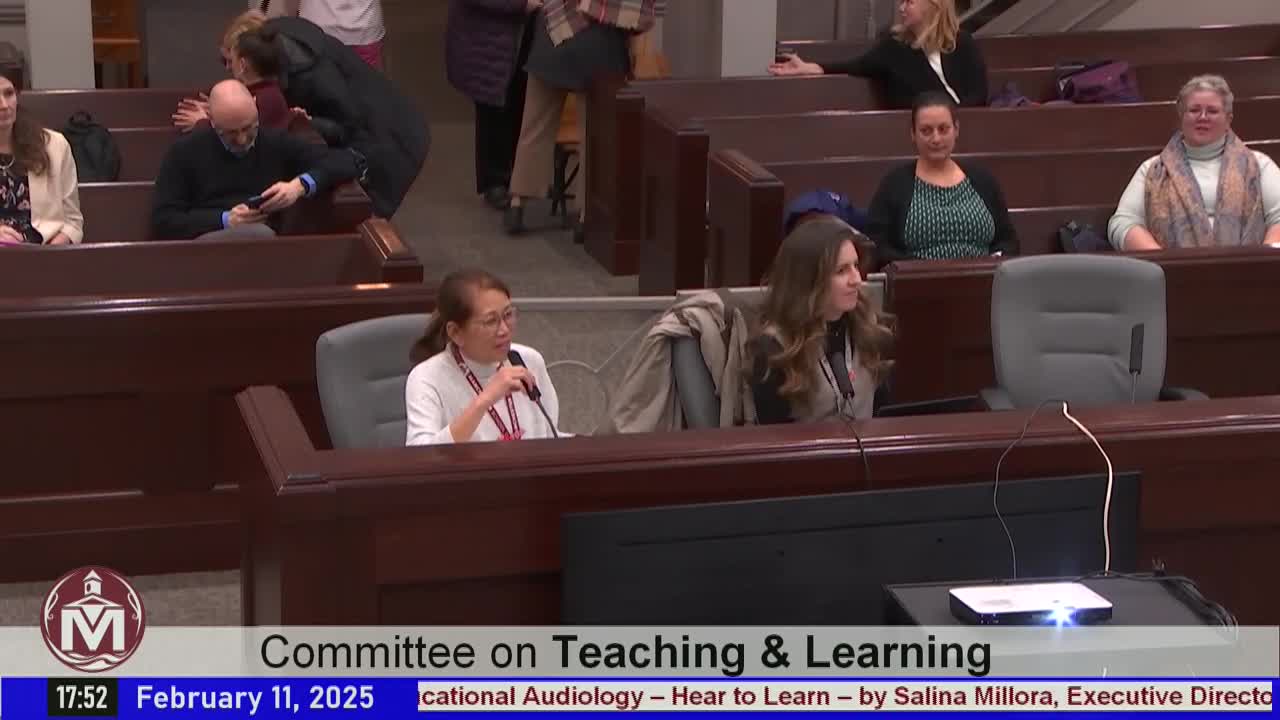
Dr. Rachel Parkington, owner and lead educational audiologist for Here 2 Learn, presented an educational audiology update to the Manchester School District Teaching and Learning Committee on Feb. 11, explaining the provider’s role in supporting students with hearing and listening needs and summarizing the partnership with the district since 2015.
Parkington described services Here 2 Learn provides: in-district comprehensive evaluations where clinical access is limited, fitting and verification of hearing assistive technology (HAT), teacher and student training on device use, and management of a district equipment inventory. She said educational audiologists are uniquely positioned to recommend and fit HAT because they understand the classroom learning environment; that task, she said, is outside the usual scope of classroom teachers.
As of early 2025, Parkington said Here 2 Learn’s Manchester caseload had grown from eight students in 2015 to 77 students and that the program manages more than 235 pieces of equipment. She emphasized that audiology is listed as a related service under the Individuals with Disabilities Education Act (IDEA) alongside speech-language and occupational therapy, and said districts cannot decline to provide audiology services because of provider type.
Parkington gave classroom examples to underline the importance of training: teachers sometimes did not wear microphones properly or did not mute microphones, degrading the signal for students who rely on HAT. She said teacher and student training are essential to ensure devices actually improve the signal-to-noise ratio and provide equitable access to instruction.
Committee members and visitors thanked the presenter and reinforced the distinction between clinical audiology (diagnosis and device fitting in clinics) and educational audiology (classroom-focused support and device verification). One committee member asked how the U.S. Department of Education categorizes audiology; Parkington replied that audiology services are covered under IDEA and thus are required related services.
Ending: The committee heard the presentation and affirmed the district partnership with Here 2 Learn; committee members urged continued coordination between clinical and educational audiologists to ensure students receive functional supports in classrooms.