Get Full Government Meeting Transcripts, Videos, & Alerts Forever!
Get email alerts on the School Budget topic
No spam. Unsubscribe anytime.
Manchester panel advances tax-cap–compliant FY26 budget after district presentation
Summary
The Manchester School District presented a tax-cap–compliant FY2026 budget that relies on a 4.27% tax-cap increase and $4.5 million from expendable trusts. The finance committee voted to move the general fund, school food and nutrition, and capital improvement budgets to the full Board of School Committee for final approval.
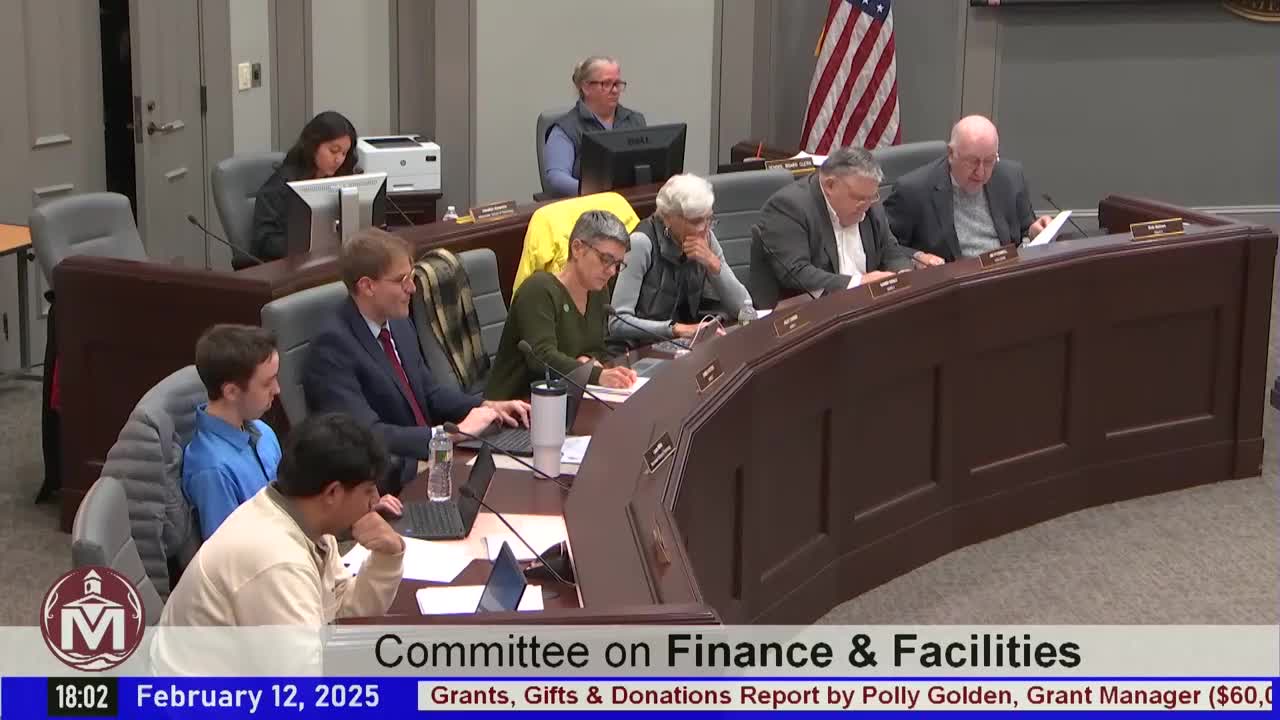
The Manchester School District finance committee on the evening of the meeting reviewed the district's tax-cap–compliant budget for fiscal year 2026 and voted to forward the general fund, school food and nutrition and capital improvement budgets to the full Board of School Committee for approval.
Superintendent (title listed in the meeting as Superintendent) opened the presentation by outlining the budget's enrollment assumption and strategic priorities. "The budget we are presenting this evening is designed with an enrollment of approximately 11,865 students," the superintendent said during the presentation.
Karen DeFrancis, executive director of finance, walked the committee through the tax-cap calculation provided by the city finance director and the revenue and expenditure projections. DeFrancis said the three-year Consumer Price Index average produced a tax-cap figure of 4.27% for FY26 and that applying that cap to current tax collections would yield about $5.14 million in additional revenue. "That would bring the fiscal year 26 tax cap compliant budget to $246,050,206," DeFrancis said.
Nut graf: The budget package presented is designed to remain within the state-local tax cap while absorbing planned salary increases, restoring positions funded temporarily by federal ESSER grants, and funding capital priorities. It relies on a mix of recurring revenue increases (notably state adequacy aid) and one-time uses of expendable trusts.
DeFrancis explained revenues and major drivers of the $11.5 million net increase the district proposes for FY26: approximately $5.1 million from the local tax cap increase, an estimated $6.4 million in other revenue increases (including an estimated per-pupil adequacy aid increase and extraordinary needs grants), and offsets including reduced one-time funding draws. The presentation notes the district's adequacy aid estimate for FY26 was $108,192,796 (an increase from the FY25 estimate of roughly $96.5 million), but DeFrancis cautioned those state estimates are based on October 1 enrollment and could change after the final counts.
On expenditures, the budget primarily funds existing positions and contractual salary increases. DeFrancis said the salary line increases by $10.7 million overall, reflecting cost-of-living adjustments, step increases, longevity pay, replacement of retirements and vacancies, and the reclassification of certain positions (notably bus drivers and newly hired registered behavior technicians) from contracted services to district salary lines. She said benefit costs were modeled with a 7% health-insurance increase and noted pension costs rose because of higher total payroll.
Committee members asked for detail on the use of expendable trusts. DeFrancis said the district closed FY24 with roughly $28.6 million in expendable trust balances and recommended using $4.5 million from the Teaching and Learning Trust in FY26 (a 50% reduction in planned one-time draws versus the prior year). She said the projected post-transaction balance would be about $22.5 million, representing about 9.5% of the then-current appropriation.
Committee members also discussed class-size policy and per-pupil spending. The superintendent and staff noted average class sizes by grade and that district per-pupil spending (presented as $17,733) remains below the state average cited in the presentation ($21,545). The superintendent framed the budget around three priorities he described as "educational programming, staffing, and learning environments."
The presentation included a review of how ESSER (federal pandemic) funds were used; finance staff provided a summary showing ESSER expenditures on HVAC and other capital projects, staffing, and supports and noted the district spent the bulk of ESSER funds while preserving programmatic gains where possible.
After questions and discussion about fiscal sustainability, bond schedules and trust balances, committee Chair Baines called for a motion. The finance committee voted to approve the tax-cap–compliant general fund budget, the school food and nutrition budget and the capital-improvements budget and to move those budgets to the full Board of School Committee for consideration.
Ending: The full Board of School Committee will receive the recommended FY26 packages for final action as part of the district's statutory appropriation process; the finance committee and staff said they will continue to track enrollment, final state adequacy aid numbers and any late-year state or federal changes that could require an adjustment to appropriations.