Get Full Government Meeting Transcripts, Videos, & Alerts Forever!
Get email alerts on the Attendance Policy topic
No spam. Unsubscribe anytime.
Committee approves updated attendance policy language with rewrite stipulation before full-board review
Summary
After questions about how skipping individual classes is classified and how the district will track and respond to absences, the Teaching and Learning Committee approved revised Instruction 101.1 (attendance) and directed additional clarifying edits before the full Board review.
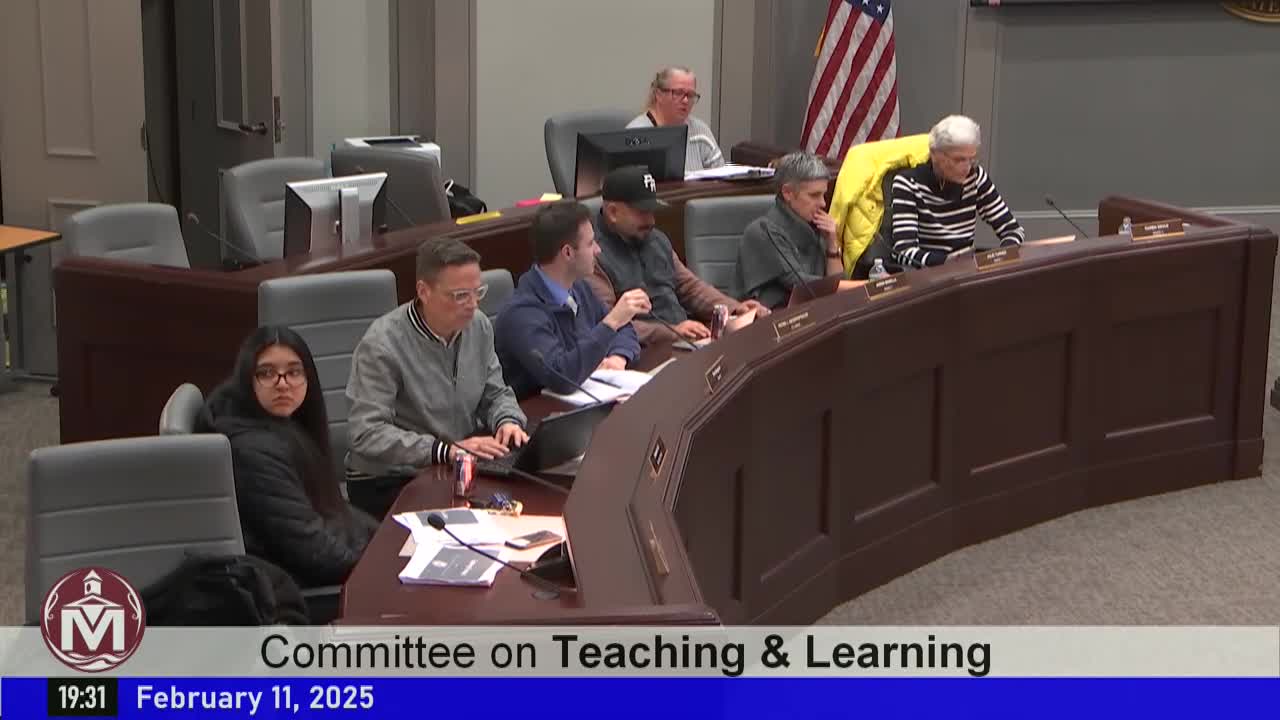
The Manchester School District Teaching and Learning Committee voted Feb. 11 to approve revisions to Instruction 101.1 (attendance) and send the policy to the full School Board with the stipulation that language clarifying how class absences and skipping will be categorized be refined before the full-board packet.
The committee discussion centered on two points: first, how the policy distinguishes excused and unexcused absences and what counts as an “unexcused absence” (for example, a single skipped period versus a full-day absence); and second, how the attendance process ties to mandatory reporting and interventions (letters at 5, 10, 15 and 20 days, home visits and further steps).
Principals and staff described the district’s current attendance follow-up: letters and escalating outreach at five, 10, 15 and 20 days; home visits beginning at 10 days; and referral to child protective services (DCYF) for educational neglect at 15–20 days of unexcused absence. Committee members asked for clearer wording so class-level skipping would not be conflated with full-day truancy in state reports.
Members suggested reorganizing the policy’s examples so items that contribute to state-level truancy reporting are separated from class-level issues that warrant school-level interventions. Committee members also discussed practical classroom consequences: several high school educators said that schools already track skipped classes and typically address them locally with interventions such as after-school make-up time.
Because the committee wanted clearer wording to avoid confusion at the full-board discussion, it approved the policy with the understanding that staff will refine the language (for example, by separating “daily attendance” items that could lead to truancy from “individual class” issues like skipping period C). A motion to approve the policy with those expectations carried by voice vote; no roll-call tally was recorded in the transcript.
Ending: The policy was approved by the committee for submission to the full School Board; staff will revise the draft wording to clearly separate class-level unexcused absences from state-reportable unexcused daily absences and return the revised text with the full-board packet.