Get Full Government Meeting Transcripts, Videos, & Alerts Forever!
Get email alerts on the Grading Policy topic
No spam. Unsubscribe anytime.
Committee approves grading-policy overhaul, forwards revised policy 125 to full board after extended debate
Summary
The Manchester School District Committee on Teaching and Learning voted to forward revisions to Instruction 125 (middle and high school grading) to the full School Board after extended discussion about implementation, equity, and the timeline for related procedures.
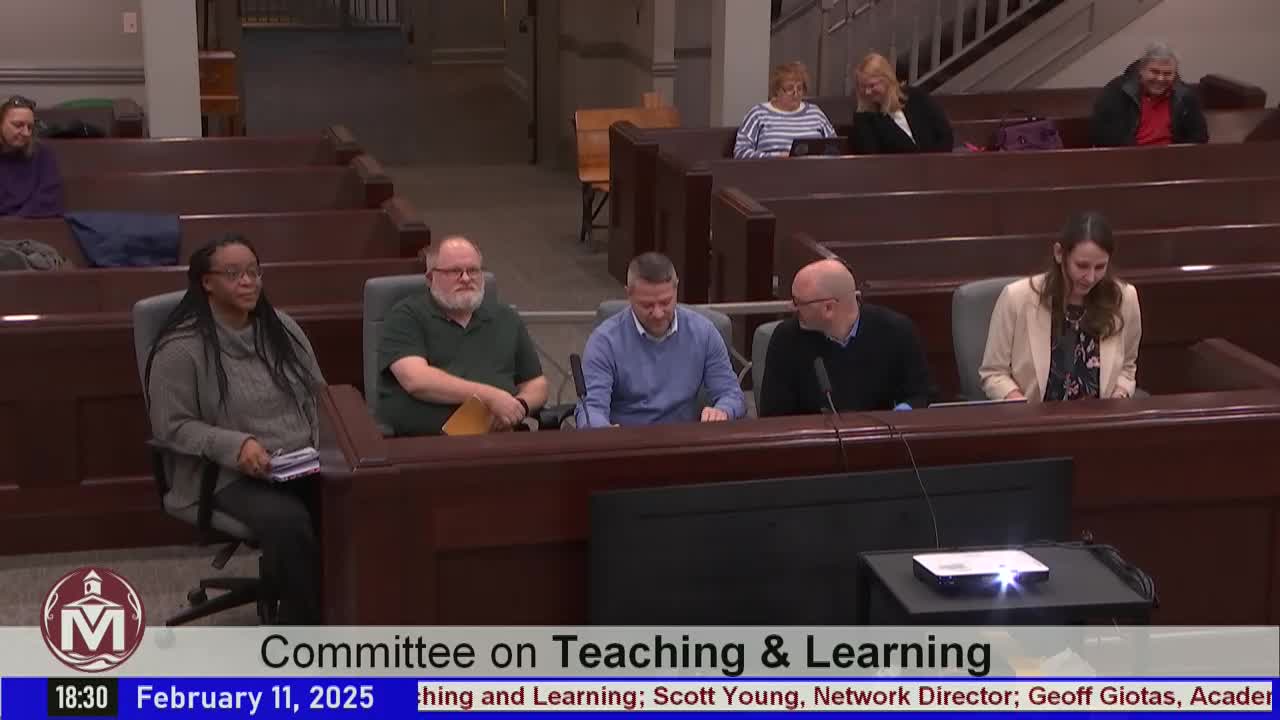
The Manchester School District Committee on Teaching and Learning on Feb. 11 voted to forward proposed revisions to Instruction 125 (middle and high school grading) to the full School Board, following extensive discussion among committee members, building principals, teachers and consultants about how the changes will be implemented.
The committee's revised policy text emphasizes that grades “should only reflect a student's academic performance” and “should not be used as a form of punishment.” The document also lays out six guiding points intended to align grading with standards-based practice, clarifies the separation of academic grades from work habits, and adds a differentiated grading table for Manchester School of Technology (MST) to avoid conflating MST’s competency labels with percentage-based grades used at other high schools.
Committee members said the policy is a “bridge” toward a future competency-based system for the whole district, but several speakers pressed for clearer, district-wide procedures and professional development before changes take effect. Leslie Whitney, executive director of teaching and learning, described the committee's work as “a bridge towards competency-based learning and reporting,” and said the committee will reconvene with Great Schools Partnership (GSP) to write procedures after the policies are approved.
Opponents on the committee did not oppose the policy’s goals but urged caution. Several members said they wanted procedural detail — including how “target due date” and late-submission practices will operate in classrooms — to be finalized and communicated before the changes reach students and families. Teachers and principals present described pilot procedures already in effect for semester 2, and some reported early, positive results: one educator said students “knowing that they're being held accountable even to the 10 days, they're turning things in more on time than they did before.”
The revised policy also removes the district’s NG (no grade) option from policy language and assigns the operational details (definitions of formative vs. summative assessment, procedures for due dates, etc.) to procedure documents and professional learning work. Committee members stressed that the procedures will be developed and rolled out in tandem with professional development for teachers and with a district roadmap that will include student and parent leadership input.
A motion to forward Instruction 125 to the full School Board carried after debate. Committee member Artero moved to forward the policy; Committee member Bergeron seconded; the committee vote was recorded as “Aye” and the motion carried.
The committee set expectations that the grading-and-attendance subcommittee, with GSP support, will draft equitable procedures and professional development plans during the spring and summer so the district can begin the 2025–26 school year with clear guidance.
Looking ahead, committee leaders said they expect a phased, multiyear transition to competency-based reporting across the district, with ongoing review and adjustments based on the practical classroom impact and feedback from staff and families.
Votes at a glance: the committee voted to forward Instruction 125 to the full board for final consideration. No roll-call vote was recorded in the transcript; the motion carried after a voice vote of “Aye.”
Ending: The committee’s vote advances the policy change to the full board and signals a multi-year shift in grading philosophy; members stressed the need for clear procedures, professional development, and a staged rollout to limit disruption to instruction and student supports.