Get Full Government Meeting Transcripts, Videos, & Alerts Forever!
Get email alerts on the State Education Bills topic
No spam. Unsubscribe anytime.
Committee reviews wave of New Hampshire education bills, flags HB 129 and school-choice measures
Summary
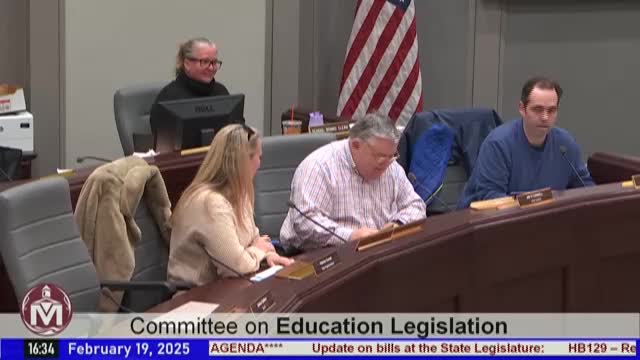
The Manchester School District Education Legislation Committee on Feb. 19 reviewed status updates for a range of education bills at the New Hampshire Legislature, highlighting HB 129, which would narrowly define "evidence-based" instructional methods, and HB 68, a school-choice measure that would require superintendents to approve certain reassignment requests within a district.
The Manchester School District Education Legislation Committee on Feb. 19 reviewed status updates for a range of education bills at the New Hampshire Legislature, highlighting HB 129, which would narrowly define "evidence-based" instructional methods, and HB 68, a school-choice measure that would require superintendents to approve certain reassignment requests within a district.
Committee members began by noting that most bills remain at committee stage but that HB 129 and HB 677 have moved to full House consideration or further fiscal review. The chair said HB 129 "was voted ought to pass by the legislature 203 to 155" in the House and is now in finance for fiscal analysis; HB 677, requiring schools to maintain a supply of epinephrine auto-injectors, moved on a voice vote and was also referred to finance.
Why it matters: HB 129 would direct state and local education authorities to adopt a definition of "evidence-based" that excludes self‑reported surveys and requires reproducibility in well‑designed studies; committee members warned that the change could affect approved trainings and district programs. HB 68 would limit superintendent discretion by requiring approval of many reassignment requests within a district and a written report when a request is denied; committee members said the text leaves open questions about tuition and whether approved private schools would be funded by districts.
Most important items
HB 129 (evidence-based definition). The committee summarized the bill as limiting evidence to objective, reproducible scientific studies and excluding surveys and self‑reported progress. Committee discussion noted administrative and fiscal burdens and disagreement in the House committee (minority report cited concerns about excluding important data and the cost of compliance). One member said transparency requirements in the bill are unclear and that the bill's text does not explicitly exempt curriculum or individual teachers.
HB 68 (school reassignment/school choice). The committee reviewed amendments requiring superintendents to approve reassignment within the public school district unless requirements are unmet; denials trigger a hearing request on "manifest hardship." Members asked whether the bill would obligate districts to pay tuition if parents seek placement at approved private schools; the presenter said intent and funding details were not specified in the posted text.
HB 677 (epinephrine auto-injectors). The bill would require schools to maintain EpiPen injectors for emergencies and provides an appropriation to the state Department of Education for reimbursement. The presenter said finance staff listed the fiscal impact as "indeterminable" in the bill packet but noted the bill anticipates reimbursement to districts.
Funding and program bills
HB 716 (dual enrollment). The bill would appropriate $2.5 million in each of two years to the Community College System of New Hampshire to support scholarships and program costs for dual enrollment; committee members said this would flow to the community college system and could help students who need aid to participate.
HB 671 (kindergarten literacy readiness pilot). The committee reported the bill passed committee unanimously as a pilot focused on early childhood literacy; the bill does not specify pilot locations in the posted text.
Special education and accountability
HB 76 would require the state Department of Education to establish and maintain a tracking system for state special-education complaints and to issue an annual report; the presenter said this places responsibility with the state rather than districts. A related bill, HB 388, proposing quarterly public reporting by superintendents on special-education statistics, failed in committee on concerns about student confidentiality and reporting burden.
Other items noted
- SB 99 (CTE access and regional agreements) passed committee 5-0 and expands access to career and technical education; the committee flagged potential implications in regional agreements and asked for further review. - HB 329 (classroom air and temperature policy) failed in committee (ITL 10-8). - HB 283 (proposed cuts to the adequate education program) received large public outcry and failed in committee (18-0 ITL reported in the discussion). - Several school-choice and voucher-type measures drew substantial public comment; the presenter said the committee record included thousands of opposition entries on some proposals.
Committee response and next steps
Members agreed to continue monitoring bills likely to move forward, particularly HB 129 and HB 68, and considered drafting a letter or inviting outside experts to a future meeting to discuss school choice implications. The chair suggested inviting representatives from the New Hampshire School Boards Association or other state organizations to brief the committee.
Votes at a glance (bills discussed in the meeting and reported status)
- HB 129: "Ought to pass" reported 203-155 in the House; now in finance for fiscal analysis (status: In progress). - HB 677: "Ought to pass" on voice vote; referred to finance (status: In progress). - SB 69: Committee "ought to pass" 5-0 (status: likely to advance). - HB 208: Committee "ought to pass" 10-8 (change to school nurse certification language; amendment removed prior experience requirement). - HB 68: Committee "ought to pass" 10-8 (school reassignment/school choice; amendment added hearing and written-report timelines). - HB 716: Committee "ought to pass"; amendment appropriates $2.5 million in each of two years to community college system (status: In progress). - HB 76: Committee "ought to pass" 10-8 (state tracking of special-education complaints; places requirement at state level). - HB 388: Failed ITL on committee concerns about confidentiality and reporting burden. - HB 329: Failed ITL 10-8 (classroom air/temperature policy). - SB 99: Passed committee 5-0 (CTE access expansion). - HB 283: Failed committee (ITL) after large public opposition.
The committee took no formal votes on positions or letters during the meeting; members directed staff to continue tracking and to consider experts for future discussion before taking any formal action.
Ending: The committee paused discussion after agreeing to monitor the bills and to return with more detail at a subsequent meeting.