Get Full Government Meeting Transcripts, Videos, & Alerts Forever!
Get email alerts on the Student Discipline Data topic
No spam. Unsubscribe anytime.
Committee sees drop in elementary conduct incidents while detention "no‑shows" spike at some schools
Summary
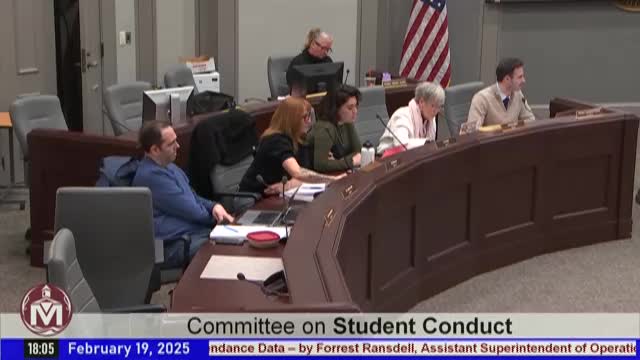
Committee data review on Feb. 19 showed elementary conduct incidents down 36% year‑over‑year, but committee members flagged large percentage increases in “failure to report to detention” at several schools.
The Committee on Student Conduct reviewed monthly conduct comparison data Feb. 19 that showed a 36% year‑over‑year decline in elementary conduct incidents and 1% declines at middle and high school levels.
Committee member Parr raised concerns about sharp percentage increases in the code “failure to report to detention,” noting a 597% increase at West and a 300% increase at Hillside. Rand Stough and other administrators said such percentage increases can result from greater assignment of detentions: when a school assigns many more detentions, the raw count of students who do not attend those detentions can increase even if the underlying rate is unchanged.
Administrators described a progressive system of sanctions: detention is generally a first‑level response, followed by Saturday school, additional detentions or, for repeated noncompliance, suspension. They said escalation can create a “vicious cycle” of multiple missed sanctions if students repeatedly fail to comply. The committee discussed the need for further school‑level review of sample sizes, location and timing codes in Aspen so teams can identify where incidents cluster and design universal or tiered interventions.
Committee members asked whether principals and MTSS teams review the data; administrators confirmed school MTSS teams and building leadership do review conduct data and use it to design supports. Committee members asked district staff to follow up with principals at schools showing larger increases and to ensure schools receive the school‑by‑school data to inform targeted adjustments.
The committee also reviewed district student discipline reporting and asked for clarification on pending student discipline cases; administrators said two high‑school cases were pending superintendent decisions on whether to proceed to board hearings or pursue return‑to‑school plans.