Get Full Government Meeting Transcripts, Videos, & Alerts Forever!
Get email alerts on the School Budget topic
No spam. Unsubscribe anytime.
Manchester School Committee approves $246 million tax-cap budget amid debate over unmet needs
Summary
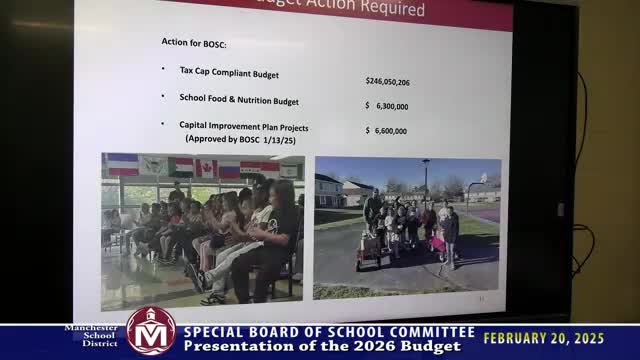
The Manchester School Committee approved a fiscal year 2026 tax-cap general fund budget of $246,050,206, a $6.3 million school food budget and $6.6 million in capital improvement projects after a public hearing that centered on longstanding gaps in per‑pupil funding and staffing.
The Manchester School Committee on Feb. 20 approved a fiscal year 2026 tax‑cap general fund budget of $246,050,206, the district’s FY26 school food and nutrition budget of $6,300,000 and a $6,600,000 capital improvement plan after a special public hearing and board discussion.
Superintendent Camille asked the full board “to take action on the following items, to approve the tax cap compliant budget presented this evening,” and the board subsequently moved, seconded and approved the package by voice vote.
The budget presentation said the district’s proposed tax‑cap number is based on a 3‑year average of the Consumer Price Index that produces a 4.27% tax‑cap increase. District staff reported the calculation adds roughly $5.1 million in tax revenue and an estimated $6.4 million in other revenue for a total projected revenue increase of about $11.5 million compared with the current year. The presentation also reported an $11.7 million increase in state adequacy aid driven by stable enrollment, a 2% per‑pupil rate increase and a larger “extraordinary needs” grant component.
Board members and speakers debated whether the tax‑cap budget adequately addresses student needs. A district presenter noted that Manchester’s per‑pupil spending—about $17,007—lags the state average by roughly $3,812 per student, a shortfall that totals roughly $45 million across the district. Several committee members urged that shortfalls in services, especially special education supports and social‑work capacity at large schools, remain unaddressed in the tax‑cap budget.
District leaders described operational steps intended to reduce external contracting costs while maintaining or expanding services. The budget moves 38 registered behavioral technicians (RBTs) from contracted services into district payroll, brings regular home‑to‑school bus drivers in‑house and reduces specialized transportation vendor costs through a recent request for proposals. Presentation slides and board comments said those changes lower contracted services and transportation costs while increasing the salary and benefits lines; the administration said the net effect is improved service delivery with lower overall taxpayer cost and cited roughly $3 million in transportation and contracted‑services savings.
Budget details included a $10.7 million increase in the salary line (reflecting cost‑of‑living adjustments, step increases, longevity and newly budgeted bus drivers and RBTs), a recommended 50% reduction in the use of one‑time expendable trust and fund‑balance funds (from $9,000,000 used last year to a planned $4,500,000 this year), and an assumed 7% increase in health‑insurance costs. The presentation also noted a $328,000 increase in debt service tied to previously bonded projects and a $17.7 million line item for phase 1 of the facilities plan.
During discussion, several committee members said the district has made progress—citing reduced class sizes, negotiated savings and investments—while others urged the board to present a separate needs budget that would itemize services and staffing gaps for the mayor and Board of Mayor and Aldermen to consider. The mayor and other board members stressed the fiscal constraints the city faces and the requirement to submit a tax‑cap compliant budget.
Committee Member Barr moved to approve the tax‑cap budget, school food and nutrition budget and the capital improvement plan; Committee Member Turner seconded. The motion passed on a voice vote; the clerk declared “Aye” and the chair announced the ayes have it.
The board will forward the approved tax‑cap budget to the mayor and the Board of Mayor and Aldermen as part of the city’s budget process. Committee members said they may request a needs budget or additional information for the finance committee if the state’s final adequacy or free‑and‑reduced counts change later in the year.