Get Full Government Meeting Transcripts, Videos, & Alerts Forever!
Get email alerts on the Chemical Safety Hygiene Plan topic
No spam. Unsubscribe anytime.
Policy committee adopts Safety 140 requiring chemical hygiene plans at schools
Summary
The Policy Committee approved Safety 140, a new Manchester School District policy requiring school-level chemical hygiene and safety plans to manage hazardous substances and respond to related emergencies. The policy implements state regulations effective Sept. 1, 2024, and is based on a New Hampshire School Boards Association model.
Assistant Superintendent Forrest Runstahl told the Manchester School Committee Policy Committee on Feb. 19 that Safety 140 is a new district policy to ensure a healthy, clean and safe learning and work environment.
"Safety 140 represents a new policy for us," Runstahl said, explaining the policy both establishes standards for the use and handling of toxic chemicals and directs creation of a chemical hygiene and safety plan for each school.
The policy requires the district to maintain a chemical hygiene and safety plan that lists all points where hazardous substances may be used or stored on district property, including science labs, art rooms, shop classes, food services, facilities, groundskeeping and custodial services. Runstahl read the policy definition: "Hazardous substances as used in this policy means and includes any material specifically designated as hazardous by the state or by state or federal law or any other substance or mixture of substances which may be explosive, ignitable, corrosive, reactive, or toxic." He said the related regulatory requirement took effect on Sept. 1, 2024, and the district used a New Hampshire School Boards Association model policy as the basis for the draft before the committee.
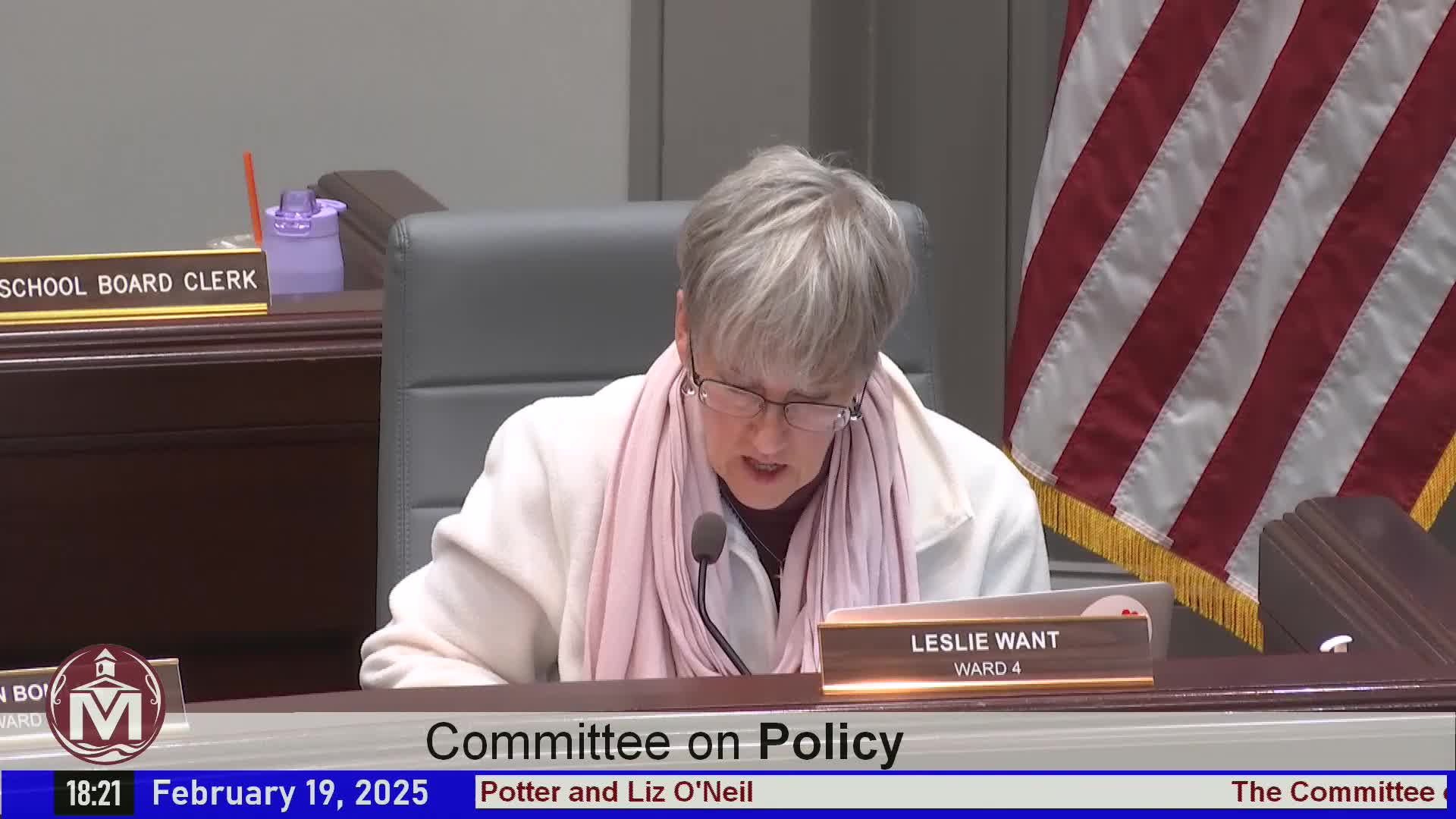
Committee members asked procedural and formatting questions. Committee member Potter asked why the district would adopt a policy requiring plans rather than adopting a single districtwide plan; Runstahl replied the district is required by state regulation to adopt a policy and that school-level procedures are kept separate so they can be updated without returning to the board. Potter also raised minor formatting issues about numbering and bullets. Runstahl noted that each school already has a filled-out plan template used for school approval processes and that designated chemical safety officers will be named at each school — often a science department head or a principal (Runstahl said Principal Espinola has taken that role at Southside).
The committee voted to approve Safety 140 "as amended." Committee member Parter moved to approve and committee member Bonilla seconded. The motion passed by voice vote; the committee recorded the outcome as approval "as amended." The committee did not record a roll-call vote tally in the meeting transcript.
Discussion items retained in the record included the policy's reliance on a model policy, the required separation between board policy and school procedures, the designation of a chemical safety officer at each school, and the policy's effective date tied to state regulation. No implementation timeline or additional staffing requirement was mandated by the committee; Runstahl said he did not anticipate a required additional staff position and expected existing staff (for example, a science department head) would serve as the site chemical safety officer.
The committee chair closed discussion after the vote and moved to the next agenda item.