
Governor Healy announces $8 billion transportation funding proposal, chapter 90 and culvert investments for rural towns
Get AI-powered insights, summaries, and transcripts
Sign Up Free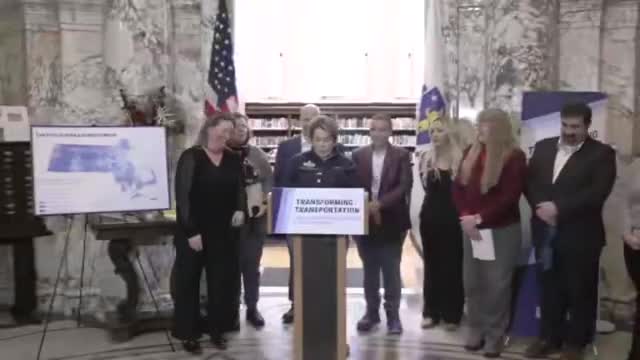
Summary
Governor Healy and MassDOT officials visited Conway to outline a proposed $8 billion, 10-year transportation plan that would increase Chapter 90 municipal aid, shift allocation to road miles, and dedicate $200 million to culverts and small bridges; local officials said the changes would sharply boost Franklin County funding.
Governor Healy on Thursday outlined a proposed transportation funding plan he said would allow the state to spend $8,000,000,000 over 10 years on roads, bridges and resilience projects while increasing annual Chapter 90 municipal aid by $100,000,000 and directing new money to culverts and small bridges.
The proposal, described at a gathering in Conway with state and local officials, would use existing voter-approved surtax revenue as leverage to access capital and expand annual municipal aid. "That's no new taxes. Okay? That's dealing with existing revenues and smart fiscal management," Healy said, adding that the plan would shift how Chapter 90 money is distributed: "we are proposing to do is change that to have it done by mileage, the actual amount of roads, within a given community."
The plan also calls for a $200,000,000 program for culverts and small bridges to improve flood resilience and additional investments in regional transit authorities and micro-transit solutions, officials said. "For Conway, that means 82% more in funding, critical support to recover from class flooding, and to build stronger and more resilient infrastructure for the future," Monica Tibbets Nutt, secretary of transportation, said.
Why it matters: Local officials and the Franklin Regional Council of Governments said a mileage-based Chapter 90 formula and the expanded culvert program would redirect more funds to low-population towns with many road miles, easing routine maintenance and resilience projects. Linda Dunlavy, executive director of the Franklin Regional Council of Governments, said the countywide average increase under the proposed mileage distribution would be about 75 percent and that "on average, every municipality in Franklin County has a 10 culverts that are in fair and poor condition."
Officials said the administration has already created a rural roads grant and a rural affairs office to help small towns access state resources. Veronique Blanchard, Conway town administrator, told the delegation that the community continues to recover from severe floods in 2023 and that the administrations attention and administrative support have been critical. "The Healy Driscoll administration's focus on small and rural towns has increased both funding and administrative help for small towns like Conway," Blanchard said.
Details of the proposal provided at the meeting included: - A proposed $8,000,000,000 of transportation spending over 10 years, financed by leveraging existing surtax revenues; officials described this as not creating a new tax. - An increase of Chapter 90 municipal aid by $100,000,000 annually, with the additional funds distributed using a mileage-based formula rather than population. - A proposed $200,000,000 expansion of the small bridge and culvert program to improve flood resilience. - Additional funding and program support for regional transit authorities (RTAs) and micro-transit solutions to improve rural mobility.
No formal vote or binding commitment was taken at the Conway meeting. Officials described the package as a proposed budget plan and said further conversations and outreach would continue: Tibbets Nutt said MassDOT staff would be in Greenfield the following day to discuss Chapter 90, passenger rail, RTAs and other elements of the plan.
Local officials and the administration emphasized the plans intent to address what they called decades of underinvestment. Healy said early flooding events in the administration's first summer prompted the new rural roads grant program and the broader push for equitable distribution. "If you don't take care of something small, it only becomes bigger. And over time, it only becomes more expensive to deal with. And, frankly, that's what happened in our state for for many, many years," he said.
What remains unspecified: The administration described the financing approach as leveraging surtax revenue to access capital but did not provide legal or fiscal instruments, specific repayment schedules, or exact timelines for rollout and project selection during the Conway session. Several numeric details cited at the meeting were given as estimates or averages; for example, the 82 percent increase cited for Conway and the 75 percent countywide average increase were presented by officials at the event and not supported with a published allocation table at the time of the meeting.
The announcement wraps a day of local consultations, including a convening of roughly two dozen town administrators, according to state officials. Organizers and officials said the outreach will continue across Western Massachusetts in the coming months.