Get Full Government Meeting Transcripts, Videos, & Alerts Forever!
Get email alerts on the Environment And Trees topic
No spam. Unsubscribe anytime.
Orinda commission backs expedited tree‑management changes, adds insurance‑related exception
Summary
The Planning Commission recommended City Council adopt an emergency update to the tree management ordinance to add an insurance‑company exception, clarify protected‑tree designations, and tighten permit review criteria; the commission endorsed the more comprehensive version of the draft and added clarifying language on insurance cancellations.
The Orinda Planning Commission on March 11 voted to recommend the City Council adopt an updated tree management ordinance that adds an exception when a tree removal is required to avoid insurance cancellation or to comply with an insurer’s explicit mandate, clarifies the city’s protected‑tree designations, and strengthens standards staff may apply when reviewing removal permits.
City staff presented two draft versions; staff recommended the more comprehensive version (Version A) that implements the City Council’s earlier direction to ease burdens on property owners facing insurance mandates, clarify the protected‑tree definition, and allow adaptation to evolving state law. "These regulations ease the burden on individuals facing tree management mandates from insurance companies and will enable flexibility in enabling property owners to respond to these requirements," said Darren Hughes, associate planner, during the presentation.
The draft ordinance reorganizes the protected‑tree definition into a clear table of four designation categories (for example, riparian trees and heritage oaks) so that residents and staff can readily determine which trees are protected and by what criteria. The update adds a new permit exception for tree removal when an insurance company requires alteration or removal of a tree at a specific property to avoid cancellation or to meet a written insurance requirement; staff said they will require documentation from the insurer (for example, a site map or parcel‑specific direction) or direct communication to verify the basis for the exception.
Version A also adds objective standards staff can use when evaluating removal requests on properties not tied to a development application. Those standards include whether the tree poses an imminent threat to public health, safety or property (supported by a certified arborist report); the degree to which the tree interferes with reasonable use or enjoyment of the property; documented signs of disease or structural instability; the number and condition of other protected trees in the area; potential for cumulative loss of protected trees; and whether practical alternatives (pruning, root management) are available.
For tree removals tied to a proposed development, the draft requires the removal permit to be valid only when a building permit for the associated development is issued, a change staff said is intended to prevent premature clearing. Staff also proposed removing an annual reporting requirement related to whether the Moraga‑Orinda Fire Protection District had required protected‑tree removals for code compliance, explaining the fire district rarely issues such directives and staff wanted to avoid a redundant reporting requirement.
Commissioners asked staff to clarify how an insurance‑based exception should be worded so the ordinance covers true cancellations rather than routine rate‑reduction recommendations. Commissioners proposed language to reflect that distinction; staff indicated they would incorporate language specifying removal may be allowed to avoid a policy cancellation or to obtain new required coverage when an insurer issues parcel-specific directives.
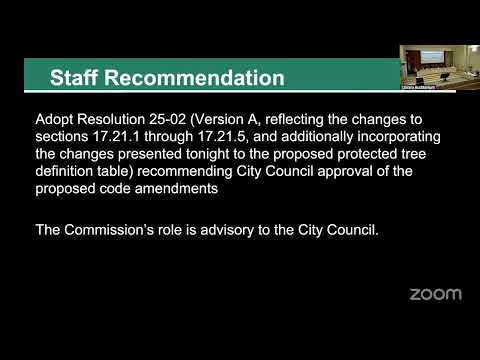
The commission voted to adopt Resolution 25-02 (Version A) with the clarified insurance exception language and to forward the recommended ordinance to City Council. Staff will present the commission’s recommendation and the revised ordinance to the City Council at an upcoming meeting.