Get Full Government Meeting Transcripts, Videos, & Alerts Forever!
Get email alerts on the Housing Policy topic
No spam. Unsubscribe anytime.
Orinda commissioners recommend zoning changes to align ADU, shelter and housing rules with state law
Summary
The Orinda Planning Commission on March 11 recommended City Council adopt zoning text amendments to bring the municipal code into compliance with state law for ADUs, shelters, and other housing definitions.
The Orinda Planning Commission on March 11 voted unanimously to recommend the City Council approve a package of zoning text amendments intended to bring multiple sections of the Orinda Municipal Code into alignment with recent California law and the city’s housing-element actions.
Selena Palmer, the project planner, told commissioners the package (draft ordinance 25-02 and resolution 25-01) makes staff‑initiated, staff‑recommended edits to definitions, residential land‑use tables, accessory dwelling unit (ADU) rules, the senior housing overlay, and regulations for emergency shelters and related uses. "These are state‑mandated changes and are not optional," Palmer said, summarizing the driver for the update.
Key changes include adding definitions and land‑use entries for employee farmworker housing, low‑barrier navigation centers and residential care facilities; updating the municipal code’s kitchen definition and the definition of transitional housing; and clarifying approval and permit‑processing language to match recent Government Code provisions referenced in the staff report. The ADU section contains the most substantive edits: updated cross‑references to the relocated state ADU provisions, adjusted height limits (allowing up to 18 feet instead of 16 feet in locations meeting state criteria), and parking exemptions including no additional parking required for studio ADUs or in instances where a parking space was converted.
On emergency shelters, the amendments increase the nightly maximum client count from seven to 20, revise spacing/location criteria (removing certain distance requirements to Orinda BART and Highway 24 while adding a minimum 300‑foot separation between shelters), and permit reduced off‑street parking requirements for shelters within one‑half mile of Orinda BART, provided the parking standard is consistent with similar residential or commercial uses.
Staff also reported and responded to a written comment from the California Housing Defense Fund alleging noncompliance with state code language. Palmer said staff adjusted sections 17.3.0.4(b)(2)(B) and 17.3.0.4(e) to match the government code’s exact phrasing and to remove potentially conflicting local language. "We modified the language to exactly match the government code," Palmer said.
Commissioners asked about the senior housing overlay changes, including how an applicable story or height limit would be set when parcels adjoin zones with differing standards. Commissioners discussed whether the more permissive or more restrictive adjacent standard should govern; staff said the city’s code administrator would make determinations and noted applicants retain appeal rights through the normal process. Commissioner discussion led to an amendment to the commission recommendation clarifying which adjoining standards would govern for the overlay (motion language recorded in the official minutes).
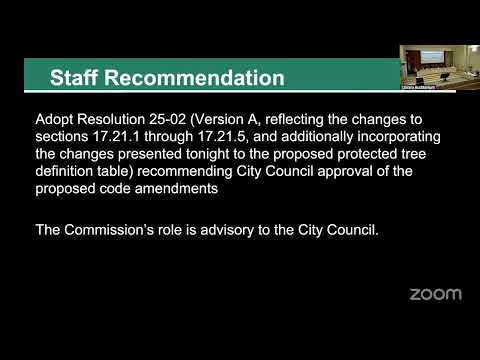
The commission voted to adopt Resolution 25-01 (as amended) and to recommend City Council approval of Ordinance 25-02 with the staff edits presented at the hearing. The vote was recorded as unanimous by roll call.
If the City Council approves the ordinance, the amendments will take effect as provided in state law and Orinda’s ordinance adoption procedures. The planning director and staff will prepare the item for the council hearing and incorporate the commission’s clarifying edits in the final draft.