Get Full Government Meeting Transcripts, Videos, & Alerts Forever!
Get email alerts on the Stormwater Floodplain topic
No spam. Unsubscribe anytime.
Resident engineer warns of blocked culverts, missing FEMA records and possible code violations in Titusville stormwater system
Summary
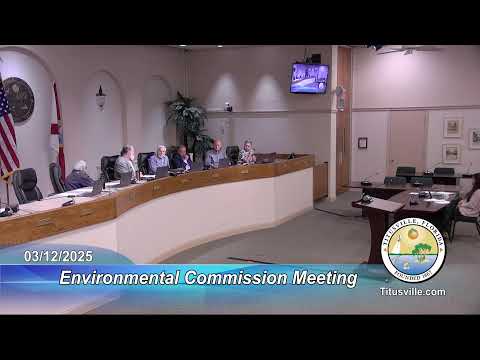
Stan Johnson, a professional engineer, told the Titusville Environmental Commission that the city's stormwater master plan and FEMA floodplain records are incomplete or missing, that culverts under I‑95 are blocked with sediment and that several small dams and weirs were built without required calculations or filings.
Stan Johnson, a professional engineer and Titusville resident, told the Titusville Environmental Commission that the city's long-standing stormwater management documents and practices leave some neighborhoods at risk and may not comply with federal and local requirements.
Johnson said the city's 1966 stormwater master plan and more recent revisions do not match current conditions and that key FEMA documentation is missing from the city's repository. "The city of Titusville is not sustainable," Johnson said, arguing that incomplete records and unreported changes have left FEMA floodplain data inaccurate.
The charge matters because, Johnson and commission members said, improperly maintained drainage and blocked culverts can raise local water levels and increase flooding. Laura Lee, a commission member, said "these culverts exist under I‑95 and they are blocked with sediment," and described standing water near Fox Lake Road and Harrison Street after recent hurricanes.
Johnson described a roughly 2.5-mile corridor from Fox Lake Road to State Road 50 that contains several large concrete culverts and said some were partially or fully obstructed when he inspected them after storms. He also said the city has built multiple small dams or weirs without submitting required storage or conveyance calculations to FEMA and that those structures may violate Titusville city code section 12-11, which he cited as prohibiting obstructions in flowways.
Commission members asked staff for factual follow-up rather than debate. Chair Majak asked who is responsible for maintaining the drainage under I‑95; Lily (city staff) said she would check agency responsibility and report back. Commissioners also requested staff obtain and compare the current FEMA flood maps and any relevant topographic data for Titusville to identify properties that now fall inside the 100‑year floodplain.
Why it matters: blocked culverts and outdated floodplain documentation can change how and where water flows during storms and affect property owners' flood exposure and eligibility for federal programs. Commission members noted the city's resilience planning work and urged staff to gather the records Johnson referenced, including the 1966 stormwater master plan, a 1989 FEMA submission Johnson cited, and a 2016 geosynthetic study he mentioned.
Commission direction and next steps: The commission did not take formal action on Johnson's public comments but directed staff to (a) determine which agency maintains the drainage under I‑95, (b) assemble the FEMA and city stormwater records Johnson referenced, and (c) compare the current FEMA flood maps to local topography and a list of buildings in or near the mapped 100‑year floodplain. Staff confirmed they will follow up at the next meeting.
Community context: The concerns touch parcels and neighborhoods along the I‑95 corridor and areas noted in the commission's resilience work. Johnson named multiple local roads and subdivisions (Harrison, Fox Lake Road, Baker Subdivision) and referenced the St. Johns River and the St. Johns River Water Management District.
No vote or formal policy change followed the public comment; the commission's request to staff is intended to create a factual record for possible subsequent action.