Get Full Government Meeting Transcripts, Videos, & Alerts Forever!
Get email alerts on the Student Assessment topic
No spam. Unsubscribe anytime.
Laconia trustees hear midyear I-Ready results showing mixed gains and flagged early-reading needs
Summary
District staff presented midyear I-Ready diagnostic and MyPath data to the Laconia School District Board on March 4, reporting gains in kindergarten and portions of middle school while noting early-reading flags in some K–3 students.
LACONIA, N.H. — District staff presented midyear results from the I-Ready diagnostic to the Laconia School District Board of Education on March 4, showing measurable student growth in several grades while noting concentrated needs in early reading and some elementary grades.
Presenters said the district uses I-Ready three times per year (fall, January and June) as a diagnostic, for a kindergarten–grade 3 dyslexia screener and to generate individualized MyPath lessons used for targeted intervention. "We use it in a few ways," a district presenter said, describing diagnostic, dyslexia screening and the personalized learning platform.
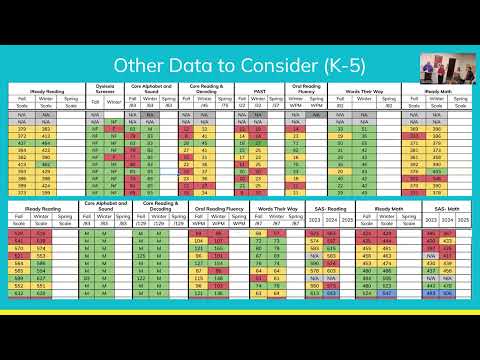
The presentation showed kindergarten cohorts moving substantially toward grade-level markers between fall and winter: presenters noted the share of kindergartners at or above grade level rose visibly (presenters said green/on-grade-level rose from the fall to winter), and that the winter data reflected roughly a half-year of instruction. District staff emphasized that kindergarten jumps are expected because many students enter school without prior exposure to K-level material.
Middle school presenters described median progress and stretch-growth measures. "In terms of median progress, we're at a 16% growth," a middle-school presenter said, adding that the district measures both "typical" and higher "stretch" growth goals for students who must close larger gaps. For some middle-school cohorts presenters reported that 36%–43% of students had already met annual growth targets as of the January diagnostic.
Presenters described how I-Ready flags students scoring below the 20th percentile in K–3 as having indicators of reading-related challenges; flagged students are reviewed against additional assessments and may be placed into intervention groups. They also noted MyPath alerts teachers if a student fails a lesson twice so staff can provide small-group or one-on-one help.
Board members asked about how I-Ready colors map to grade-level distance (green = on grade level; yellow described in the presentation as roughly one year behind; red as two or more years behind) and whether the district disaggregates results for preschool or Head Start attendees. Presenters said the system can report by program but cautioned that isolating causal effects for very young students is difficult because many variables affect early learning outcomes.
Presenters also explained domain-level reporting in math (numbers/operations, algebraic thinking, geometry) and reading (phonemic awareness, phonics, high-frequency words, comprehension), and noted teachers and data teams use I-Ready alongside other assessments and data walls to set interventions.
Board members requested both median and all-student views so elected members can see how outliers affect summaries; presenters said both reports are available and that median is used to reduce skew from extreme results. The district plans to present end-of-year results after the June diagnostic.
District speakers: Superintendent Champlin; a district I-Ready presenter; Matt (middle-school presenter); Ms. Judd (board member).