Get Full Government Meeting Transcripts, Videos, & Alerts Forever!
Get email alerts on the Education Stem topic
No spam. Unsubscribe anytime.
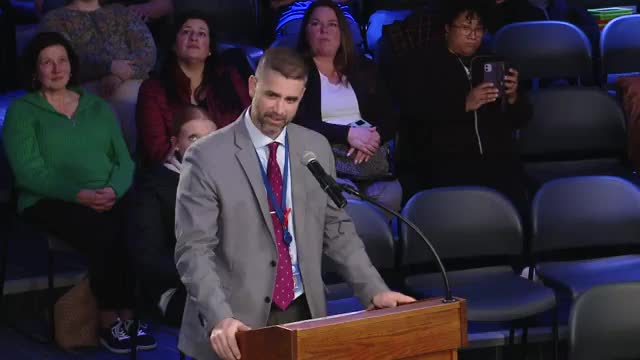
Woodbury students demonstrate expanded STEM, computer-science pathway to Salem School Board
Summary
At the Feb. 11 Salem School Board meeting, Woodbury teachers and students showcased an expanded K–12-aligned STEM pathway using Project Lead The Way, with demonstrations of micro:bit/hummingbird robotics, MIT App Inventor apps and a RobotC lifeline rescue prototype.
Woodbury teachers and students presented the Salem School Board with a detailed look at the school’s engineering, computer science and STEM offerings during the board’s Feb. 11 meeting, showing classroom projects and explaining how the programs connect from the elementary grades through high school.
Principal Barry opened the presentation by describing the district’s view of computer science and engineering as foundational, saying, "Like reading, writing, or math, computer science, and engineering are foundational skills" for students. Brad Saint Germain, the district’s K–8 math and science director, described the pathway as one that "provides all students with critical lenses for interpreting and navigating the world around them." The program at Woodbury uses Project Lead The Way as a curriculum framework and offers modules and semester courses for sixth- through eighth-grade students leading into high‑school options.
Nut graf: The presentation highlighted hands-on projects and new instructional resources the district says will support a K–12 progression in STEM that aims to develop both technical content and “durable” skills such as collaboration, critical thinking and perseverance.
Teachers and students demonstrated specific classroom projects. Innovators and Makers students used Microsoft MakeCode, micro:bit controllers and newly purchased Hummingbird kits to create interactive mini-golf holes with distance sensors, servos, tricolor LEDs and programmed audio. Teacher Erica Sweatt and computer science teacher Andre DeMaris explained students spend a 45‑day quarter connecting hardware and software; one student presenter described debugging a “distance sensor” and adjusting servo angles so the system would reliably detect a ping-pong ball.
Eighth-grade App Creators students showed mobile prototypes built in MIT App Inventor. Students Madeline Riley and Jenna Bowden demonstrated a “Woodbury Navigator” app they designed to help new students and visitors find classrooms, including a home screen with team lists and a simple navigation flow built from paper prototypes. As Jenna Bowden explained, the class emphasizes user interface design and event-driven coding.
In engineering design, teachers Paul Gelinas and Joe Ferraro presented the Robot Lifeline project: teams design, build and program a robotic rescue vehicle using RobotC to travel along a cable and rescue figurine hikers. Eighth‑grade students Ian Dufresne and Jacob Thompson demonstrated a model that traversed a classroom rope and discussed design tradeoffs such as center-of-mass placement, battery location and dealing with line sag.
Teachers described classroom pedagogy as deliberately building “durable skills” alongside technical content. Saint Germain placed the work in district context, saying the pathway is meant to "inspire, explore, and plan" so students who wish to pursue robotics, AP computer science or CTE pathways in high school will be prepared.
Board members praised the presentations. Patricia Corbett commended students and staff for the program’s progress; one board member noted a bill under consideration in Concord that would reduce state requirements for classes of this type and said the students’ work would make a strong case for continuing such instruction. Superintendent Mara Palmer and other administrators praised the students’ public‑speaking and problem‑solving skills demonstrated during the presentation.
The program materials and student projects shown included: Project Lead The Way engineering modules for grades 6–8, micro:bit and Hummingbird kits for physical computing, MIT App Inventor for mobile app prototyping, and RobotC for text‑based robotics programming. Teachers said the Woodbury renovations helped provide updated instructional space and equipment.
Board members asked about project management tools taught in class; instructors said they are introducing an adapted, paper-based version of agile/scrum so students learn to set a minimum viable product, run short reviews and plan tasks. Principal Barry and staff said the district hopes these middle‑school offerings will feed into the high school’s existing robotics and computer‑science opportunities.
Ending: The presentation concluded with applause and brief board discussion; the board then moved on to the evening’s business items. Several board members said they would like to feature short recorded segments about the warrant articles and budget to explain them to voters before the March election.