Get Full Government Meeting Transcripts, Videos, & Alerts Forever!
Get email alerts on the Housing Landbank topic
No spam. Unsubscribe anytime.
Seneca County hears land bank housing plan; backs Ovid redevelopment and infrastructure grant resolutions
Summary
The Finger Lakes Regional Land Bank updated the Seneca County Board of Supervisors on a housing pipeline that would convert vacant, tax‑foreclosed sites into seven rental units and supportive housing; the board approved related redevelopment and infrastructure grant resolutions and other easements to support village water interconnects.
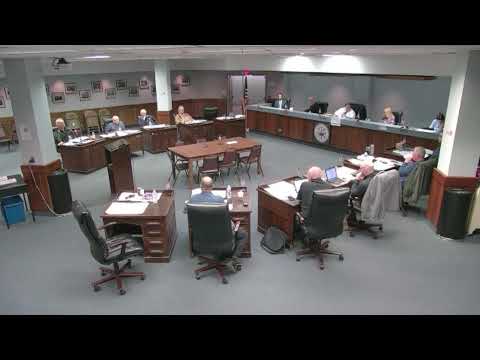
The Seneca County Board of Supervisors on March 11 heard an annual presentation from the Finger Lakes Regional Land Bank Corporation on efforts to convert vacant, tax‑foreclosed properties into housing and voted to approve several redevelopment and infrastructure grant actions supporting projects in Ovid, Willard and Waterloo.
The land bank presentation described a two‑track housing pipeline: a seven‑unit affordable housing package to be transferred to Seneca Housing and a separate permanent supportive housing package to be developed with FLACRA. The board also approved a set of resolutions to help the projects proceed, including backing a county infrastructure grant application and authorizing easements for a village interconnect.
The land bank’s mission, the presentation said, is to “identify, improve, and redistribute vacant, blighted and tax‑abandoned properties to eliminate the harms and liabilities caused by such properties and return them to productive use,” and the agency outlined work completed so the sites reach a “shovel‑ready” standard. Jill Henry, of the Finger Lakes Regional Land Bank Corporation, told supervisors the land bank and partners have done demolition, design work, environmental site assessments and cost estimates so projects can move quickly if state funding is awarded.
Henry said one package—supported in part by $500,000 from the Seneca County Housing Trust Fund (ARPA money)—covers two sites: a three‑unit project in Willard (Pleasant Street) and a four‑unit townhouse‑style project on West Seneca Street in Ovid, a site close to the former Big M grocery. “When this project transfers to Seneca Housing, it will be a complete shovel‑ready site,” Henry said, listing permits, designs and budgets among completed tasks. She told the board the land bank applied to New York State Homes and Community Renewal (HCR) in February and expects to hear back in May.
Bruce Murray, chair of the Seneca County Industrial Development Agency, said making sites shovel ready is essential to attract private developers. “To get a private real estate developer to come in and build … that site is shovel ready,” Murray said, adding that private money typically follows where the public sector has reduced site risk. Murray supported two resolutions on the agenda he said were key: the planning grant (item 44) and the infrastructure grant noted in the agenda.
Joe McGrath, of the land bank, described how the county historically transferred the worst properties to the land bank after tax auctions; he warned recent legal changes have altered that calculus. “That calculus might change this upcoming year because we’re no longer able to keep the excess revenue from the auction; it has to be returned to the property owner,” McGrath said, referencing a U.S. Supreme Court decision and recent state legislation that changed tax‑foreclosure proceeds handling. He said staff will need to decide whether to continue accepting properties at no cost or use available grant dollars for acquisition.
The land bank also described a package with FLACRA to develop permanent supportive housing in Waterloo that would shift some county emergency housing costs to state programs. The plan includes acquiring and demolishing 55 Washington Street (a vacant historic, highly distressed property previously owned by Wells Fargo), obtaining historic‑clearance approvals, and building a reconstructed historic frontage on Washington plus two townhouses fronting Huff Street and one single‑family unit on Walnut Street. Henry said the land bank will apply for the next round of Land Bank Initiative (LBI) funds where acquisition is an eligible expense and noted a portion of any award would be contributed to the Ovid/Willard project.
Supervisors asked implementation questions. Supervisor Hyson clarified the county can still take properties but cannot keep surplus auction proceeds. Supervisor Schmitter and others urged pursuing private buyers for some properties where feasible, leaving the most distressed parcels for the land bank. McGrath said, if state programs continue, the plan is for construction to begin “as soon as it gets nice in 2026” and to finish before winter that year; he emphasized that timeline depends on HCR and continued program funding.
The board approved several agenda items tied to redevelopment and infrastructure. The board authorized easements to facilitate a water interconnect between the Village of Waterloo and the Town of Seneca Falls (agenda item 29), authorized a grant application for a redevelopment plan for the Village of Ovid (item 42), reappointed Jill Henry as Seneca County fair housing officer (item 44), and supported a county resolution backing the 2025 county infrastructure grant program (item 45). Each motion was carried by voice vote as recorded in the meeting minutes.
Residents, local officials and the IDA emphasized that making sites shovel ready—through demolition, permitting, design and targeted public investment—would be critical to attract private developers to rebuild commercial blocks and bring grocery and other services back to hamlets such as Ovid. Aaron Roizen, mayor of the Village of Ovid, told the board the county’s support for water improvements has been “outstanding” and will help the village’s water main project and broader redevelopment.
What’s next: HCR’s response to the land bank’s HCR application is expected in May; the land bank said it will use grant funds if awarded to finish acquisition and construction documents so the projects can move to a developer or to Seneca Housing for implementation.
Votes at a glance
- Item 29 — “Authorizing easements to facilitate a water interconnect between the Village of Waterloo and the Town of Seneca Falls.” Motion moved/seconded (not specified). Outcome: voice vote — carried.
- Item 42 — “Authorize the grant application for the redevelopment plan for the Village of Ovid.” Motion moved/seconded (not specified). Outcome: voice vote — carried.
- Item 44 — “Resolution to reappoint Jill Henry as Seneca County Fair Housing Officer.” Motion moved/seconded (not specified). Outcome: voice vote — carried.
- Item 45 — “County resolution supporting the 2025 county infrastructure grant program.” Motion moved/seconded (not specified). Outcome: voice vote — carried.
(Other agenda items from the March 11 meeting were considered and carried by voice vote; the minutes record aye/aye/ carried outcomes for routine motions.)