Get Full Government Meeting Transcripts, Videos, & Alerts Forever!
Get email alerts on the Legislative Priorities topic
No spam. Unsubscribe anytime.
Matthews commissioners review proposed 2025–26 legislative priorities; transportation funding and school planning dominate discussion
Summary
Commissioners reviewed an EQV Strategic–draft one‑page legislative priorities document, discussed transportation funding (including Powell Bill, EV impacts, and NCDOT caps), affordable housing funding options, school‑capacity forecasting and other topics; formal adoption was deferred to March 24, 2025.
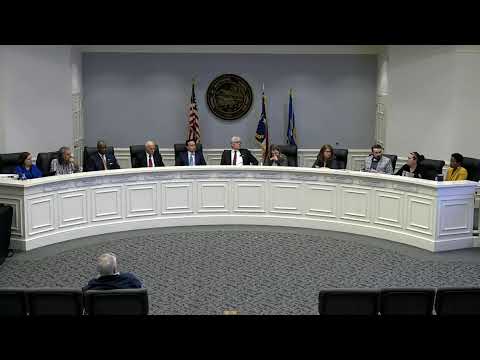
Matthews commissioners spent the March 10 work session reviewing a one‑page draft of the town’s 2025–26 legislative priorities prepared by EQV Strategic, focusing discussion on transportation funding, affordable housing and school‑capacity forecasting.
The board did not adopt the priorities at the March 10 meeting; the agenda item was deferred to the March 24 regular meeting so staff can present revised wording and commissioners can suggest targeted additions. Town Manager Becky Hawk told the board the one‑page format reflects feedback from EQV that North Carolina legislators prefer brevity.
Transportation prompted the longest debate. Commissioners and residents pressed for a clearer statement about Powell Bill funding — the state program that distributes gasoline‑tax revenues to municipalities — noting revenue declines tied to higher fuel efficiency and electric vehicles. Commissioner John Urban and others asked that the draft prioritize new funding mechanisms for NCDOT projects, or raise statutory “caps” that limit spending in particular NCDOT divisions; speakers cited U.S. 74 as an example of a project whose costs exceed those caps. Several commissioners also raised concern that use of public‑private partnerships and express‑lane projects is shifting costs and tolls onto users.
Board members asked staff to add language about electric vehicles and evolving revenue sources, and to consider an explicit ask to increase or maintain Powell Bill funding rather than simply “support maintenance.” Staff said the town does not yet know its FY‑26 Powell Bill allocation.
Affordable housing and funding drew multiple suggestions. Commissioners discussed lobbying for state funding streams and a proposed statewide cabinet position to coordinate housing policy and funding; several said the board should explicitly request increased long‑term state funding for municipal housing partnerships. Staff and commissioners also debated how much specificity to put in the document — for example, whether to ask for state help securing property for developers, or for low‑interest loans to towns.
School capacity and forecasting were also raised as legislative asks. Several commissioners urged the town to seek clearer statewide forecasting rules to ensure rezonings and new developments are evaluated against realistic, up‑to‑date school capacity forecasts. Commissioners proposed a legislative request for mandatory post‑occupancy evaluations or updated forecasting formulas so school‑building decisions reflect growth patterns.
Other items discussed included: - Local control and recent state bills that limit municipal authority (commissioners suggested including concrete Matthews examples such as billboard law impacts). - Public‑notice modernization: commissioners asked to broaden the draft request to allow electronic public‑notice options beyond the large‑circulation newspaper currently required (Charlotte Observer) while retaining physical on‑site signage and direct mail. - Broadband and “dig once”: Commissioners asked the draft to support classifying broadband as a utility or otherwise encourage shared conduit to avoid multiple trenching in public rights‑of‑way. - Police video access: staff said the draft asks the legislature to permit more local discretion for providing police video to governing bodies when appropriate. - NCDOT rights‑of‑way: commissioners requested wording to allow municipalities to replant trees or install landscaped berms in NCDOT rights‑of‑way in some locations as an alternative to sound walls.
Why it matters: commissioners repeatedly said the goal is a concise, one‑page document that Raleigh will read and use. Staff and EQV will return with revised wording and a recommended prioritization; the board plans to consider final adoption at a March 24 meeting.
Commissioners and staff said they will continue to work with EQV Strategic on framing and prioritization; the board did not take a final vote on the legislative priorities at this session.
Ending: Staff will circulate the redrafted one‑page priorities ahead of the March 24 meeting and suggested EQV attend a follow‑up session with commissioners to map advocacy timing and top‑level asks.