Get Full Government Meeting Transcripts, Videos, & Alerts Forever!
Get email alerts on the Land Use Natural Medicine topic
No spam. Unsubscribe anytime.
Timnath staff proposes restrictive zoning for natural medicine healing centers and cultivators; council leans toward most restrictive scenarios
Summary
Town staff told council and the planning commission that Colorado's post‑Proposition 122 regulatory framework allows local time, place and manner restrictions but not outright bans; staff presented zoning scenarios and setbacks for healing centers and cultivators and the council generally favored the most restrictive mapped options.
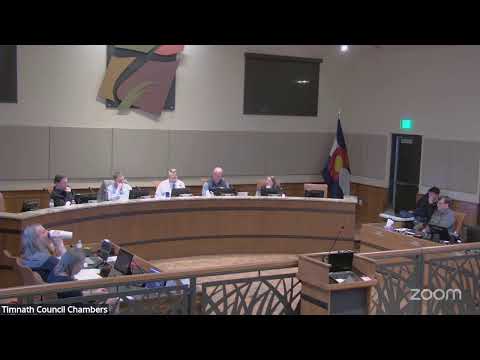
Town staff briefed the Timnath Town Council and Planning Commission on May 11 about options for regulating state‑licensed natural medicine businesses — healing centers and cultivation facilities — under Colorado’s post‑Proposition 122 regulatory framework.
The legal backdrop: Proposition 122 and state implementation
“...this work session is our your opportunity to explore how we're going to regulate, natural medicine in the town,” staff member Ms. Graves said at the start of the discussion.
Staff explained that Proposition 122 (a citizen initiative in 2022) decriminalized personal use of certain plant‑based psychedelic substances for adults 21 and older, and that subsequent state legislation (including a natural medicine regulation act referenced in the presentation as bill 23‑290) created state licensing for cultivators and for facilitators at supervised healing centers. Staff reiterated that local governments cannot prohibit healing centers or cultivation facilities outright but can impose reasonable time, place and manner restrictions; the state imposes a mandatory 1,000‑foot pedestrian route setback from childcare centers and schools.
Scenarios presented
Staff presented four scenarios for where healing centers could be permitted (mapping existing zones where medical/dental offices are allowed and progressively narrowing permitted zones). Under the scenarios staff mapped the acreage that would remain available to healing centers under the mandatory 1,000‑foot school setback:
- Scenario 1 (least restrictive): ~695 acres (approx. 13.64% of town) would be eligible. - Scenario 2: ~574.34 acres (approx. 11.26%). - Scenario 3: ~375.78 acres (approx. 7.37%). - Scenario 4 (most restrictive): regional commercial only — ~196.7 acres (approx. 3.86%).
Cultivation facilities were proposed to be treated like manufacturing and restricted to industrial zoning, with three scenarios that layered increasing residential property‑line setbacks. Staff reported the approximate areas that would remain available under each cultivation scenario (scenario 1 ~2.2% of town, scenario 2 ~1.89% ~96.43 acres, scenario 3 ~1.57% ~under 80 acres). (Numbers presented in the work session were staff calculations of current zoning footprints and reflect the town’s existing incorporated area at the time of the meeting.)
Key regulatory details staff highlighted
- The state requires licensed facilitators and imposes licensing standards under the Department of Regulatory Agencies; business rules for cultivators and testing facilities fall under the Department of Revenue. - Healing centers are supervised settings; state rules limit quantities on‑site, require licensed facilitators, and prohibit direct retail or taking the product off‑site for personal use. - Staff noted a practical qualification that licensed facilitators will require hands‑on experience (presented as roughly 200 hours of practical experience or training for certification) and that clients must remain on site until they are no longer under the influence.
Council and commission discussion and direction
Commissioner Tom Wood and several council members raised operational and enforcement concerns, including how trace amounts in food or edible mushroom products might be treated and practical enforcement limits for low concentrations. Council members repeatedly asked whether staff could impose additional local restrictions such as hours of operation, spacing limits between centers, and additional setbacks from residential property lines for both healing centers and cultivators.
Multiple council members said they preferred a cautious, restrictive approach. On cultivators, councilmembers expressed support for the most restrictive scenario (scenario 3), which limits cultivation to industrial districts and applies the larger residential setbacks discussed. On healing centers, a majority of councilors favored the most restrictive mapped scenario (scenario 4) that limits healing centers to regional commercial areas (staff noted this would confine most healing centers to key commercial corridors such as Gateway North, Ladera and the Costco/Walmart area rather than residential or neighborhood commercial areas).
Council also asked staff to include possible conditions in draft code language: hours of operation (weekday/daytime preference mentioned by one councilor), spacing requirements to avoid clustering, and a requirement that operators demonstrate compliance with state licensing; multiple council members suggested starting restrictive and loosening rules later if monitoring and state licensing built experience and data.
Next steps
Staff said it will prepare draft land use code amendments reflecting council guidance and that the item will move first to the Planning Commission for recommendation; staff noted a moratorium date in July and said they were targeting May for the Planning Commission review and drafting work to be ready for the town’s schedule.
Ending
Council directed staff to draft code language consistent with the conservative approach discussed (most restrictive mapped zones), to propose hours and spacing options, and to return the proposal in the planning commission/council review schedule.