Get Full Government Meeting Transcripts, Videos, & Alerts Forever!
Get email alerts on the Wildlife Management topic
No spam. Unsubscribe anytime.
Commissioners press for clearer plans on elk counts, hoof‑rot testing and wildlife‑area management
Summary
Advisory commissioners discussed rising elk presence, hoof‑rot testing, wildfire impacts to forage, lake‑level management and a desire for more coordinated state and federal action; commissioners asked for a follow‑up from state staff and proposed drafting a letter asking for updates.
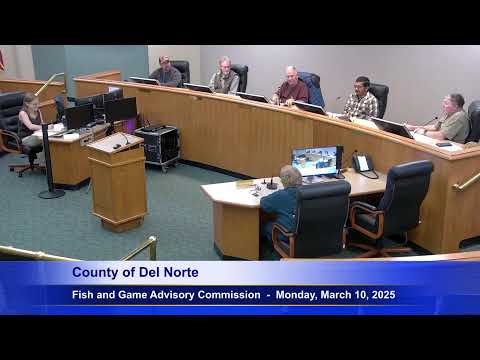
Donner County Fish and Game Advisory Commissioners spent a lengthy portion of Monday’s meeting pressing state wildlife staff and each other for clearer information on elk numbers, disease testing and management of state wildlife lands after large wildfires.
Commissioners and residents described growing elk presence along the coast and inland, and they said recent wildfire burn severity has altered forage and may be influencing elk movement. "After the fire is a premium, a year or two after the fire is premium food time at property for wildlife. Everything sprouts back," one commissioner said; other commissioners countered that some local burns were so hot they left little regrowth and that elk are increasingly visible in valleys and near roads.
Disease testing and lab work: Commissioners noted that CDFW has redirected some tests to Washington State labs rather than the state lab that experienced long delays. A county speaker said the Washington State laboratory has an expert on hoof rot and that sending tests there should speed analysis. The commission asked for continued follow‑up and data sharing on the diagnostic work.
Wildlife area management and lake levels: Commissioners discussed long‑standing concerns about management of Fish and Wildlife lands, lake‑level targets and the need for updated, local input into state wildlife area management plans. Lisa (a CDFW land management staffer named during discussion) was reported to have eight pending management plans statewide; commissioners asked for a local Zoom meeting with CDFW to give direct input and for the commission to draft an outline or sections for a local plan to submit to Sacramento. "I would like to see an outline, at least outline a plan that we can have the supervisor send to Sacramento," one commissioner said.
Counts and tags: Commissioners noted perceived undercounts in official elk estimates and asked whether the county could secure more resources for population surveys. One commissioner suggested the commission ask for a 30‑day update from CDFW after recent site visits; another commissioner volunteered to draft a letter of thanks and a request for follow‑up information.
Coordination with federal agencies and local management: Commissioners urged stronger coordination between CDFW, the U.S. Forest Service and other state agencies for habitat restoration and management; specific tactics discussed included controlled burns and pasture management. Several commissioners emphasized funding constraints at state agencies and recommended local documentation (video evidence and written reports) to build a case for funding and prioritized action.
What the commission decided: Commissioners agreed to request an update from state wildlife staff in roughly 30 days and asked for a draft letter of thanks and a request for progress reporting to be prepared for committee review. They also discussed preparing a locally informed outline to submit to CDFW land‑management staff; no formal motion with roll‑call votes was recorded during the meeting.