Get Full Government Meeting Transcripts, Videos, & Alerts Forever!
Get email alerts on the Marine Protection topic
No spam. Unsubscribe anytime.
Tolowa Dene Nation petition seeks no-take protections for surf smelt at Pyramid Point
Summary
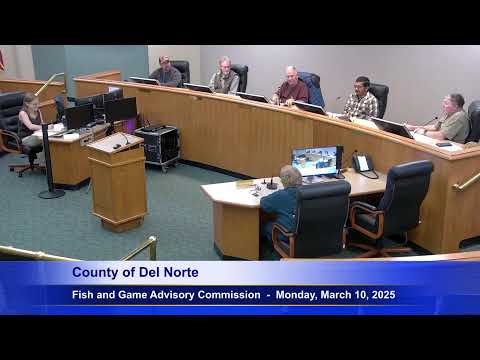
Dozens of local residents and tribal representatives told the Donner County Fish and Game Advisory Commission on Monday that a regulation petition before the California Department of Fish and Wildlife (CDFW) seeks to stop recreational surf‑smelt take at Pyramid Point while retaining tribal exemptions.
Dozens of local residents and tribal representatives told the Donner County Fish and Game Advisory Commission on Monday that a regulation petition before the California Department of Fish and Wildlife (CDFW) seeks to stop recreational surf‑smelt take at Pyramid Point while retaining tribal exemptions.
The petition, submitted by the Tolowa Dene Nation, would remove the current regulatory allowance for surf smelt taken by dip net or a Hawaiian‑type throw net and reclassify the Pyramid Point area as a no‑take State Marine Conservation Area (SMCA) while preserving tribal harvest exemptions for the Tolowa Dene Nation, Roseanne Lahuchi, Marine Division Manager and marine biologist for the Tolowa Dene Nation, told the commission. "Our petition will be to remove the allowance for surf smelts by dip net or Hawaiian type throw net and it will change into a no take SMCA, with tribal exemptions for Tolowa Dene Nation," Lahuchi said.
Why it matters: Surf smelt (a locally called traditional food) support a seasonal fish‑camp practice the Tolowa Dene say has declined since the late 2000s. Petitioners and allied environmental groups told the commission they view a no‑take designation as an added layer of protection for the species, the local ecosystem and tribal cultural practices.
Background and process: Lahuchi outlined the state’s petition review steps. CDFW and the Fish and Game Commission completed a Decadal Management Review (DMR) in 2023 and in early 2024 the commission referred 20 MPA modification petitions to CDFW for evaluation. CDFW divided petitions into near‑term and long‑term “bins” in Phase 1, then plans to separate petitions into discrete action items (Phase 2) and run an adaptive management evaluation (Phase 3). Lahuchi said the Pyramid Point petition is currently in CDFW’s Phase 2 (bin 2) pending further analysis of policy and data needs.
Support and local concerns: Josefina Barrantes, an environmental advocate with the Environmental Protection Information Center (EPIC), said the Power Nature coalition and more than a dozen local groups support the petition. "We believe that creating a highly protected area will have increased benefits for protecting biodiversity, confer resilience, and benefit species and ecosystems," Barrantes told the commission. Janelle Koval, a Del Norte County resident, also spoke in favor.
Local practical issues surfaced during questions: commissioners and residents asked whether the change would restrict general beach access (it would not), how often surf‑smelt runs occur, who enforces existing MPA rules, and whether the petition includes a mechanism to reopen recreational take if populations recover. Lahuchi explained the decadal review process can lead to future changes: MPAs that recover can be reexamined in later reviews.
Enforcement and signage: Lahuchi said existing MPA rules already restrict most take at Pyramid Point except for the dip‑net exemption; wardens have issued fines in some cases and there are two signs at public access points that list regulations. County commissioners and residents suggested outreach to Airbnb and vacation rental hosts to reduce inadvertent violations and improve public awareness.
What the commission did: The presentation was informational. Lahuchi said she was invited to present and that commission members could submit individual comments or a group letter to CDFW or the Fish and Game Commission; Jackie (commission staff) was asked to record contact information for the petition lead so commissioners could send comments.
Looking ahead: The petition remains under CDFW review in Phase 2. Commissioners discussed the option of submitting a support letter or comments but did not take a formal vote during the meeting.