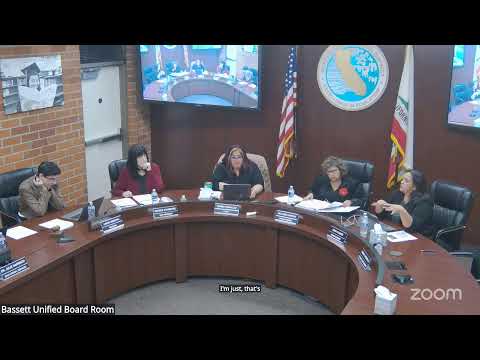
Bassett Unified presents second interim showing positive certification but ongoing multi‑year deficit
Loading...
Summary
District chief business officer presented the 2024‑25 second interim report and the board received a "positive" certification, citing higher attendance-driven LCFF revenue but a multi‑year structural deficit driven by rising costs and one‑time capital spending.
Bassett Unified School District officials told the board Monday that the district’s 2024‑25 second interim financial report carries a positive certification even as it projects multi‑year structural deficit spending.
The district’s chief business officer presented the report and said an increase in average daily attendance (ADA) raised Local Control Funding Formula (LCFF) revenues, producing green (positive) variances across the three fiscal years shown. The report nonetheless shows projected deficits of about $6.6 million for 2024‑25, $4.2 million for 2025‑26 and roughly $3.0 million for 2026‑27, with an ending unrestricted general fund balance shrinking from an estimated $19.3 million in the current year to $12.2 million in 2026‑27.
The nut graf: why it matters — the positive certification means the district can meet its near‑term financial obligations, but administrators and board members emphasized the underlying structural gap — ongoing expense growth (salaries, retirement contributions, special education costs and health benefits) and one‑time items such as the HVAC capital program — that will require policy choices to avoid ongoing reliance on reserve balances.
District staff told the board the most significant revenue boost in the current interim came from a rise in ADA (from 92.6 to 94.2 in the CBO’s presentation), which increased LCFF funding. The presentation also reflected federal carryover, modest local revenue increases (interest), and statewide revenue assumptions drawn from the enacted 2024‑25 budget and the 2025‑26 proposal. The CBO noted state COLA (cost‑of‑living adjustment) projections are uncertain: the state proposal at the time of the presentation reduced COLA for 2025‑26 to 2.43 percent and staff said they expect the May revision to clarify the final number.
Board members asked for clarifications on multiple items. Board Member Nadellos asked how a lower COLA would affect district revenue; staff replied that LCFF base and program funding would decline proportionally if the final state COLA is lower than the district assumed. Board Member Flores asked whether the district’s HVAC program was complete; staff said the capital work is largely finished and the budgeted project expenditure will drop out of future years’ budgets once final paid invoices and DSA (Division of the State Architect) documentation are complete. A board member asked whether out‑of‑district special education transportation could be reduced; the district’s special education director said the district currently lacks a full continuum of local placements and therefore still needs to send some students to regional providers, which drives transportation and placement costs.
The report included projections for LCFF components (base, supplemental/concentration, and add‑ons) and assumptions about retirement rates (STRS/PERS) and step/column increases for certificated and classified employees. Staff also identified committed reserves held in the ending fund balance: a required 3 percent reserve for economic uncertainty, a board‑approved litigation reserve (approximately $2 million), and a carryover reserve for supplemental/concentration funds (about $1.5 million).
Board discussion repeatedly returned to the structural deficit: staff said the district is meeting its liabilities across the three fiscal years presented and therefore is not required to submit a fiscal stabilization plan to the Los Angeles County Office of Education, but administrators said they are examining personnel, contracts and other reductions to close the structural gap.
Ending: The board accepted the second interim report and heard staff describe next steps (monitoring the May state budget revision, working on enrollment/attendance improvements, and continuing cost‑management work). No formal budget changes were adopted at the meeting; the materials and the CBO’s presentation will be posted with the minutes for public review.