Get Full Government Meeting Transcripts, Videos, & Alerts Forever!
Get email alerts on the Land Use Zoning topic
No spam. Unsubscribe anytime.
Lancaster County reviews UDO Module 4: council resists broader administrative variance powers, favors stronger enforcement
Summary
Planning staff presented Module 4 of the county's Unified Development Ordinance, proposing administrative and enforcement changes; councilors rejected broad new administrative variance powers and favored stronger enforcement mechanisms in lieu of civil penalties.
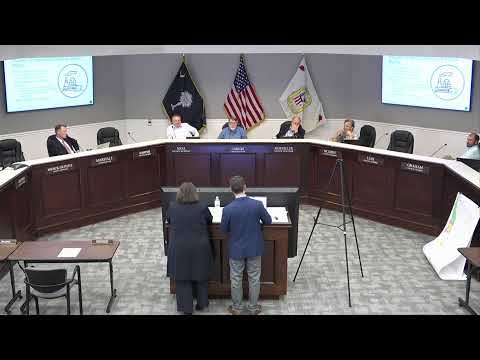
Lancaster County's Committee of the Whole held a workshop on Module 4 of the Unified Development Ordinance (UDO), focusing on administration, procedures and nonconformities. Planning staff presented proposed reorganizations of existing Chapter 9 and sought council guidance on several policy questions.
Why it matters: Module 4 will set how permits, variances, notices and enforcement operate across Lancaster County. Changes could speed project reviews or shift authority from quasi-judicial boards to administrative staff and will affect development approvals, property owners and enforcement against noncompliance.
Planning staff said Module 4 aims to conform Lancaster County's rules to the South Carolina Planning and Zoning Enabling Act and to consolidate procedures such as zoning permits, variance and special-exception processes, and plat reviews. Staff flagged one principal policy question for council: whether to expand staff authority for administrative modifications (currently limited to small setback adjustments) to allow percentage-based adjustments to other dimensional standards such as buffers, parking and height.
Council reaction: Several council members said they were uncomfortable broadening staff's authority on administrative variances. At least one councilmember said requiring a Board of Zoning Appeals hearing for larger adjustments preserves public accountability and predictable standards for developers. Others urged faster decision-making but did not endorse granting broad blanket authority to staff for percentage adjustments.
Enforcement: Staff recommended moving away from civil monetary penalties that are assessed administratively in the current UDO and aligning enforcement with the county's general code. Council members favored stronger, concrete enforcement tools such as stop-work orders, expiration or revocation of permits, and use of liens for abatement when authorized. One councilmember suggested withholding permits across unrelated projects by bad actors as leverage to compel compliance; staff said that option is under consideration for repeat noncompliance.
Nonconformities and vested rights: Council and staff discussed how to treat vacant platted lots that no longer meet current lot-size or setback standards and whether to treat undeveloped lots differently from developed lots. Staff noted the need to balance property owners' expectations (lots platted decades earlier) with public-safety and public-health constraints (for example, septic-field requirements). On manufactured homes and parks, staff proposed allowing replacement of existing nonconforming manufactured units with HUD-certified (post-1976) units and retaining a time window to replace destroyed units (for example, one year), while discouraging perpetuation of very old units beyond reasonable life expectancy.
Junkyards and site features: Staff said the code's current definition of junkyards (two or more inoperable vehicles, boats or equipment) can capture ordinary rural conditions; council asked staff to refine the definition so it distinguishes small, rural examples from larger salvage yards. For nonconforming site features, council favored allowing more rural flexibility (for example, gravel yards versus paved surfaces) than would be required in denser areas.
Next steps: Staff will prepare a draft Module 4 that reflects council's preference to limit expanded administrative variance authority, to replace the UDO's civil penalties approach with stronger enforcement remedies tied to the general code, and to include clarified rules on nonconforming lots, manufactured-home replacement, and a refined junkyard definition. The module will be returned to council for formal review once drafted.
Ending: Planning staff said Module 4 will be the next draft circulated to staff and council; they will follow with Module 3 in summer and continue to coordinate the UDO update with the county's budget calendar.