Get Full Government Meeting Transcripts, Videos, & Alerts Forever!
Get email alerts on the Special Education Budget Climb topic
No spam. Unsubscribe anytime.
Lewiston committee hears special education budget, CLIMB expansion and MaineCare billing gains
Summary
District special education leaders told the Lewiston School Committee on March 12 that the CLIMB program has reduced outplacement costs, generated MaineCare billings and created pressure to add staff and space as the district plans expansion.
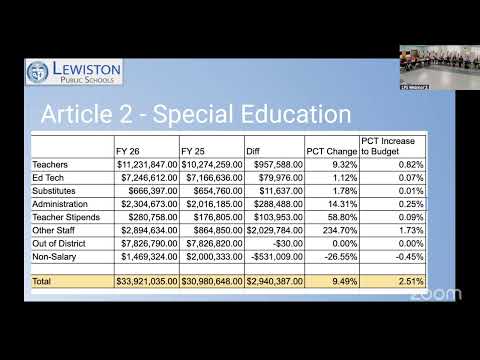
Lewiston — At a Lewiston School Committee meeting Wednesday, March 12, 2025, Special Education Director Kirsten Crafts presented the district’s special education budget and updates on CLIMB, a new in-district program for students with complex needs, saying the program has reduced outplacement costs while creating new staffing and facilities needs.
Crafts told the committee that CLIMB currently serves 23 students and that the program’s team includes five teachers, 24 behavioral health professionals (BHPs), a billing specialist, front-office support and a related-services team. CLIMB students access shared spaces at McMahon Elementary School — including gym, library and unified-arts classes — and district staff said the program has allowed some students to return from more expensive outplacement programs.
The presentation sought to link program expansion, staffing and billing. Crafts and her staff described program start-up costs and projected revenue: they estimated roughly $2.6 million in projected savings tied to students staying in-district (a projection for Aug. 2024–July 2025) and reported staff-hiring costs in the multi‑million‑dollar range. District staff said CLIMB could generate roughly $1.3 million in MaineCare reimbursements and that related FLS/RISE programs could yield about $841,000 at current enrollment levels. The district also reported it is now billing for transportation for certain special‑education placements.
Why it matters: School officials framed the CLIMB expansion as both a student‑centered and budgetary strategy — returning students from outplacements can reduce long daily transports and high private‑placement tuition bills while allowing the district to capture federal/state reimbursements that follow in‑district services.
Major details
- Enrollment and wait lists: Crafts said the district has reduced its private‑placement wait list from roughly 50 last year to about nine students waiting for special‑purpose private school placement; she reported six students have returned from outplacements into Lewiston programs. The district also reported 226 students in higher‑need, in‑district special programs this year, up from about 90 last year.
- Child Development Services (CDS) and incoming kindergarten caseloads: the district noted 96 active CDS students slated to start kindergarten next year (up from about 80), plus roughly 22 students currently in the child‑find process who may require evaluations and services. Staff warned those numbers could increase the coming year and flagged limited early‑intervention capacity in the community.
- Costs and billing mechanics: Crafts explained that when a student is placed in a special‑purpose private school the district pays a portion of the cost and that the state collects a "seat cost" (the district cited a 38% state share the SAU must account for). The district reported paying about $3.1 million this year toward that state seat cost. Crafts showed a wide variation in daily tuition rates charged by private providers and noted these figures do not include additional transportation or related‑service charges. She also said the district identified opportunities to increase MaineCare billings and has adjusted past billing to capture more allowable revenue.
- Staffing and space constraints: presenters said staffing shortages — in particular credentialed BCBAs (board‑certified behavior analysts), trained BHPs and special‑education teachers — limit how quickly the district can expand in‑district placements. Crafts and committee members discussed adding special‑education coaching positions and/or targeted program coaches to train staff and improve retention. Committee members asked the administration for a costed proposal for a special‑education coach or a package of staffing investments and the expected savings those investments would unlock.
- Program design and outcomes: CLIMB staff described the program’s multidisciplinary approach and family engagement. Katie Colasante, a CLIMB director, said, “We’re serving students with highly complex neurodevelopmental disabilities, mainly in the autism spectrum disorder category.” Colasante added CLIMB holds parent meetings monthly and prioritizes carryover between home and school. April Karen, the other CLIMB director, said families “have the right to have ABA programming within a public school setting,” noting the program’s goal of reducing lengthy transports and keeping students in their community.
Committee questions and next steps
Committee members pressed for clarity on space (an additional bathroom stall at McMahon was discussed), staffing models, credential requirements for BCBAs and the feasibility of bringing more students back from private placements. Superintendent Jake Ligmas and Crafts said the district would return with a specific cost proposal describing one or more coach positions, estimated costs, and an outline of the likely savings from reduced outplacements. Crafts indicated the administration could present initial options in the coming week.
Discussion vs. decisions
The meeting featured discussion and requests for follow‑up; the committee took no policy votes or budget votes on special education at the session. The only formal action recorded at the meeting was a motion to adjourn, which the committee adopted by voice vote.